
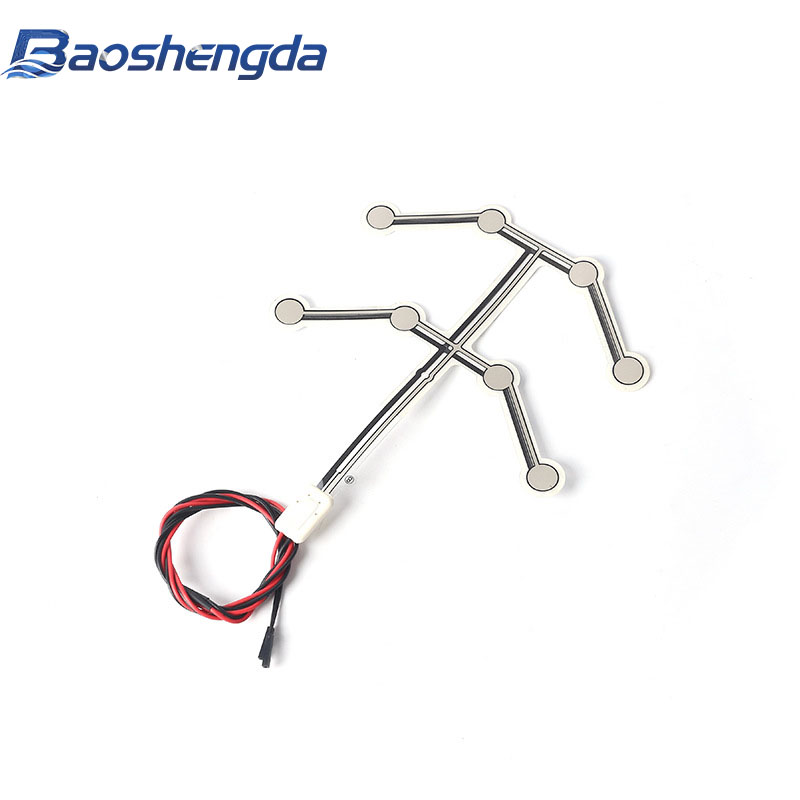
Cover photo: an existing Baoshengda pressure-film component. It does not show an integrated heater or an implementation of either patent.
When pressure sensing and heating share a film, define the layer arrangement and trace both circuit connections before approving a sample. A drawing should show where the pressure-sensitive material sits, where heating current flows and what the external controller receives. Put the unresolved interfaces on the sample request, including who will supply the controller. You can discuss these choices before the finished pad specification is complete.
Patent documents and disclosed structure
Baoshengda's utility-model grant announcement CN223348808U, published on 2025-09-16, describes a film base with a printed heating circuit on its first surface. Claim 1 places conductive pressure-sensitive material either on the second surface or over the heating layer. Dependent claim 4 names PET. Claims 6 and 7 describe a connected dot-and-line pattern. Claims 8 and 9 connect the sensing and heating structures to an external control circuit. These passages establish the disclosed arrangement, not a tested specification for an ordered part.
The separately numbered invention application CN119277582A was published on 2025-01-07. Comparing the original documents, their claims 1 through 10 have matching wording after whitespace is removed. The utility-model front page also records a same-day invention application. They remain two document types and application numbers: 202422784882.7 for the utility model and 202411630790.1 for the invention application. The application publication is not a grant announcement. This comparison is not a current legal-status review or evidence of commercial implementation.
Choose the construction before discussing sample readings
Ask which arrangement the supplier is proposing: pressure-sensitive material on the opposite face of the film base, or over the heating layer. Keep that choice on the sample drawing. If that choice is undecided, ask the supplier to identify the proposed constructions separately. Each sample needs its own identified arrangement. The alternatives in a patent are not interchangeable sample specifications.
For each proposed construction, identify the base, printed functional regions, connections and any additional layers actually included in the quotation. Ask the supplier to explain the electrical separation and connection scheme. Do not infer an insulating layer, a dielectric rating or a material grade from the schematic. A label such as PET is not a complete substrate specification.
Mark the intended loaded area, available mounting space, lead exit and connection location on the same sketch. These are buyer inputs for reviewing the proposed part, not dimensions supplied by the patent. If the pad construction or cover material is undecided, record it as an open assembly condition instead of silently assuming a bare-film result applies after assembly.
Trace the sensing path and heating path separately
Request a connection map with one trace from the pressure-responsive structure to its readout and another from the heater to its supply and control. Identify any shared connections explicitly, including signal and return paths. These are functional paths, not a requirement for two physical connectors or a claim that the circuits are electrically isolated. This avoids treating one physical film as one electrical signal or assuming that a convenient connector assigns the functions correctly.
The printed dot pattern is not enough to establish the number of independently measurable zones. Ask how many outputs the offered part actually provides, which regions contribute to each output and what measurement method the controller expects. Keep the supplier's circuit drawing beside the mechanical layout so that a proposed zone boundary can be checked against the actual connections.
The existing component photograph on this page illustrates pressure-film form and its lead connection only. It does not show an integrated heater, the patented layer stack or a production implementation of either document. Use the patent text for the disclosed architecture and the proposed sample drawing for the part being discussed.
Build a sample record around the open interfaces
The following is a proposed buyer review record, not a patent-reported test procedure or a set of guaranteed results. Agree suitable instruments, electrical separation, heater control and acceptance criteria with the responsible equipment owner before testing. A pressure-readout instrument should not be connected to an unidentified heater path.
| Record | Attach to the sample | Keep unresolved until verified |
|---|---|---|
| Layer arrangement | Marked side or overprint construction and revision | Unspecified layers and material grades |
| Circuit interfaces | Connection map, output definition and controller boundary | Independent zones or electrical separation inferred from appearance |
| Mechanical condition | Loaded area, mounting arrangement and cover condition | Transfer from bare film to the finished pad |
| Measurement condition | Agreed loading, readout method and heater state | A pressure reading treated as a finished-pad approval |
When comparing samples, retain the construction revision and state which conditions were held constant. If heater state, mounting or readout settings change, keep that change visible in the record. Attach the conditions to the result so that the next reviewer can see which sample and setup produced it.
Keep component approval separate from pad approval
A film connection map does not define the complete controller, temperature protection, wiring, enclosure or finished pad. Assign responsibility for those items in the quotation review. Where a requirement belongs to the assembled product, request the corresponding assembly evidence rather than moving the responsibility into the film drawing.
Do not convert advantages stated in a patent into guaranteed thickness, cost, service life, safety or energy savings for a proposed assembly. Set measurable requirements for the actual application and identify who will validate them. Neither the publication dates nor the component photograph supplies that validation.
This hardware review is different from deciding when a pressure signal should enable heating. For that separate controller discussion, see our contact-area and thermal-response review based on CN118102513B. Its control decisions do not establish the layer construction described by the two documents considered here.
What to include in the first inquiry
For a pressure-film sensing component, start with the intended loaded area, mounting context, connection constraints and what the readout must distinguish. If heating is also required, identify the heating-film interface and whether the external controller is supplied by you or needs discussion. Leave unselected layer arrangements and assembly conditions visibly open.
You can request a sample-interface review with an existing photo or sketch if available, the use case, an approximate quantity and the question you have not settled. Complete production drawings are not a prerequisite for the first conversation. Ask for a shared layer and circuit map with the unresolved items marked before moving to finished-pad approval.
Need help reviewing a structure?
Send your drawing, photos, application, and quantity. Baoshengda can help check the structure before sampling.
Send Drawing for Quote