
Define the loaded contact region, heating-enable condition and mounted thermal response before sampling a pressure-triggered heating assembly. A pressure sensor supplies an input. It does not by itself define standby behavior, thermal limits or recovery after an abnormal result. Assign those decisions before asking a component supplier to reproduce the parts.
Baoshengda's CN118102513B patent document, published as an invention-grant announcement on **2024-06-25**, describes a pressure-sensing heating-control system and method. Its front page separately lists the earlier application publication on 2024-05-28. The discussion below explains that dated document and proposes questions for sample review. It is not a claim that the illustrated component implements the patent, that a product has been validated, or that the patent's current legal status has been independently confirmed.
Read the heating-enable condition as an area decision
Claim 1 acquires carrier, temperature, pressure and circuit information. It calculates a pressure-contact ratio from area information and compares that ratio with a preset value. The description at paragraphs [0081]–[0083] generates a heating signal when the ratio meets or exceeds the preset and a standby signal when it falls below it.
That condition should not be replaced in a purchase specification by an unexplained force threshold. Ask how the proposed sensing layout and readout establish the area information used by the controller. An isolated force reading is not, by itself, a demonstrated contact-area measurement. Define the intended carrier, the region that can be loaded and the interpretation of partial or changing contact.
One embodiment, described at [0144]–[0148] and identified in Figure 4, names a nanocarbon heating structure, pressure-sensing layer, electronic control switch and power supply. It also identifies FSR technology for pressure sensing. These are described functional elements; the drawing is not evidence that all functions share one film or that a supplied sample includes the controller.
Keep thermal response separate from the enable signal
Claim 2 and paragraphs [0092]–[0110] distinguish a non-positive temperature-rise-rate branch from a branch above a preset upper rate. Subsequent decisions use circuit information and carrier temperature. A flat temperature trace alone is therefore not enough to classify the assembly as faulty: the electrical state and the temperature condition involved still matter.
For a real sample, the equipment owner should define the measurement position, carrier stack, starting condition and readout interval. Keep the pressure-state record alongside the carrier-temperature and electrical observations. Do not substitute a free-air heater reading for the response of the intended mounted carrier.
The document gives application examples for temperature rise, but those examples are not universal acceptance limits for another product. Agree the actual limits and protection requirements for the intended use rather than copying a number from the patent into a component order.
Review standby and recovery before approving the controller scope
Paragraphs [0113]–[0125] describe a self-check following an abnormal heating-control signal. The sequence stops heating, returns the carrier to room temperature, starts a heating self-check and compares resistance observations with a temperature-resistance model.
That is a disclosed sequence, not a recommendation to permit automatic restart in every finished product. The system owner must decide the allowable fault state, whether restart is permitted, who can authorize it and what independent protection is required. Controller firmware and the finished-product protection design need separate validation. The patent's stated benefits do not establish measured safety or energy savings for the buyer's assembly.
Put the input state and observed response in one sample record
The following is a proposed review record, not a qualification procedure reported in the patent. Use an equipment-owner-approved fixture and method. Any abnormal-state evaluation needs its own agreed controlled method; do not improvise a live fault to fill a table.
| Review condition | Evidence to retain | Decision owner |
|---|---|---|
| Contact below the configured area condition | Sensing layout, readout interpretation and observed standby response | Sensing and controller teams |
| Contact meeting the configured condition | Identified contact region, enable state, electrical observations and carrier-temperature response | Controller and equipment teams |
| Contact distribution changing during use | Which region changed, how the input was interpreted and what the controller did | Sensing and equipment teams |
| Abnormal response or recovery request | Approved method, recorded circuit and temperature state, shutdown result and any restart authorization | Equipment owner and protection-design team |
Save the agreed configuration with the observations. Changes to the sensing layout, carrier materials, attachment, power arrangement or controller version can change what a comparison means. Keep the actual input and response observations even when the final review status is pass.
Separate the component drawing from the complete assembly
A supplier can review an agreed heating pattern, outline, connection arrangement and sample construction for a flexible heating film. The sensing team owns the contact-region interpretation; the controller team owns the enable, standby and recovery logic. The equipment owner retains the carrier installation, protection requirements and finished-assembly acceptance.
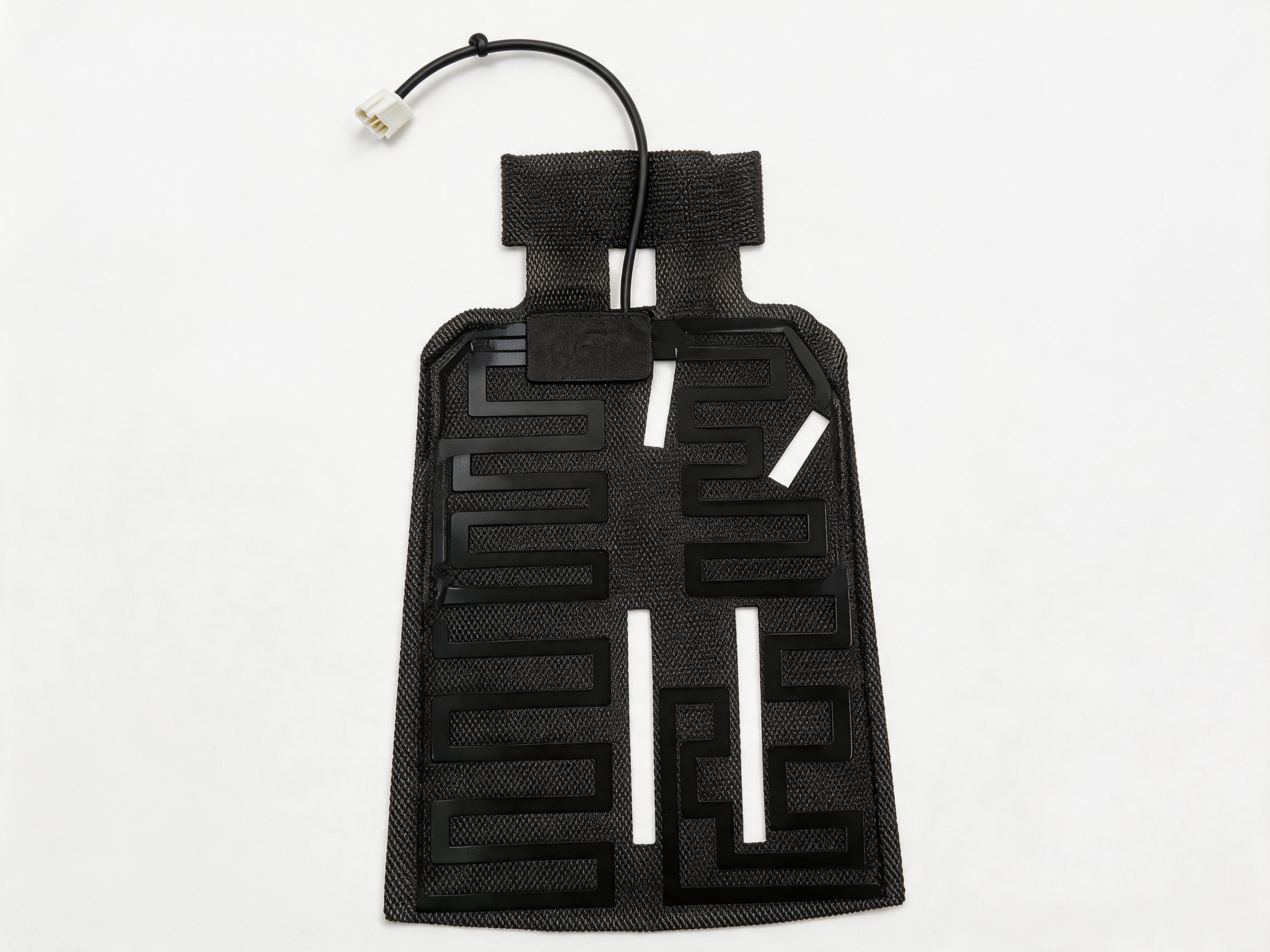
The retained original component photograph shows a shaped textured backing, patterned heating tracks, a cable and a connector. It does not show a pressure-sensing layer, controller or implementation of CN118102513B. The photograph alone does not establish the material chemistry, resistance, supply rating or thermal performance of the patented embodiment.
Start with the unresolved decision, not a complete drawing package
An existing component or carrier photo, a drawing if available, the intended use, approximate quantity and the question still unresolved are enough to begin a discussion. A complete production drawing is not required for an initial inquiry. For a firm sample plan, add the intended contact region, mounted stack, electrical connections, controller responsibility and agreed evidence needed for acceptance.
Use the Request Quote form to ask for a heating-component scope review. Identify whether the next decision concerns the component geometry, the sensing input or the controller response, and say which system-level decisions remain with your engineering team.
Need help reviewing a structure?
Send your drawing, photos, application, and quantity. Baoshengda can help check the structure before sampling.
Send Drawing for Quote