
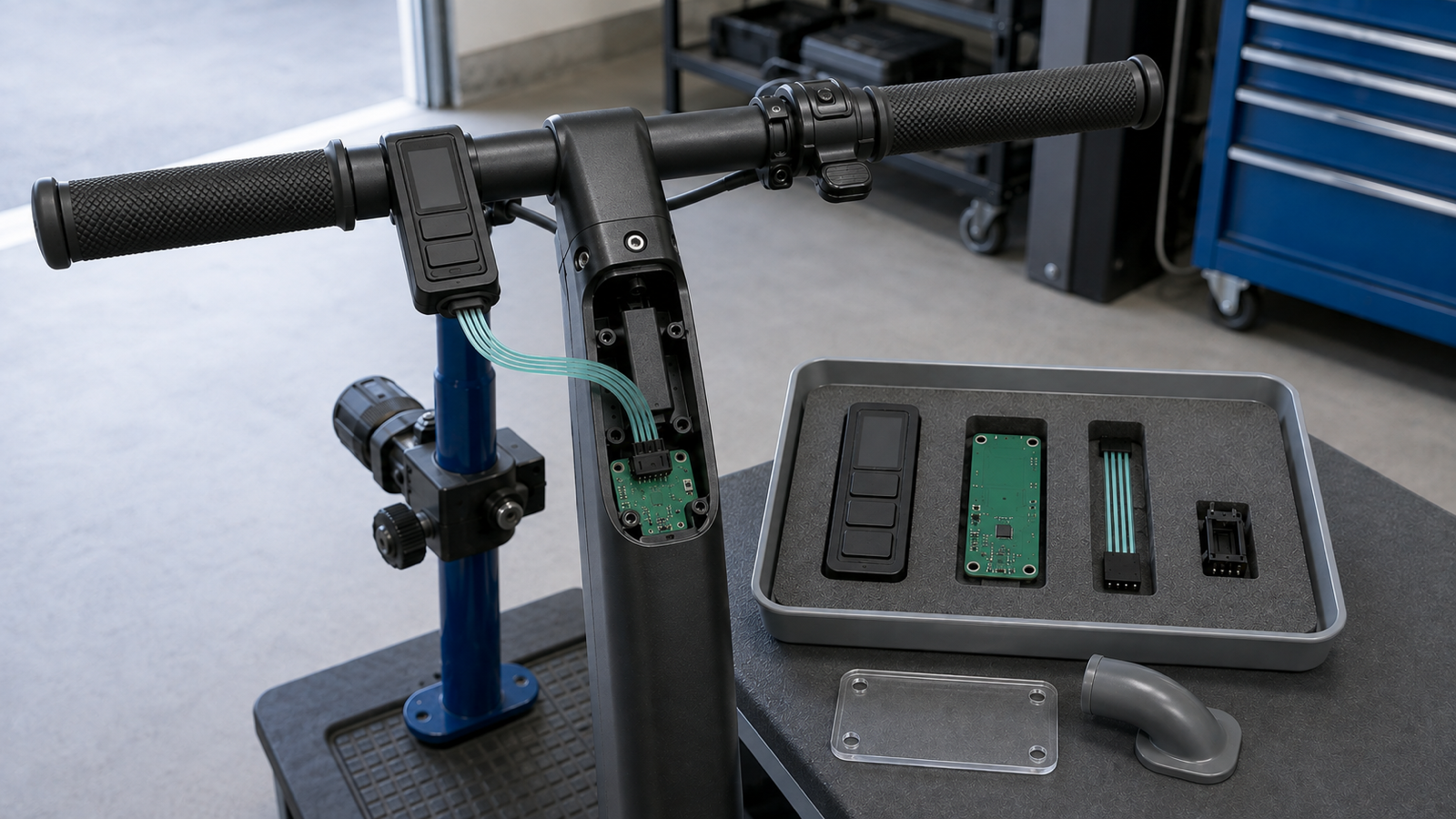
For an electric-scooter model family, use one integrated handlebar-interface supplier when the mounted result depends on shared control of the printed surface, tactile response, sealing land, flexible circuit, tail route and connector. Split sourcing can work, but only if the buyer owns stable interface drawings, revision rules, matched samples and acceptance responsibilities for every boundary. Compare total change and assembly risk, not just piece price. Before transfer, freeze the housing datum, actuation target, environmental exposure, artwork or light map, tail contact side, connector mate and service-access route, then approve loose, mounted and complete-vehicle evidence separately.
The lowest piece price may move cost into the interfaces
An integrated control subassembly can place the overlay or key surface, circuit, adhesive or gasket, tail and connector under one revision and one drawing package. That does not guarantee a good design, but it reduces the number of handoffs that must stay synchronized. When the enclosure changes, the interface supplier can review whether the edge land, key position, tail exit and connector access changed together.
Split sourcing can be appropriate when the buyer already controls the mechanical and electrical interfaces. A separate overlay printer, circuit supplier, molded housing source and harness supplier may offer capacity or commercial flexibility. The tradeoff is ownership. Someone must decide which drawing is the master, who checks cumulative tolerances, who approves a material substitution and who owns a failure that appears only after mounting.
This is why the comparison should begin with responsibility rather than a preferred manufacturing process. A complete interface can still fail if the vehicle owner supplies an incorrect housing or controller definition. Separate components can work well when every interface has an owner and the buyer maintains the integrated acceptance plan.
A current e-scooter launch makes model-family control relevant
A September 7 Segway release about two upcoming flagship eKickScooter models describes all-terrain and long-range products scheduled for a European launch. The release does not disclose their handlebar-control construction, does not state that a membrane switch is used, does not identify Baoshengda as a supplier and provides no evidence for the sourcing approach discussed here.
The useful buyer signal is the model-family problem. Products aimed at different duty profiles may share styling or a mounting envelope while using different actions, indicators, harness routes or service parts. A common-looking control module is not automatically interchangeable. Before a buyer commonizes the part, the variant matrix must show which physical, optical and electrical details really stay common.
Current micromobility attention therefore leads to a durable sourcing question: should the interface be purchased as one controlled subassembly, or can its parts be split without losing revision and mounted-fit control? The answer depends on evidence at the interfaces, not on the product announcement itself.
Compare integrated and split sourcing by failure ownership
Use a decision table before asking for quotations. Replace generic claims such as “one-stop” or “specialist supplier” with evidence that can be reviewed.
| Decision area | Integrated interface supplier | Split component suppliers | Evidence the buyer should own |
|---|---|---|---|
| Housing fit | One supplier can review panel perimeter, adhesive or gasket land and key locations together | Tolerance stack crosses housing, overlay, circuit and assembly sources | Housing drawing, datum scheme, edge support, flatness and mounted photos |
| Tactile response | Key stack and circuit contact can be sampled as one interface | Key feel may change with separate dome, spacer, keymat, PCB or overlay revisions | Actuation target, travel or force method, fixture and acceptance range |
| Sealing boundary | Adhesive, gasket path, tail exit and surface preparation can be reviewed together | Each source may assume another party owns the leak path | Cross-section, compression or bond land, tail exit and assembly process |
| Artwork and lighting | Printed zones, windows and light-blocking layers can share one controlled revision | Overlay and light-source changes can drift independently | Controlled artwork, day and night sample, window and indicator map |
| Tail and connector | Circuit, tail length, contact side, stiffener and connector orientation can be checked as one route | Flex and harness suppliers may each meet their drawing but fail when assembled | Pin map, mate part, contact side, bend keep-out, strain relief and service clearance |
| Change control | One subassembly revision can collect related changes | A small change may require several supplier approvals and a buyer-led integration review | Master BOM, change notice route, golden sample and revision compatibility matrix |
| Failure isolation | Supplier can reproduce the agreed subassembly check | Buyer must identify which component or interface caused the mounted symptom | Loose-component test, mounted test, controller input evidence and returned-part plan |
An integrated source is usually stronger when a fault can be created by interactions among layers. Split sourcing is more defensible when interfaces are stable, the buyer has its own integration engineering and the commercial benefit is large enough to fund that control.
Freeze six interfaces before comparing quotations
First, freeze the mechanical envelope. Define the complete perimeter, thickness, housing datum, supported edge, fastener or adhesive land and allowable assembly offset. A sample that lies flat on a bench may lift, wrinkle or bind when the real housing applies uneven support.
Second, define the user-input construction. State which zones are tactile, how they are identified, whether a separate molded key or flat printed panel is used and how the target response is measured. Do not use “good feel” as the acceptance requirement. The buyer should own the method and the range.
Third, draw the environmental boundary. Specify the expected temperature, cleaning, dust, splash, UV, glove and storage conditions that the interface must encounter. These conditions are inputs to component selection, not proof of an ingress or vehicle rating. The complete mounted assembly still requires system-level validation.
Fourth, control every printed or illuminated zone. Provide artwork files, color and finish references, window definitions, light-blocking areas and acceptable day and night appearance. If different models use different actions or indicators, keep a clear common-versus-variant matrix.
Fifth, freeze the circuit and tail. Include the contact layout, pin numbering, tail length, exit direction, contact side, stiffener, bend keep-out and strain-relief method. A tail can fit the connector and still be routed against a sharp housing edge or assembled with the contacts facing the wrong direction.
Sixth, identify the connector and service route. Record the exact mate, keying, latch direction, board location, insertion access and removal space. A service spare is not ready if technicians must pull the harness at an unsafe angle or remove unrelated assemblies to reach the connector.
Approve the transfer in three separate sample stages
A useful transfer does not jump from drawing review to a complete vehicle sample.
**Stage 1: loose interface evidence.** Review the printed surface, complete perimeter, key-zone construction, circuit continuity, tail dimensions, contact side, stiffener and connector orientation. This stage catches manufacturing and drawing errors without hiding them inside the housing.
**Stage 2: mounted control evidence.** Install the interface in the intended housing with the defined adhesive, gasket, fasteners, bend route and connector mate. Check alignment, edge support, tactile response, light or window appearance, tail clearance and service access. The buyer should record the housing and interface revisions used.
**Stage 3: complete-vehicle evidence.** The vehicle owner tests every assigned action and visible state with the actual controller and firmware, including startup, normal operation, fault handling and service replacement. Component evidence cannot prove throttle, braking, ride-mode logic or vehicle safety. That responsibility remains with the system owner and its qualified test plan.
Keep a golden sample from each approved stage. If the sourcing boundary changes later, compare the new parts to the same controlled evidence instead of relying on memory or photographs alone.
Define what the interface supplier can and cannot support
A physical-interface supplier can help review the overlay or key surface, spacer or tactile construction, printed circuit, adhesive or gasket interface, display or indicator windows, tail, stiffener, connector orientation and agreed component or fixture evidence. It can also flag drawing conflicts, incomplete datums and revision mismatches before tooling or sampling.
The supplier cannot validate vehicle dynamics, braking, throttle behavior, motor control, battery management, firmware, wireless communications, cybersecurity, regulatory compliance or complete-vehicle environmental and safety performance. It also cannot guarantee interchangeability when the buyer withholds the current housing, PCB, connector or controller definitions.
For a related example of keeping system behavior separate from component evidence, see the guide to supplier-transfer evidence for smart-cockpit physical controls. The equipment is different, but the ownership lesson is similar: component approval and system approval are not the same event.
Send one boundary-controlled RFQ package
Before requesting a comparison quotation, include:
- the model, market and revision matrix, with common and variant functions separated;
- current samples, approved drawings and a list of known field or assembly issues;
- panel perimeter, thickness, housing datum, support and adhesive or gasket land;
- key-zone construction, tactile target and measurement method;
- artwork, finish, windows, indicators and day or night appearance requirements;
- circuit schematic or contact matrix, pin numbering and controller input ownership;
- tail length, exit, contact side, stiffener, bend keep-out and strain relief;
- connector manufacturer and part number, mating part, keying and insertion direction;
- expected temperature, splash, dust, cleaning, UV, glove and storage exposure;
- buyer-owned housing, PCB, harness, controller and firmware responsibilities;
- sample stages, fixture ownership, approval records and golden-sample retention;
- annual quantity, service-spare quantity, packaging, traceability and change-notice needs.
Review automotive and vehicle HMI interface options when preparing the component scope. If you can provide the current interface, housing datum, tail and connector definitions, use the Request Quote form to send a privacy-safe comparison package. Ask for separate commercial lines when you want to compare an integrated interface with a split-supply alternative, but keep the same acceptance evidence for both.
Need help reviewing a structure?
Send your drawing, photos, application, and quantity. Baoshengda can help check the structure before sampling.
Send Drawing for Quote