
What must an automotive HMI buyer freeze before moving a physical smart-cockpit control panel to a replacement supplier? Freeze one controlled interface package that links each visible control to its mechanical datum, key construction, circuit net, tail and connector, controller input ID, feedback state and mounted acceptance test. Keep the released golden sample, but do not use appearance alone as the master. A panel can match color and outline while changing actuation, pin mapping, tail strain or support inside the bezel. Quote only after the buyer, vehicle integrator and component supplier agree which evidence defines interchangeability and who owns software behavior and vehicle-level safety.
Smart-cockpit integration makes physical handoff evidence more important
FISITA launched a Smart Cockpit Expert Group on September 4, 2026. Its stated scope brings smart-cockpit engineering, vehicle controls, driver interaction, in-cabin sensing, HMI software and AI into one discussion. That is useful context for sourcing because a physical control is no longer an isolated printed part. Its function may be interpreted by software, confirmed by a display or light state, and constrained by the surrounding trim and electronics.
The announcement is not a membrane-switch specification and does not identify any Baoshengda relationship. It highlights an integration problem that buyers already face during a supplier transfer: the old sample may show what the panel looked like, but not why every dimension, contact, connector pin and control state was released. The replacement project therefore needs evidence that crosses the mechanical, electrical and functional boundaries without asking the component supplier to recreate vehicle logic from a photograph.
Build a transfer master set before requesting price
A useful master set has more than an artwork file and one used part. Start with a released panel drawing and the mating bezel or housing section. Identify primary and secondary datums, the active key zones, the supported and unsupported areas behind the face, the tail exit and the connector approach. Add the circuit drawing or netlist, connector part and mating direction, plus the input ID used by the controller.
Keep two physical references when possible. One remains a protected golden sample for visual and mounted comparison. The second can support inspection that may expose the stack, dome, spacer, adhesive or printed circuit. A worn field return can provide failure clues, but it should not silently become the dimensional master. Heat, cleaner, sunlight, repeated operation and removal can change its shape and surface.
Record the revision of every master. Artwork, mechanical outline, circuit, connector and software mapping can change on different schedules. A single filename such as final-panel cannot show which combination reached production.
Use a function-to-interface matrix, not a symbol list
The transfer package should connect the buyer's intended action to evidence the replacement supplier can inspect. The matrix below is a practical starting point.
| Interface item | Transfer risk | Evidence to freeze | Sample decision |
|---|---|---|---|
| Visible key zone | Shape looks right but the active area shifts relative to the bezel | artwork datum, key center, emboss or flat-zone boundary and housing support map | verify loose registration and mounted reach |
| Tactile stack | A substitute dome, spacer or support changes force and return | released stack, material callout, actuation target and support condition | compare loose and mounted force behavior |
| Circuit input | The legend is correct but the key closes the wrong net | circuit drawing, continuity map, controller input ID and allowed simultaneous presses | verify every input at the connector and system monitor |
| Tail and connector | Pinout matches on paper while exit angle or mating direction strains the flex | tail outline, keep-out area, bend boundary, connector part, orientation and retention | inspect insertion, routing and strain after mounting |
| Feedback state | A press is detected but the driver receives the wrong confirmation | expected tactile, light or display response and the system owner for that response | separate component evidence from integrated-state approval |
| Revision identity | A cosmetic update hides an electrical or mechanical change | independent artwork, mechanical, circuit and software revision fields | reject unapproved cross-revision combinations |
Do not let a printed icon define a function by itself. The same symbol can be assigned differently across trim levels or software releases. Use stable function IDs in the controlled records, then connect those IDs to artwork and controller mapping.
Convert the old part into evidence without copying its wear
Measure the old part against its mating structure before drawing a replacement. Check the overall perimeter, corner radii, key centers, windows, apertures, tail exit and connector access from stable datums. If the component uses adhesive, distinguish the die-cut boundary from the edge visible after years of compression. If it is mechanically captured, identify the surfaces that set position and the areas that must remain free to move.
Photograph both sides under neutral light and record which sample was measured. Inspect the tail near the exit and connector because a crease or repair there can make the field part a poor template. If the original drawing and the part disagree, do not average them. Open a controlled discrepancy, decide which requirement governs, and issue a released transfer drawing.
A replacement supplier can help describe manufacturable features, but the buyer owns the decision to preserve or intentionally change the interface. This matters when the legacy stack contains materials that are no longer available. A proposed substitution should be documented as a change with its own sample evidence, not hidden inside an apparently identical part.
Approve the replacement through three linked samples
Use a sequence that reveals different failure modes instead of relying on one final vehicle check.
1. **Loose component sample:** inspect full perimeter, print, windows, key registration, tail, connector and connector-level continuity. This catches visible and electrical errors before the bezel hides them.
2. **Mounted interface sample:** install the panel in a representative bezel or fixture. Check surface support, edge fit, actuation, return, tail routing, connector access and strain. A loose key can feel acceptable yet bind or become too stiff after mounting.
3. **Integrated input sample:** the vehicle integrator confirms that each released function ID reaches the intended controller input and produces the approved feedback in relevant operating states. This is a system test, not evidence that the component supplier owns the software.
Keep the same sample identity across the records. If one part is used for dimensions and another for electrical testing, say so. Record deviations and the disposition that closed them. A signature on a beauty sample does not approve pin mapping, and a continuity pass does not approve mounted feel.
Define interchangeability before tooling or repeat orders
A transfer project may serve current production, service spares or both. State whether the new panel must be interchangeable with every released vehicle revision or only a named configuration. Freeze the mating connector, pin assignment, bezel datum, fastener or adhesive boundary and the permitted tail route for that configuration.
Also define change notification. A material, dome, adhesive, ink, connector or process change can affect fit, feel, appearance or electrical behavior even when the sales description stays the same. List which changes require buyer review, which need a new mounted sample, and which create a new part number. Keep tooling ownership and revision marking in the commercial package so a later repeat order does not depend on memory.
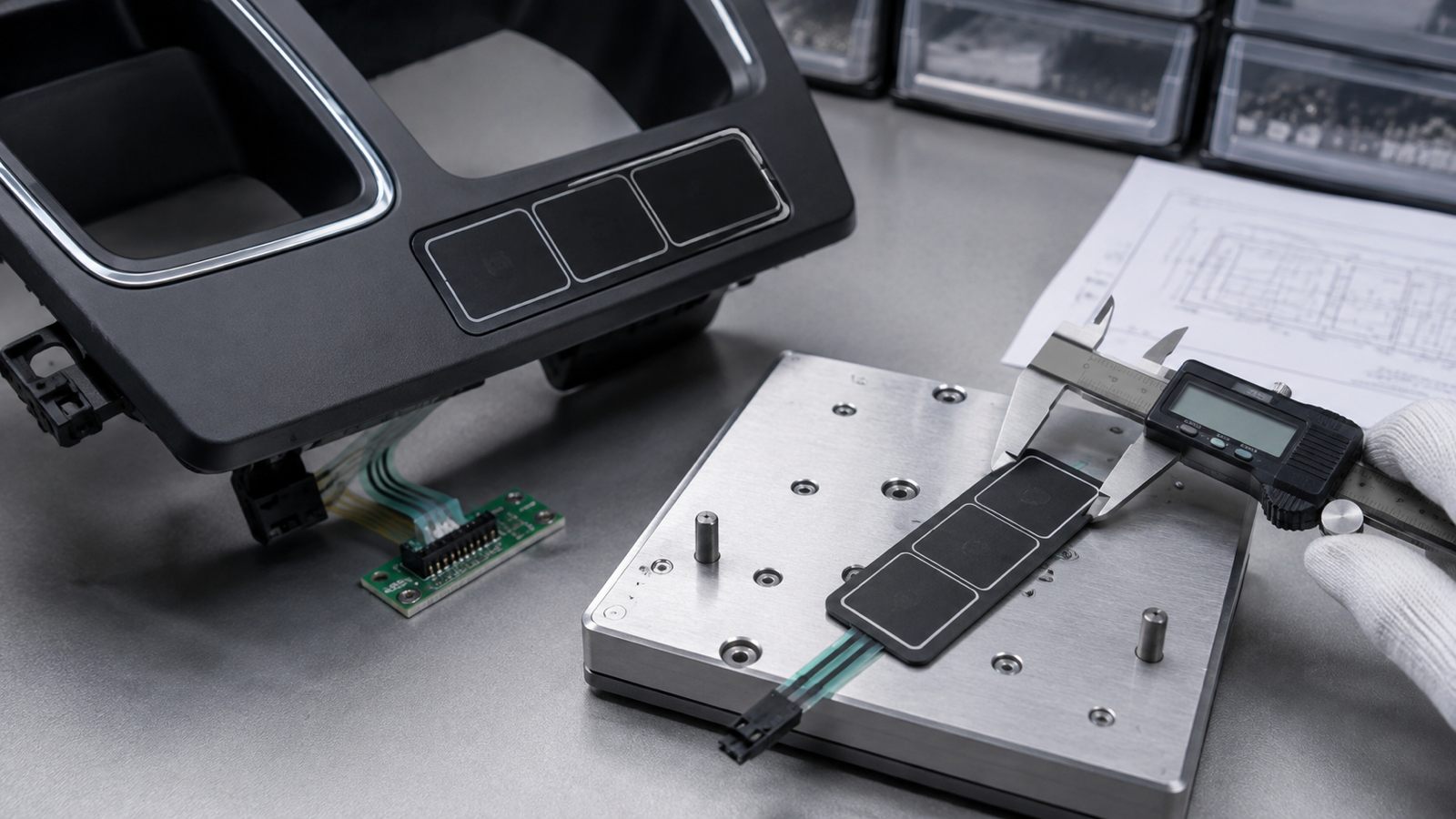
The cover's installed and loose panels illustrate this evidence problem. They are a generic engineering scene, not a customer product. They show why the buyer should compare the complete face, housing relationship, tail exit, connector and measurement action together. They do not prove electrical performance, software mapping, functional safety or vehicle approval.
Keep the component supplier boundary explicit
Within an adequately defined scope, a physical-interface supplier can review and quote the printed overlay, membrane-switch stack, tactile construction, spacer and adhesive pattern, flexible circuit, tail, connector and component-level inspection plan. The supplier can provide dimensional measurements, circuit continuity results and agreed loose or mounted actuation evidence.
The vehicle owner or qualified integrator remains responsible for control allocation, driver interaction strategy, software input interpretation, display and lighting logic, diagnostics, cybersecurity, hazard analysis, functional safety, homologation and finished-vehicle validation. A supplier-transfer sample should not be described as vehicle-safe because its three keys close the expected contacts.
This boundary should appear in the quotation and sample plan. It prevents missing information from becoming an implied promise and lets each reviewer approve the evidence they actually control.
Send an automotive HMI supplier-transfer RFQ that can be audited
Before requesting a replacement quote, send a controlled package with:
- application and vehicle configuration, user role, sample quantity and expected demand range;
- released front-panel drawing with datums, perimeter, key zones, windows, apertures and surface requirements;
- mating bezel or housing section with support, compression and keep-out areas;
- material stack, tactile construction, actuation target and allowed substitutions;
- circuit drawing or netlist, function IDs, connector-level continuity map and simultaneous-press rules;
- complete tail outline, exit position, bend and strain boundaries, connector part, pin assignment and mating direction;
- protected golden sample plus the condition and identity of any measured or destructive reference;
- loose, mounted and integrated sample gates with acceptance owner for each result;
- independent artwork, mechanical, electrical and software revision fields;
- interchangeability rule, change-notification process, tooling ownership and rejection disposition.
Review the automotive HMI component scope before assigning the front-panel boundary. When the transfer package is ready, request a supplier-transfer quotation review with the controlled drawings, interface matrix, sample plan and revision evidence. The goal is a comparable component quote and a traceable approval path, not an unsupported promise about the complete smart-cockpit system.
Need help reviewing a structure?
Send your drawing, photos, application, and quantity. Baoshengda can help check the structure before sampling.
Send Drawing for Quote