
No. A generic resin, film or adhesive test report cannot by itself approve the biocompatibility evidence for a wearable FSR sample. First identify which finished surfaces contact the body, whether contact is direct or indirect, and for how long. Then map the exact sensor laminate, adhesive, cover, printed layers, processing, cleaning or sterilization state and revision to the test article. If the tested specimen differs from the final finished device, record and justify that difference. The FSR supplier can provide component identity, drawings, material declarations and traceable samples, but the device manufacturer must own the finished-device risk assessment, test strategy and regulatory submission.
Start with the finished contact stack, not a material name
A wearable force-sensing resistor may sit under a textile liner, foam actuator, pressure-spreading pad or replaceable cover. In another design, part of the sensor laminate or adhesive edge may be exposed. Those two assemblies do not present the same body-contact question even if the FSR uses the same base film.
Draw the cross-section that is actually proposed for the finished device. Mark every surface that can touch intact skin or another contacting component during intended use, foreseeable movement, cleaning and replacement. Record the contact type and duration defined by the device team. Include edges, vents, seams and tail exits rather than showing only the nominal sensing area.
Then give every layer a revision-controlled identity. “PET,” “medical adhesive” or “foam” is not enough for sample release. Record the supplier and grade when the buyer is authorized to disclose them, thickness, coating or print system, adhesive construction, backing, colorant where relevant, and any process that could change the finished surface. A change in adhesive, curing, printing, lamination, cleaning or sterilization can make an old report a poor match for the new build.
The September FDA update makes test-article mapping explicit
The FDA listed its current What Should I Put in a Test Report? resource in a September 9 biocompatibility update. The page says a report should identify the test specimen. When the tested article is not the final finished device, the difference needs a justification in the report or submission. It also points device teams to preparation, test method, parameters, acceptance criteria, results and conclusions rather than treating a one-page certificate as the complete record.
That update does not say every wearable FSR needs the same test, and it does not approve any Baoshengda material or device. It does not transfer the finished-device evaluation to a component supplier. Its practical sourcing consequence is narrower: the RFQ and sample package should make it possible to show what was tested, what is being built, what differs and who owns the rationale.
A test report can be technically detailed and still be unusable for the current sample if the article identity is vague. Conversely, a component data package can be valuable without claiming that it is the finished-device biocompatibility conclusion.
Build an evidence map before requesting a test report
Use one evidence map for the wearable assembly. It should connect each physical item to the buyer decision it can support and to the evidence still missing.
| Item in the proposed build | Buyer decision | Evidence to request or create | Do not assume |
|---|---|---|---|
| Skin-contact liner or cover | Does this finished surface control direct contact? | drawing zone, material grade, finish, cleaning state, lot and revision | a generic fabric or film certificate represents the processed part |
| Foam actuator or pressure spreader | Can compression expose an edge or transfer residues? | dimensions, density or hardness as specified, adhesive, assembly position and mounted sample | a buried item can never affect the contact pathway |
| FSR laminate and printed sensing zone | Is the exact sensor construction represented? | controlled stack, film and print identities, cure or lamination process, lot and revision | all FSRs with the same outline use the same materials or processing |
| Adhesive, spacer and edge seal | Which surfaces or manufacturing residuals may matter? | supplier grade, pattern, exposed-edge review, conversion process and finished sample | an adhesive report applies after an unrecorded substitute or process change |
| Tail, stiffener and connector transition | Is this zone outside contact, and can motion move it into contact? | tail drawing, exit geometry, bend restraint, enclosure or cuff routing and use simulation | the nominal CAD position proves the worn or flexed position |
| Tested specimen | Does the report represent the proposed final build? | specimen identifier, dimensions, preparation, extraction or test conditions, deviations and results | a coupon is automatically equivalent to the assembled wearable device |
This map is more useful at quotation stage than a folder of unrelated declarations. It tells the sensor supplier which identities and samples are needed, shows the test laboratory what the article represents, and gives the device owner a controlled place to justify gaps.
Freeze the sample build before comparing evidence
Do not request a compliance package while the mechanical stack is still changing. Freeze at least one evidence build with a bill of materials, component drawings and an assembly cross-section. Link the physical sample to that build through a unique revision and lot record. If several variants share the same sensor but use different liners, adhesives or cleaning processes, identify them as separate configurations until a qualified reviewer decides what evidence can be bridged.
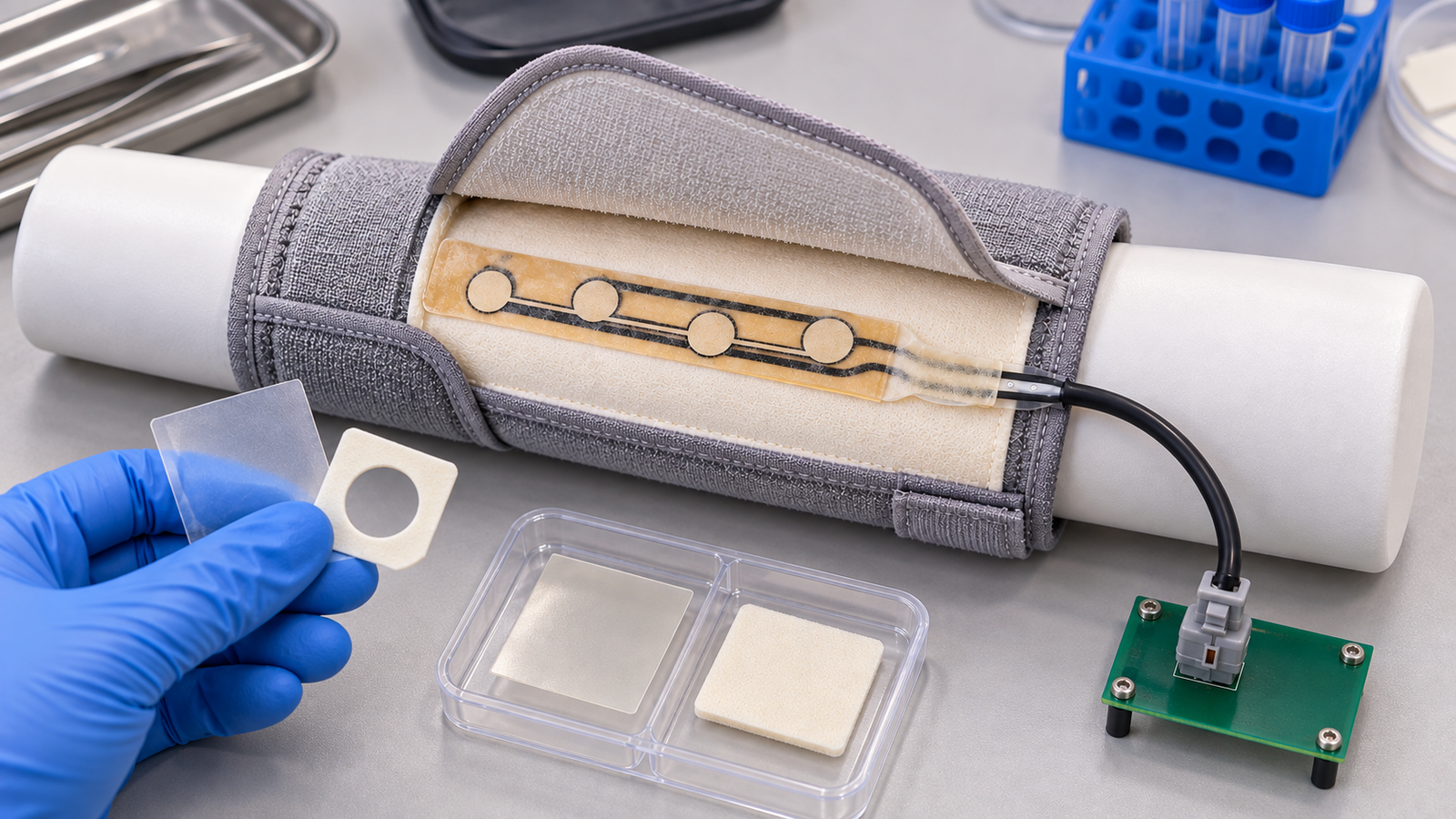
Photograph the loose sensor and the installed sample under controlled internal documentation. Keep the complete active zone, tail exit, bend relief and connector visible. Add a sectioned or deliberately opened non-production sample when it is necessary to prove which layer contacts the body and which layer remains buried. Do not use a generated marketing image as test-article evidence. The cover for this article is a technical illustration of an engineering review, not a photograph of a tested or approved device.
Record manufacturing details that can affect the final article, including printing, drying or cure, lamination pressure, die cutting, adhesive conversion, cleaning, handling aids and sterilization when it is part of the device process. The purpose is not to make the component supplier design the test program. It is to prevent an evidence package from describing a different build than the one being quoted and sampled.
Decide whether a supplier report is applicable, supportive or irrelevant
A buyer can screen a report in three steps.
First, compare identities. Does the report name the same film, adhesive, ink, coating or finished component revision? If it describes only a trade family or an unnamed coupon, record the uncertainty rather than treating it as a match.
Second, compare processing and article form. A raw film, printed coupon, converted adhesive part and assembled sensor are different articles. Check dimensions, exposed area, surface treatment, cure, lamination, cleaning, sterilization and preparation. If the report uses an extract, the report should describe how that extract was prepared. If the proposed device differs, the device owner needs a documented rationale or new evidence.
Third, compare the decision the report was designed to support. A declaration, chemical characterization report or biological test result answers only the scope stated by its method and acceptance criteria. It does not automatically approve sensor force response, adhesive bond, skin comfort, cleaning durability, electrical safety or the complete wearable device.
Classify each document as applicable, supportive with a defined gap, or not applicable. That simple disposition prevents a quotation team from sending more paperwork while leaving the test-article question unanswered.
Keep performance sampling and biocompatibility evidence linked but separate
The same sample revision may need both force-performance checks and material or biological evidence, but the two decisions are not interchangeable. A contact stack can be dimensionally correct and show repeatable resistance change while its finished-device contact evaluation is still open. A material report can be applicable while the actuator geometry produces unstable force transfer.
For component sampling, define the target force window, contact footprint, preload, compression stack, readout circuit, loading rate, dwell, release condition, cycle count and temperature or humidity when relevant. Record zero load, loaded output, release recovery and any baseline shift after mounting. Keep the tail bend and connector fixture consistent.
For the contact-evidence package, keep the same component and assembly revision identifiers, but record contact surfaces, material and process identities, test-article mapping and the responsible device reviewer. Linking the records prevents a late mechanical change from silently invalidating an earlier evidence review.
Supplier boundary: component evidence is not device approval
Baoshengda can review and manufacture a custom FSR pressure sensor with a controlled active zone, tail and connector to a released drawing. Within an agreed scope, the supplier can provide component drawings, construction identifiers, buyer-authorized material information, revision and lot traceability, sample build records, dimensional checks, continuity checks and force-response data from a defined component fixture.
The component supplier does not automatically determine the finished medical device's body-contact category, evaluation endpoints, clinical relevance, toxicological assessment, test laboratory scope, sterilization validation, cleaning validation, electrical safety, software behavior, usability, regulatory classification or submission strategy. It also cannot declare a complete wearable device biocompatible because one incoming material has a report. Those decisions belong to the legal manufacturer and its qualified regulatory, biological-safety and testing teams.
If a buyer cannot yet define the finished contact stack, quote a controlled discovery and sample phase rather than promising a final compliance outcome. That makes the open decisions visible before production tooling or volume pricing is treated as fixed.
Drawing, sample and RFQ checklist
Prepare a compact package before using the Request Quote page:
- intended device use, user population and final-use environment in non-confidential terms;
- contact type, contact duration and the device team's owner for that classification;
- assembly cross-section showing direct, indirect and non-contact zones;
- FSR outline, active-zone shape, tail exit, bend keepout, stiffener, contact side, connector and pin assignment;
- target force range, actuator footprint, preload, compression stack and defined component test method;
- revision-controlled bill of materials for films, conductive or resistive print, spacer, adhesive, liner, foam and edge seal;
- supplier grades, thicknesses, finishes and buyer-approved substitutes where disclosure is permitted;
- printing, cure, lamination, die-cutting, cleaning, handling and sterilization boundaries;
- existing reports with test-article identity, preparation, method, parameters, acceptance criteria, results and deviations;
- a comparison showing how each tested article matches or differs from the proposed finished build;
- prototype quantity, production forecast, sample lots and required traceability;
- separate acceptance owners for force performance, mounted fit, material evidence and finished-device approval.
A quotation based on this package can separate sensor construction, component performance evidence and device-level work that remains outside the supplier scope. That is more useful than attaching a generic report after the sample has already changed.
Need help reviewing a structure?
Send your drawing, photos, application, and quantity. Baoshengda can help check the structure before sampling.
Send Drawing for Quote