
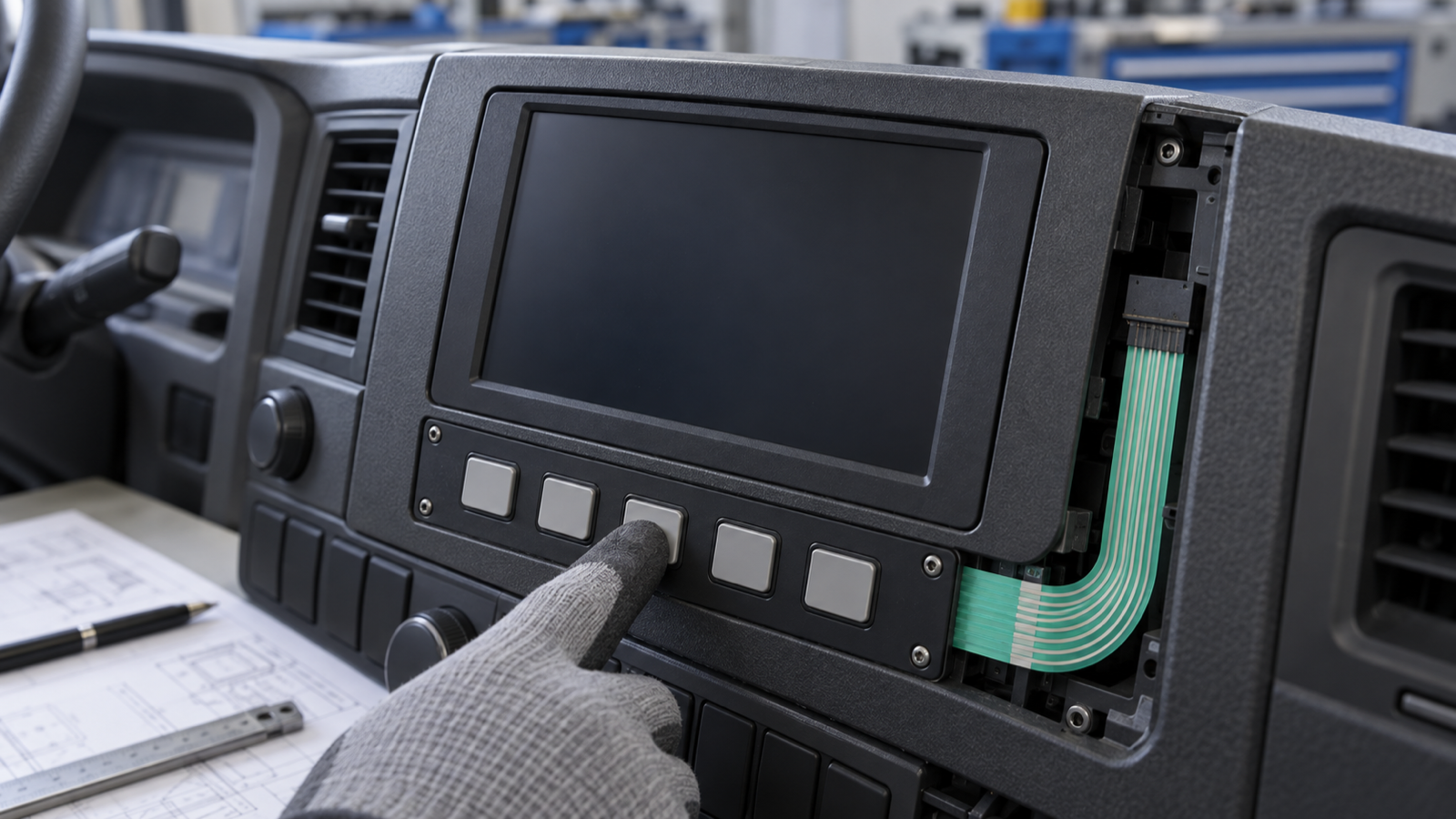
Keep dedicated physical keys for truck HMI actions that are frequent, time-sensitive or expected to work with minimal visual search. Use the touchscreen for contextual choices, setup and information that benefits from flexible menus. Before a buyer releases artwork or circuitry, every proposed action should be classified by frequency, urgency, reach, confirmation method and consequence of a wrong selection. The component decision then becomes concrete: key count and separation, tactile intent, legend and lighting behavior, switch matrix, flexible-tail exit and connector orientation. A mounted sample must confirm that the chosen keys can be located and pressed in the real bezel; a loose keypad alone cannot settle the control-allocation question.
A current truck interface still mixes digital and physical access
GM's September 15 pickup-truck user-interface announcement describes a large digital interface, quick access to frequently used controls and retained physical controls for customers who prefer tactile feedback. It also gives a single-button activation example for driver-assistance controls. This is a whole-vehicle manufacturer announcement; it does not specify a Baoshengda component, a membrane-switch construction or a universal control rule.
The useful sourcing lesson is narrower. Screen size does not decide whether a function belongs on glass or on a dedicated key. The buyer must map each action to its use condition before asking a keypad supplier to freeze the face, circuit and connection. Otherwise, a clean drawing can still encode the wrong interaction decision.
Allocate actions by use condition, not by available panel area
Start with the action list rather than a preferred number of keys. For each action, ask how often it is used, whether it is needed while attention is elsewhere, whether gloves are expected, how the user confirms the result and what recovery looks like after an unintended press.
An action is a stronger candidate for a dedicated key when the user should find it by position, distinguish it from adjacent actions and receive a consistent press cue. That does not prove that a membrane switch is appropriate for every vehicle function. The vehicle OEM remains responsible for system architecture, functional safety, software behavior and vehicle validation. It does mean that the front-panel buyer can define what the component sample must demonstrate.
Touchscreen placement is more reasonable when an action is infrequent, depends on visible context, changes with system state or benefits from a guided sequence. A touchscreen can also consolidate setup choices that would otherwise create too many permanent legends. The important point is to document the reason for each allocation instead of treating physical and digital input as competing design fashions.
| Decision factor | Keep a dedicated physical key when... | Touchscreen is reasonable when... | Evidence before sample |
|---|---|---|---|
| Use frequency | The action is repeated often and a stable position reduces search | The action is occasional or configuration-oriented | Ranked action list and expected operating sequence |
| Attention and reach | The user needs predictable access with limited visual search | The user can read and confirm a contextual choice | Cockpit position, reach direction and mounted bezel view |
| Selection separation | Neighboring actions must be distinguished by position or spacing | Menus can provide clear visual separation | Key-center spacing, active areas and guard space |
| State feedback | A press cue is useful before the system response is visible | The screen itself presents the choice and response | Defined tactile intent plus system feedback responsibility |
| Revision behavior | The action and legend are expected to remain stable | Labels or available choices will change through software | Controlled legend list and revision owner |
Freeze the physical-key geometry before artwork polish
Once the physical-key candidates are chosen, define the active key centers, separation and surrounding dead area. A visually balanced row is not enough. Two adjacent keys can look distinct but still feel ambiguous through a glove if their active areas, embossing or spacing do not support the intended selection.
The drawing should identify the bezel opening, visible perimeter, key-center coordinates, display relationship and any keep-out zones. If raised keys are requested, define the embossing concept and which dimensions are inspection characteristics. If a flat construction is preferred, the sample plan still needs a way to judge location and press confirmation. Artwork should follow the approved geometry rather than disguise uncertainty with icons and color.
Lighting and legends are separate decisions. The buyer should state which legends need night visibility, which areas must remain opaque and how display light should be isolated from the key field. A supplier can review print layers, windows and light-blocking intent at component level, but cannot infer final cockpit brightness or vehicle-level visibility from a standalone panel.
Circuit, tail and connector must follow the mounted package
The control list becomes an electrical input matrix. Each dedicated key needs a traceable circuit position, common-line strategy where applicable and an agreed pin assignment. Before quotation, provisional key count and connector preference may be enough if they are labelled as assumptions. Before production release, the circuit drawing, tail contacts and connector orientation must be controlled.
Tail routing is easiest to get wrong when the front view dominates the RFQ. Mark the tail-exit edge, bend direction, available clearance and mating-connector location in the installed orientation. A connector that is correct on a loose drawing may still face the wrong way after the panel is bonded into its bezel. The mounted sample should show the complete route without forcing a sharp bend at the film edge or connector transition.
For buyers evaluating a custom automotive HMI panel and keypad, these details allow a component supplier to discuss artwork, layer stack, tactile construction, circuit and connection without claiming control of the vehicle electronics or software.
Keep enquiry, quotation, sample and release evidence separate
A useful first enquiry can be short. Send the use case, a panel or bezel photo, approximate outer size, proposed action list, expected sample quantity and any known tail direction. State which decisions remain open. This is enough to begin a feasibility conversation without pretending that the design is frozen.
For quotation, identify the assumptions that affect scope: number of physical keys, film and support concept, backlighting intent, tail length, connector family, expected annual quantity and whether the supplier is quoting a keypad only or a broader front-panel stack. An assumed value belongs in the quotation record, not hidden inside the price.
The mounted sample should then answer physical questions:
- Can the intended key be located and pressed in the actual bezel position?
- Are neighboring active areas sufficiently separated for the intended hand or glove?
- Do legends, windows and any lit zones remain distinct in the planned viewing condition?
- Does the tail leave the panel in the correct direction and reach the connector without interference?
- Does each key map to the expected contact in the agreed low-voltage test setup?
Production release requires the controlled mechanical drawing, approved artwork, circuit and pinout, material and layer-stack definition, tolerances, inspection points and the accepted mounted sample or equivalent approval record. A successful prototype press is useful evidence, but it does not replace the released documents.
Send the action map before requesting a final keypad drawing
The fastest next step is not a finished icon sheet. Prepare a one-page action map that names each proposed control, its frequency, urgency, expected hand or glove, confirmation method and preferred physical or touchscreen location. Add the bezel opening, display position, available depth, tail direction and connector location.
Baoshengda can use that package to review a component-level automotive HMI construction and identify which dimensions, artwork, circuit and connection details remain assumptions. Submit the action map, available drawing, photos, quantities and sample objective through the Request a Quote page. The resulting discussion should support a keypad sample and production specification; vehicle-level interface strategy, software behavior and validation remain with the OEM and its system partners.
Need help reviewing a structure?
Send your drawing, photos, application, and quantity. Baoshengda can help check the structure before sampling.
Send Drawing for Quote