
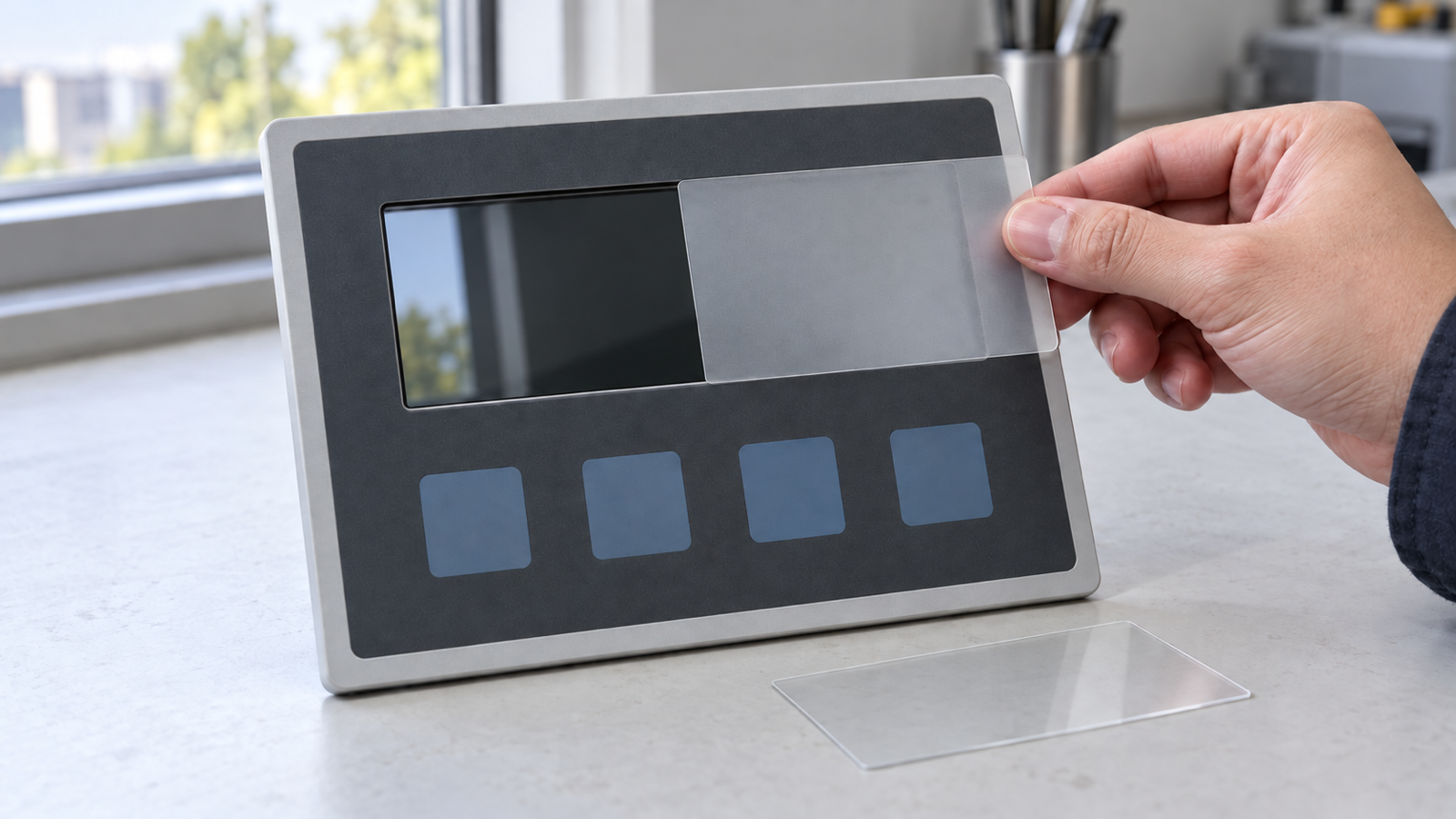
Do not quote a single matte finish across a public charger overlay unless the display window has already been approved with that exact surface. Separate the frequently touched printed field from the optical window on the drawing and in the quotation. A texture that softens visible reflections on the surrounding panel can also scatter light passing through the window, changing how small characters and status details appear. Ask for the proposed finish map, an identified film and coating construction, and samples on the intended display stack. Choose the window treatment from that evidence, not from the word matte or a loose color swatch.
Give the display window its own quotation line
The first decision is not whether matte looks more professional. It is whether the printed field and the viewing window have the same job. The field carries legends and receives repeated contact. The window must preserve the information produced by a separate display. Treating both regions as one unspecified finish hides a technical decision inside a price comparison.
For quotation, mark the touch field, transparent viewing region, opaque border and any indicator windows as separate zones. Identify which surface faces the user. State whether the proposed texture is part of the base film, a coating, or another agreed treatment. A description such as fine matte PET is not a complete construction specification. Two quotations using those words may include different surfaces, thicknesses and window-processing assumptions.
A separate window requirement does not automatically require a separate window part. It means the supplier must explain the proposed construction and price the actual scope. Do not assume that a textured film can simply be made optically clear in one region without reviewing the available process.
Outdoor rollout creates a finish decision, not a material prescription
In its September 10, 2026 public-charging update, Toronto Hydro describes four Shell Recharge sites beginning their rollout across Toronto. The utility explains its role in electrical-capacity planning, connection requirements and project coordination. It also describes a pilot that gives eligible charging providers direct access to 480-volt service. These are deployment and connection facts, not specifications for an overlay, keypad or display window.
The practical connection for a charger OEM is the move from a controlled review room to public locations with different viewing directions and lighting. The announcement does not report a glare defect, name a front-panel material or establish a supply relationship with Baoshengda. The component decision here is an engineering implication: settle the window and surrounding finish before reproducing a front panel across locations. Utility connection readiness and front-panel optical acceptance remain separate decisions, with separate owners and evidence.
Describe the finish map before comparing prices
Prioritize three items: the surface construction, the boundary between finishes, and the sample needed to release the choice. The quotation should make all three inspectable. Otherwise, a lower price may simply exclude a window operation or the display-mounted sample work that another supplier has included.
Material names alone do not identify surface finish. As background, Covestro's film selector guide lists graphic-film grades with different first- and second-surface textures. This illustrates why a grade and face orientation matter; it does not select a grade for your charger or prove its outdoor suitability.
| Quotation item | What the buyer should define | What an incomplete offer leaves unresolved |
|---|---|---|
| Printed touch field | User-facing finish, color reference and where contact occurs | Whether appearance and cleaning expectations refer to the same surface |
| Main display window | Viewing outline, proposed optical finish and full display stack | Whether the price assumes the field texture continues over the display |
| Finish transition | Controlled boundary and permitted registration variation | Whether texture or coating may enter the viewing region |
| Indicator windows | Required color and visible state, assessed with actual indicators | Whether a window treatment changes the intended indication |
| Sample scope | Loose construction samples plus a representative mounted review | Whether sample pricing includes the build needed for a decision |
| Production release | Agreed construction, finish reference and change-notification scope | Whether a later film or coating substitution needs renewed review |
Use a display-mounted sample to resolve the remaining choice
A loose film on a white table cannot show the finished display's contrast. Review candidate constructions over the intended display and any protective lens or air gap that belongs in the assembly. Keep the display settings and viewing positions consistent when judging alternatives. Include small characters, low-contrast details and the states that users must distinguish, rather than only a large bright logo.
Inspect both the reflection and the displayed information. A smooth window may preserve detail while presenting a distinct reflected light source. A scattering surface may soften that reflection but spread light over a wider area. Neither observation establishes a universal winner. The acceptable result depends on the actual stack, light direction, display output and viewing task.
Agree any numerical haze, transmission or gloss requirements with the responsible material and display specialists before acceptance. Do not invent a threshold from a supplier photograph. A simple coupon review can help locate the required finish boundary and narrow sample options; it cannot replace finished-assembly acceptance. The cover illustrates that preliminary discussion, not a measured result.
Do not trade optical clarity for an undefined durability claim
Matte, anti-glare, anti-fingerprint and abrasion-resistant describe different properties. One word does not prove the others. Ask what construction supports each requested property and which agreed evaluation will check it. If fingerprints are the concern, examine the relevant touch zone before and after the specified cleaning procedure. If visible scratches are the concern, define the contact and cleaning exposure instead of accepting a broad scratch-proof claim.
Outdoor use adds requirements that a finish swatch does not answer, including weather exposure, cleaning chemistry and the bonded assembly. Keep those requirements in the specification, but do not assume the overlay supplier is approving the enclosure seal or complete charger. A clear window choice should not silently change the agreed film, adhesive, print protection or mounting scope.
Send the marked zones, then agree the sample scope
Baoshengda can review the printed layout, film-overlay construction, window zones and sample requirements through its custom graphic overlay and film-panel service. The useful next step is a zone-marked drawing and a defined sample request, not a promise that one standard finish will work on every display. Manufacturing feasibility and any proposed treatment still require project review. The charger manufacturer retains responsibility for display selection, system usability, environmental qualification and whole-equipment compliance.
For a quotation package, prepare:
- The overlay outline and revision, with touch field, viewing window, opaque border and indicator zones marked separately.
- The proposed film and coating identities, face orientation, thickness and any existing approved finish references.
- The representative display, lens and mounting stack, including the viewing tasks the sample must preserve.
- Cleaning and outdoor-exposure requirements, plus the acceptance method and person responsible for each decision.
- Sample quantities, intended production quantities, artwork variants and whether alternative window constructions should be priced separately.
Request an overlay quotation with the finish zones marked. Ask the response to separate the base construction, window treatment and mounted-sample work. That gives purchasing a comparable price and gives engineering a clear decision to close before production.
Need help reviewing a structure?
Send your drawing, photos, application, and quantity. Baoshengda can help check the structure before sampling.
Send Drawing for Quote