
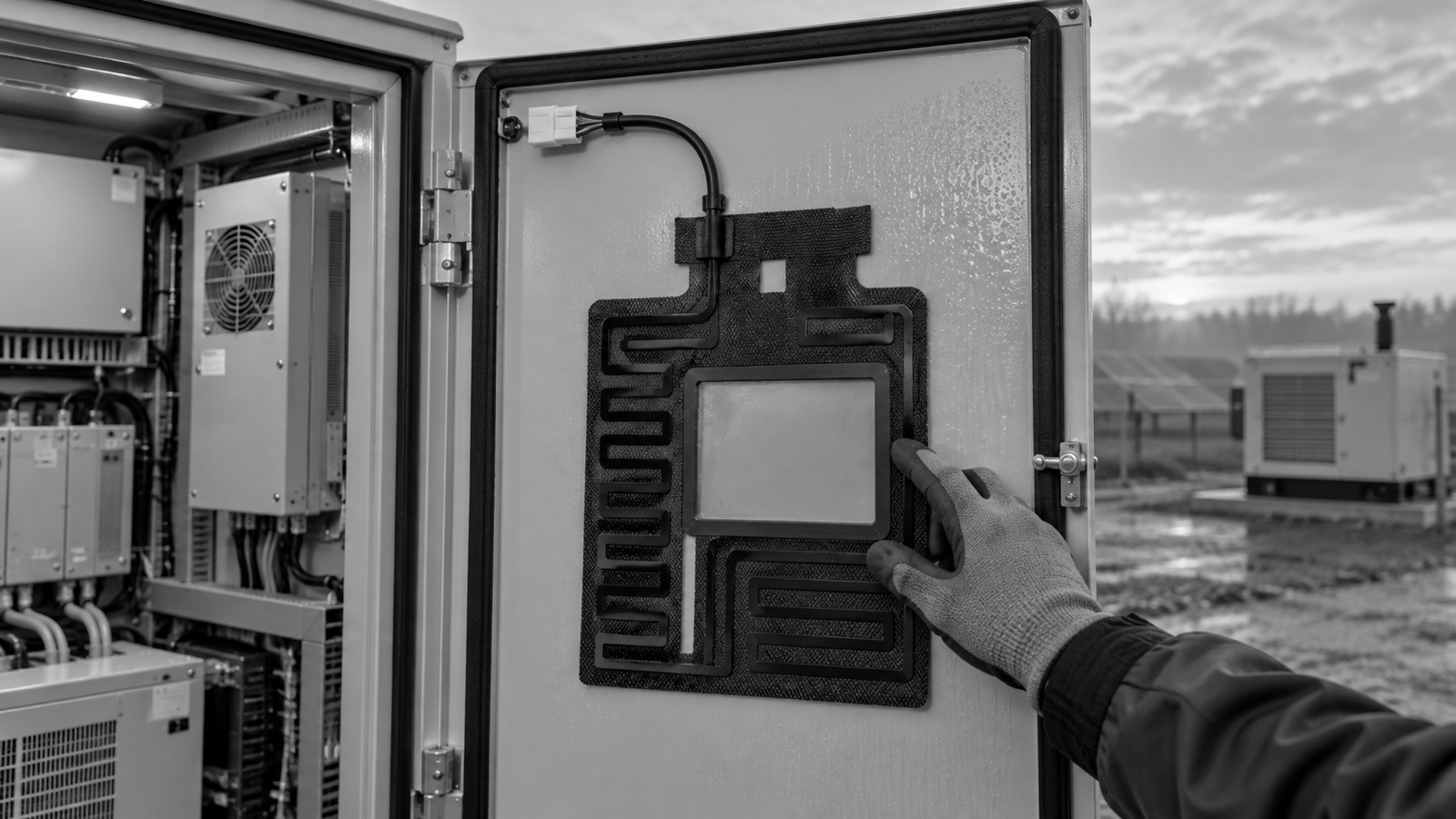
Use enclosure HVAC for the cabinet's overall thermal and humidity strategy. Add local flexible heating film only when a specific door-mounted display, viewing window, keypad surround or sensor zone needs faster surface recovery, a higher local temperature margin or protection that general air circulation cannot reliably provide. The two measures solve different problems and may be used together. Start an enquiry with a cabinet-door photo, the affected zone, available voltage and a rough duty condition. A quotation can state assumptions, but a mounted door sample should confirm the heat path, lead routing and surface response before production release.
Outdoor storage cabinets make local cold surfaces easier to miss
Power Genius announced two outdoor PV-diesel-storage cabinet models on September 17. Its release describes integrated photovoltaic, storage, power-conversion, energy-management and diesel interfaces for remote and commercial sites. The source is a whole-system manufacturer announcement. It does not identify Baoshengda, disclose a local heater, prove condensation at a control window or establish a universal cabinet design.
The practical component question appears at the door. A cabinet may maintain an acceptable average internal air temperature while a thin metal door, clear window or operator area remains a colder local surface. Door opening, wind exposure, thermal bridges and uneven air circulation can make that small zone behave differently from the cabinet interior. A local heater can address the surface zone, but it must not be treated as a replacement for enclosure HVAC, ventilation, drainage, sealing, insulation or system-level safety controls.
Choose the architecture from the actual cold surface
Begin with the location that must stay usable. If the risk affects battery modules, power electronics or the whole enclosure, it belongs to the cabinet thermal-management design. If it is limited to a viewing pane, a door-mounted interface or a small inspection surface, a shaped flexible heater may place heat closer to the problem with less unnecessary warming elsewhere.
The highest-impact decisions are the heated boundary, the available electrical interface and the mounted heat path. A heater drawn around a window but bonded to an insulating layer may not warm the intended surface as expected. A suitable voltage on paper is not enough if the connector, cable exit, switching method or protection concept conflicts with the cabinet architecture.
| Decision | Evidence for the buyer | What the supplier can review | What remains system-level |
|---|---|---|---|
| Whole-cabinet or local zone | Marked door photo and affected surface | Whether a shaped heater can fit the local area | HVAC capacity and cabinet humidity strategy |
| Heater footprint | Drawing of window, keep-outs and bondable surface | Trace layout direction and lead exit concept | Final surface-temperature limit |
| Electrical interface | Available voltage, switching concept and connector preference | Resistance and power assumptions for quotation | Fuse, controller and fault-response design |
| Mounted heat path | Door material, stack section and adhesive interface | Sample construction and lead strain relief | Cabinet heat-loss model and safety approval |
| Service access | Door motion, cable path and replaceable parts | Connector position and bend allowance | Maintenance procedure for the complete cabinet |
This table is not a performance guarantee. It separates component evidence from the decisions that the cabinet designer must own.
Ask early with incomplete information, but label the unknowns
A useful first enquiry does not require a released thermal model. Send a straight-on door photo or sketch, the approximate local zone, available supply, operating environment, planned sample quantity and expected annual quantity. Mark whether the problem is a fogged viewing surface, slow low-temperature recovery, frost risk or another observed condition. If the condition has not been measured, describe it as a design concern rather than a confirmed failure.
Baoshengda can review a custom flexible heating film component around a declared local area, including a practical footprint, resistance or power assumption, insulated lead direction and connector concept. The supplier cannot infer cabinet airflow, battery safety, software logic or final compliance from a door photo. An early discussion can identify missing inputs without pretending that incomplete evidence is a production specification.
Keep quotation assumptions separate from sample acceptance
For quotation, record the assumed heater outline, keep-outs, nominal supply, resistance or power direction, lead length, connector family, bond surface and quantity. State whether a temperature sensor or switching device is supplied elsewhere. If the buyer has not fixed the door stack, quote the heater as a component under a clearly named mounting assumption.
A mounted sample should then test the actual door stack. Review adhesion, full lead and connector clearance, cable flex when the door opens, the temperature of the intended surface and nearby materials, and recovery under a representative cool and humid condition. Compare the local zone with the surrounding door rather than relying only on a loose heater bench reading. Record the test fixture, starting condition, energization method, observation point and acceptance rule.
The flexible film supplier can support the component drawing and sample build. The cabinet manufacturer or integrator remains responsible for thermal analysis, condensation management, electrical protection, fire strategy, battery limits, control logic and approval of the complete equipment.
Release production only after the mounted path is controlled
Production release needs more than an approved appearance. Freeze the heater outline and trace zone, material stack, resistance or power requirement, supply and connector, lead exit, strain relief, bond surface, keep-outs, inspection method and revision identifier. Link those items to the controlled cabinet-door drawing so a later enclosure change does not silently move the heater away from the intended surface.
Use a short release checklist:
- marked door drawing with the local heated boundary and reference datums;
- heater outline, trace zone and no-heat keep-outs;
- declared voltage and resistance or power requirement;
- complete lead, connector, routing and door-motion clearance;
- adhesive or mounting stack and prepared bond surface;
- mounted-sample condition, observation points and acceptance rule;
- responsibilities for controller, fuse, sensor and system safety;
- matching drawing, sample and purchase-order revision.
If you are still deciding between local heat and enclosure-wide thermal management, send the current door photo and known electrical interface through the request a quote page. The first useful answer should be which unknowns block a component quotation, not a promise that a local heater will solve the complete cabinet environment.
Need help reviewing a structure?
Send your drawing, photos, application, and quantity. Baoshengda can help check the structure before sampling.
Send Drawing for Quote