
A front photo and an old overlay can start a replacement enquiry, but they are not enough to release a reliable production order. First identify whether the removable part is only a printed graphic overlay or a complete membrane-switch assembly. Then recover the outer profile, display-window position, key-zone artwork, adhesive interface and installation orientation from controlled measurements and the most complete available sample. A supplier can quote an explicit assumption set before every detail is known. Sample approval should then confirm fit, appearance and assembly behavior. Production release needs approved artwork, controlled dimensions, material and adhesive definitions, plus a retained reference sample. A photograph remains supporting evidence, not the master specification.
First identify what the old part actually is
Buyers often use “overlay,” “keypad” and “membrane switch” for different constructions. That distinction changes both quotation scope and replacement risk.
A graphic overlay is the printed front film. It may provide legends, colors, windows, surface finish and adhesive attachment, while the electrical switch remains a separate part beneath it. A complete membrane switch normally adds spacer layers, printed circuits, a flexible tail and a connector or exposed contacts. Some assemblies also include embossed keys, shielding or rigid support.
Begin with views of the front, back and every edge. Record whether a flexible tail leaves the part, whether the old film can be separated from an electrical stack, and whether the enclosure carries a separate switch board. If only the front photo is available, describe the construction as unknown rather than asking a supplier to silently choose one. Otherwise, an overlay-only quotation and a complete switch quotation may look comparable while covering different products.
Current medical-device replacement pressure does not remove component controls
A September 15 Mindray North America announcement about the SV70 non-invasive ventilator discusses replacement pressure, fleet standardization and a shared user-interface approach within a medical-device family. It is a whole-device company announcement. It does not identify Baoshengda, a graphic-overlay construction or any component supplier.
The useful sourcing lesson is narrower. When an equipment family is being maintained, standardized or replaced, an apparently simple front film may still carry revision-specific window geometry, symbols and installation assumptions. A familiar-looking face is not proof that two revisions share the same cutouts, adhesive border or switch arrangement. Replacement work therefore needs a controlled evidence path even when the immediate commercial request begins with one worn part and several phone photos.
Know what a front photo can and cannot prove
A square front view can show the general arrangement, the number of visible key zones, the presence of a display window and the condition of the printed surface. A second view beside a scale can improve early size estimation. Oblique photos can reveal edge wear, trapped residue or a raised feature.
The same images cannot reliably establish film thickness, window tolerance, hidden adhesive coverage, color limits, surface texture, rear-side printing, emboss height or the datum used to position the part. Perspective distortion can move apparent hole centers. A ruler placed above the part may not lie in the same plane. A dark display window may be a transparent filter, a printed dead front or simply an opening in the photographed sample.
Treat each photo as evidence for a specific observation, not as an uncontrolled drawing substitute.
| Available evidence | Useful for the first review | Still unresolved before production |
|---|---|---|
| Straight front photo | Overall appearance, visible zones, obvious damage | Scale, tolerance, hidden layers and artwork authority |
| Photo beside a ruler | Approximate size and quotation range | Calibrated dimensions, perspective error and datum definition |
| Old physical part | Profile, window, thickness, finish and adhesive-residue review | Whether wear or shrinkage changed the original geometry |
| Enclosure or bezel sample | Installed fit, edge clearance and window registration | Final assembly process, cleaning method and revision control |
| Historical artwork or PDF | Legend content, color intent and revision clues | Whether the file is approved, one-to-one and production current |
Build the quotation around declared assumptions
An indicative quotation can be useful before the master drawing is complete, provided that unresolved items are visible. State whether the price assumes an overlay-only part, a proposed PET or polycarbonate film family, a particular printing side, a provisional adhesive construction and no electrical tail. Identify the estimated outer size, number of cutouts, finish, color count, prototype quantity and expected production volume.
Do not turn those assumptions into hidden specifications. If the old part contains a customer logo, warning symbol or licensed artwork, confirm that the requester is authorized to reproduce it and transfer the artwork privately. A supplier can help reconstruct manufacturing artwork from authorized evidence, but should not infer ownership from a photograph found online or from a part number alone.
Quotation scope should also say who supplies the housing, display window definition and installation fixture. A film that fits an uncoated prototype may not behave the same way on the production enclosure after texture, paint, cleaning or assembly pressure changes.
Use the first sample to recover fit and appearance
The first physical sample is not just a miniature production order. It is the quickest way to convert uncertain evidence into controlled observations.
Compare the candidate overlay with the old part and, when available, the actual enclosure. Check the full perimeter, display-window registration, hole centers, edge clearance and key-zone relationship. Review the surface under the lighting that matters to the equipment. If a transparent or tinted window is required, compare visual clarity and color only against an agreed reference and background.
For an overlay-only part, evaluate removal liner, adhesive coverage, placement method and edge behavior on a representative substrate. Record temporary sample differences, such as a provisional color or hand-cut feature, so that approval is not misread as acceptance of every production characteristic.
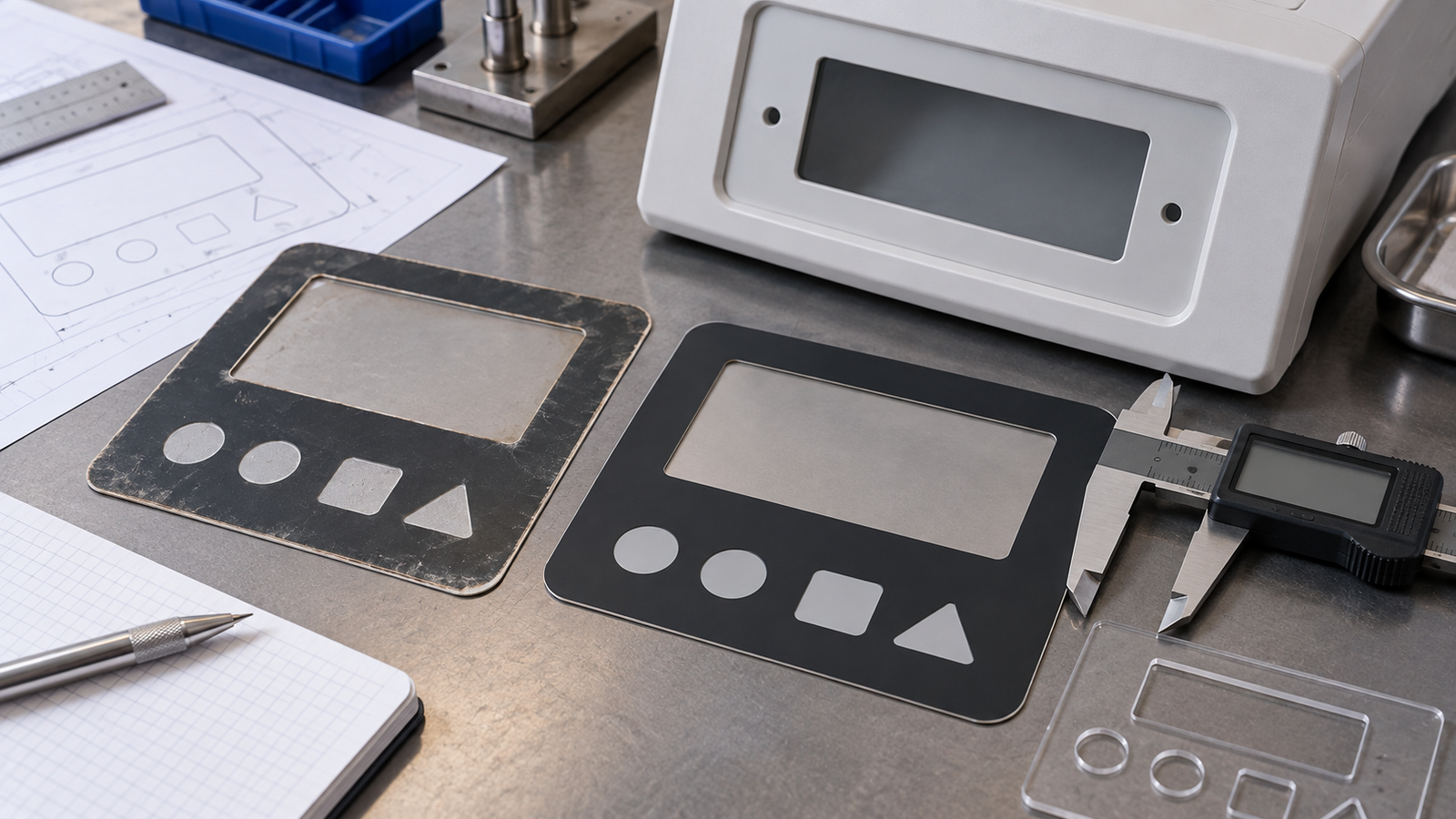
The generated cover for this article is a generic engineering scene. It illustrates a worn sample, a clean candidate, a bezel opening and a dimensional check. It is not a customer device, a medical qualification result or proof of compatibility.
Production release needs controlled ownership and revision evidence
A production release should replace provisional assumptions with a controlled package. That package normally identifies:
- approved outer profile, cutouts, window and alignment datums;
- authorized artwork and legend revision;
- film, surface finish, print construction and color references;
- adhesive type or agreed performance basis, coverage and liner;
- installation orientation and the representative housing surface;
- accepted sample or golden reference, inspection points and revision status;
- packaging, handling and quantity requirements relevant to the film surface.
Baoshengda can review an authorized old sample, available photographs, enclosure information and approved artwork to help define a graphic-overlay quotation and sample plan. That review does not establish medical-system compatibility, regulatory approval, sterilization suitability, price or lead time before the inputs are assessed. Whole-device validation and release remain with the equipment manufacturer.
Send a useful first enquiry without pretending the file set is complete
A strong first enquiry can be short. Send the front, rear and edge photos; approximate outer size; old physical part availability; equipment revision; whether a tail or electrical stack is present; display-window and cutout needs; housing material and surface; cleaning exposure; prototype quantity; production volume; and the source and authorization status of the artwork.
Label missing items as unknown. Ask the supplier to separate quotation assumptions, sample checks and production-release requirements in the response. That makes it possible to move quickly without allowing a phone photo to become an accidental master drawing.
Review the custom graphic overlay construction and printing options before deciding whether the replacement is an overlay-only part. Then send the available sample evidence for a replacement-overlay review and state which dimensions, artwork files and enclosure details can follow after the first technical assessment.
Need help reviewing a structure?
Send your drawing, photos, application, and quantity. Baoshengda can help check the structure before sampling.
Send Drawing for Quote