
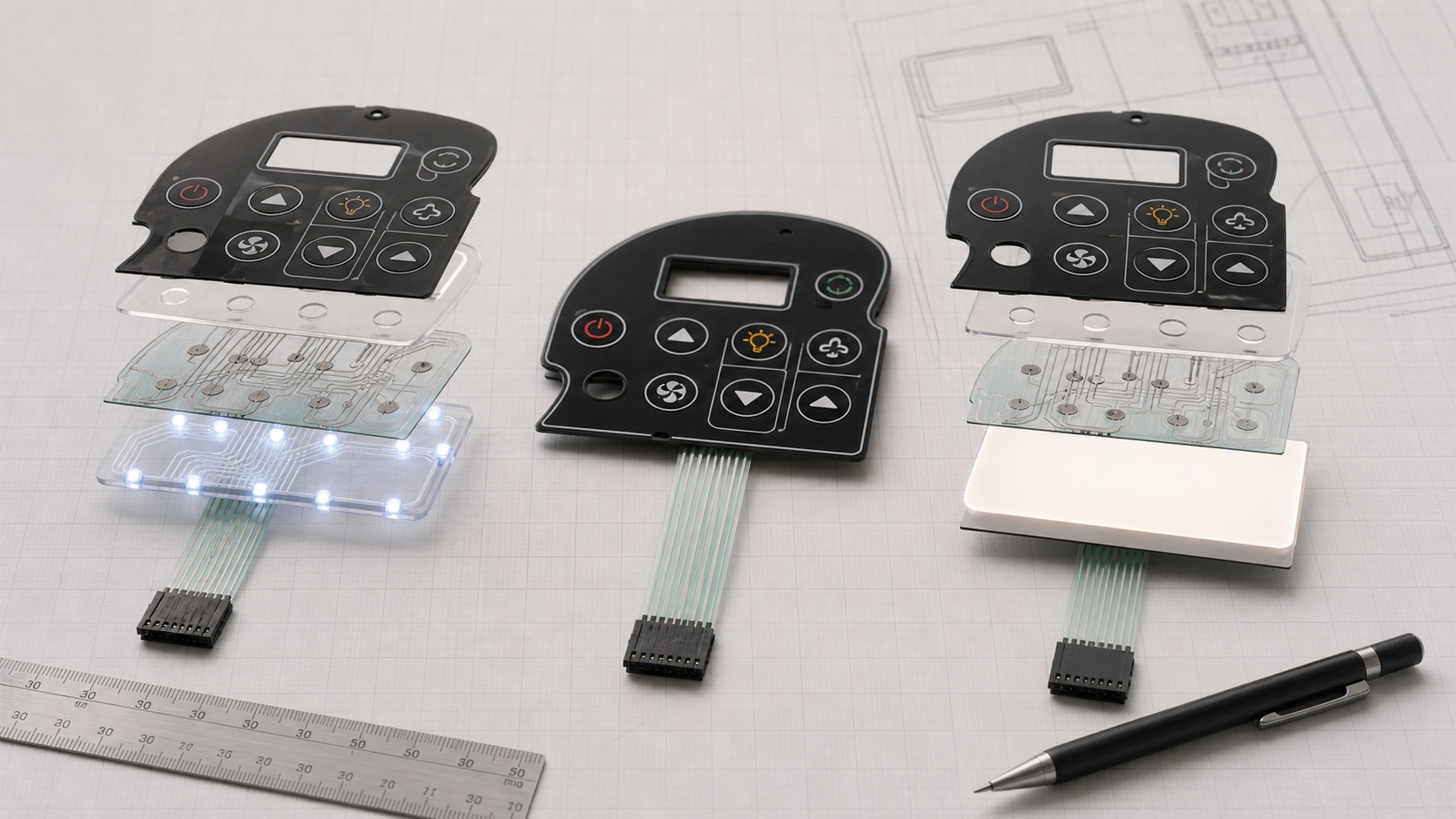
Quick answer: choose LED backlighting when the project needs stronger brightness, selective icon lighting, or longer service life around defined key areas. Choose EL backlighting when the buyer needs a thinner and more even glow across a larger graphic zone and accepts the inverter, brightness limits, and life tradeoffs that come with it. If the project is already headed toward a custom illuminated keypad, the backlit membrane switch page is the closest product reference.
The first decision is not LED or EL. It is how the panel must be read.
Many buyers start by asking for a backlit panel and then jump straight to light source names. That is too early.
Define these reading conditions first:
- Is the panel mainly used in low light, mixed indoor light, or outdoor service conditions?
- Does the operator need to find keys only, or read full legends clearly?
- Should all icons glow together, or only selected functions?
- Does the panel include a display window that must stay visually balanced beside the lit icons?
- Is the front panel thin and cosmetic, or does it also need tactile key response and heavy assembly support?
Without those answers, the light-source choice becomes guesswork.
Where LED backlighting usually fits better
LED backlighting is usually the safer choice when the buyer needs stronger output and more control over where the light appears.
LED structures are commonly chosen when the project needs:
- Higher brightness for dim rooms, vehicle cabins, or equipment used at night.
- Separate icon zones that should not all light at the same time.
- Better compatibility with status colors such as red, green, amber, or blue.
- Simpler long-term replacement planning for a product that may run many hours.
- Easier dimming or brightness tuning at the electronics level.
The tradeoff is structure. LED backlighting often needs more space for LEDs, light guide planning, masking, and local hot-spot control. A panel can be electrically correct and still look uneven if the icon spacing, diffuser path, or housing support is weak.
Where EL backlighting still makes sense
EL backlighting is still useful when the buyer wants a thin, soft, and even lighting effect across a wider legend area.
EL structures are often considered when the project needs:
- A very slim front stack with limited depth behind the overlay.
- A more uniform glow across a larger symbol field.
- A lower-profile appearance without obvious point-light hot spots.
- A decorative or guidance-oriented panel where extreme brightness is not the main goal.
The tradeoffs should be stated early:
- EL is usually dimmer than a well-tuned LED solution.
- The project may need an inverter, which changes the electrical plan and noise review.
- Service life expectations can differ from LED-based structures.
- Bright daylight readability still depends heavily on the overlay print, dead-front design, and surface finish.
A buyer who asks for EL only because it looks even in a sample photo may miss the inverter and daylight limits that matter later.
Check the panel stack before comparing sample photos
LED and EL should not be compared as light sources alone. Compare them as full panel stacks.
Review these structure points before approving one direction:
- Overlay material and whether the print density matches the intended light source.
- Dead-front icon requirement when the panel is off.
- Window area, adhesive clearance, and border thickness around the display opening.
- Available depth behind the panel for light guide, diffuser, EL layer, or wiring space.
- Tail route and connector space if the illuminated panel also carries switch circuits.
- Housing pressure points that can change flatness, light leakage, or key feel after assembly.
If the backlit area sits next to tactile keys, a display window, or a curved housing, the stack-up usually matters more than the catalog name of the light source.
Sample-stage risks that buyers should force into the review
This comparison should include real failure modes, not only appearance preference.
Push these checks into the sample review:
- LED version: look for hot spots, uneven icon intensity, and light leakage at corners or thin strokes.
- EL version: look for insufficient brightness, weak daylight contrast, and whether the glow still reads clearly through the chosen overlay finish.
- Both versions: check whether the display window, bezel pressure, or adhesive edge changes how the lit area looks after installation.
- Both versions: inspect the panel in low light and under stronger front light, not only in a controlled indoor photo setup.
- Both versions: confirm whether the power plan, dimming method, and connector layout still fit the product electronics.
A useful comparison is not "which one looks nicer on the bench." It is "which one still works better after the real stack, housing, and viewing condition are included."
What buyers should send before asking for a quote or revised sample
A better RFQ package usually includes more than artwork and overall size.
Send these details:
- Front-panel drawing with dimensions, key zones, and any display window.
- Artwork file showing which icons must be hidden, always visible, or selectively lit.
- Expected operating light condition, such as dark room, indoor equipment, vehicle cabin, or semi-outdoor service use.
- Housing section, photo, or note showing the depth available behind the panel.
- Power constraints, dimming requirement, and any preference for selective or full-area lighting.
- Existing sample complaint, especially hot spots, dim legends, inverter concern, or light leakage.
- Quantity and whether the panel is an early engineering sample or a near-production review.
If your team is ready for structure review, send the package through the Request Quote form so the lighting method, panel stack, and assembly limits can be checked together.
Final approval rule
For a backlit membrane switch project, the right question is not whether LED or EL is generally better. The right question is which option matches the panel depth, viewing condition, brightness target, electronics plan, and sample-stage risk of the actual product. Buyers usually save one revision round when they define those conditions first and compare the two lighting methods inside the real panel structure.
Need help reviewing a structure?
Send your drawing, photos, application, and quantity. Baoshengda can help check the structure before sampling.
Send Drawing for Quote