
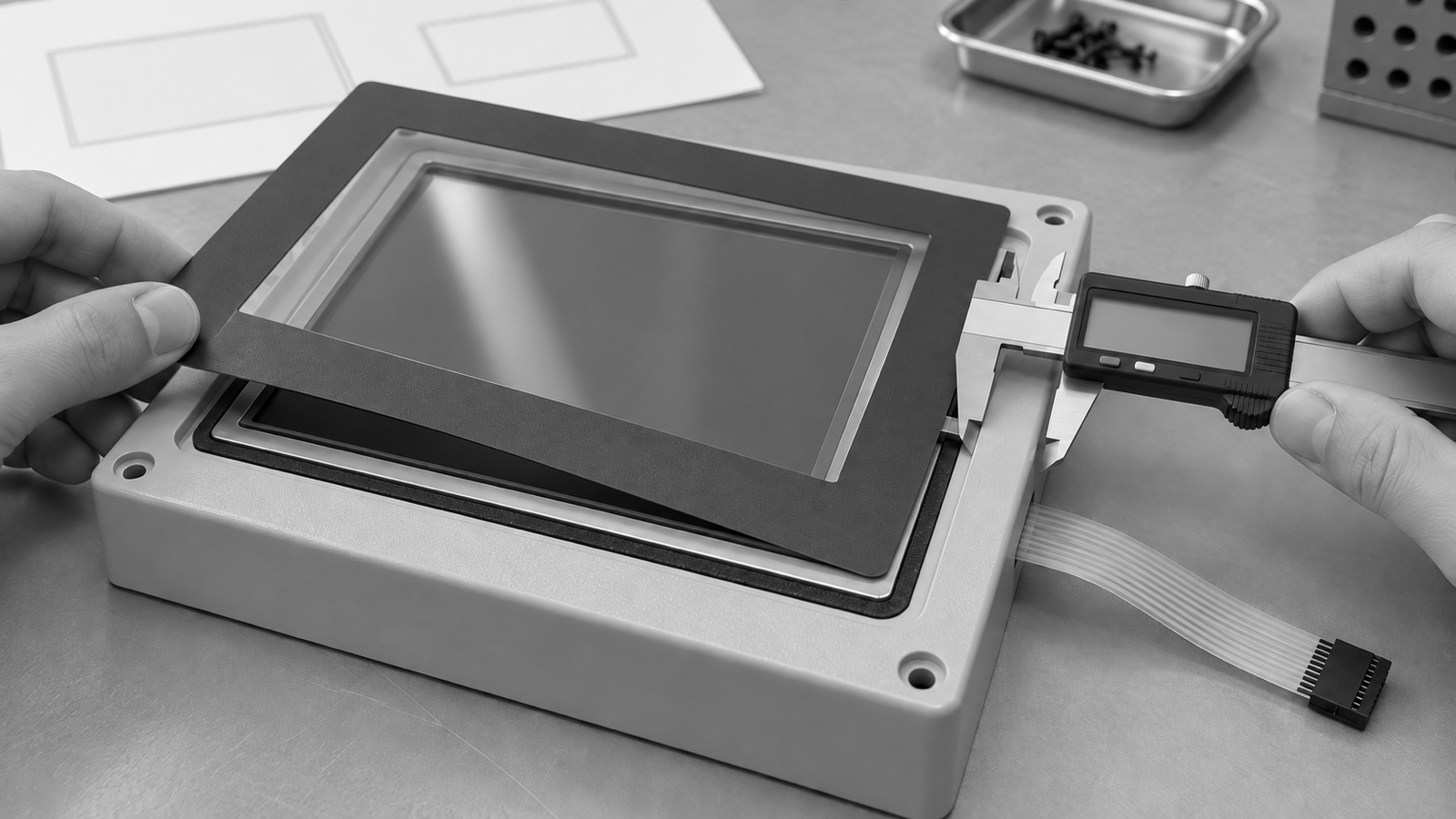
Do not use one nominal screen size to define an industrial touchscreen overlay. Control three geometries separately: set the optical clear zone and printed mask from the LCD active image area plus the agreed viewing margin; set mechanical clearance from the display-module outline; and set the visible reveal and centering from the finished enclosure bezel. Tie each geometry to one declared housing datum. For an initial enquiry, a module datasheet, front photo and enclosure sketch can be enough. A quotation may use clearly labelled assumptions, but a mounted sample should verify the visible border, adhesive keep-out and alignment before the drawing is released for production.
A larger industrial touchscreen creates a drawing question, not one dimension
Coperion's September 14 K-Vision-III announcement describes a redesigned feeder-line controller with a larger high-resolution touchscreen, retained familiar workflows and control of up to 24 feeder modules. It also presents replacement of individual controllers as part of the operating context. This is a whole-controller manufacturer announcement. It does not identify Baoshengda, specify a graphic overlay, publish the internal display geometry or establish a universal tolerance.
The useful sourcing signal is narrower. When a controller face is enlarged, replaced or reconfigured, the visible screen, display module and enclosure opening still belong to different parts. A buyer who sends only a nominal display diagonal or screenshot leaves the overlay supplier to guess the window boundary. The RFQ should instead state which edge answers each engineering question.
Keep five boundaries separate on the front-panel drawing
The active image area is the part of the display intended to present content. It is not necessarily the same as the outer glass or module outline. The overlay clear window and opaque print mask must be designed around the intended view, including the agreed visible margin and expected assembly variation.
The display-module outline controls mechanical space behind the overlay. The finished bezel opening controls what the operator sees after assembly. An adhesive or gasket keep-out controls where bonding material must not intrude into the viewing zone or service opening. These boundaries can be concentric, but they should not be assumed to share one size or one tolerance.
| Boundary | What it controls | Evidence to request | Do not substitute |
|---|---|---|---|
| LCD active image area | Usable optical view and printed-mask placement | Display drawing with active-area dimensions and datum | Nominal diagonal or screenshot |
| Display-module outline | Mechanical clearance and installation envelope | Controlled module drawing and orientation | Active-area width and height |
| Overlay clear window | Transparent zone and opaque border | Overlay drawing tied to housing datum | Bezel opening alone |
| Finished bezel opening | Visible reveal, centering and assembled appearance | Enclosure drawing or measured approved housing | Loose overlay dimensions |
| Adhesive or gasket keep-out | Bonding boundary around the window | Adhesive drawing and sectional stack | A visual border on artwork |
Choose one stable enclosure or housing datum and dimension the display, overlay window and bezel aperture from it. Avoid chaining one edge from another when the parts are assembled independently. The goal is not to prescribe a universal tolerance. It is to make every visible and mechanical relationship auditable.
Start the enquiry before every detail is frozen
A buyer does not need a complete production package to ask whether a custom graphic overlay film panel is worth reviewing. A useful initial enquiry can contain the display-module datasheet, one straight-on front photo, an enclosure sketch, approximate outer dimensions, intended environment, sample quantity and expected annual quantity. Mark the known housing datum and state which window decision is still open.
If the existing unit is being replaced, identify whether the old overlay, module or enclosure will remain. A front photo can reveal the visible border, but it cannot prove the active-area coordinates, module envelope, adhesive edge or rear clearance. If no controlled drawing is available, say so. The supplier can identify missing component inputs without pretending that the photo is a dimensional specification.
This initial package supports an early feasibility discussion. It does not authorize artwork release, material substitution or production. That distinction keeps a buyer from postponing a useful enquiry while also preventing assumptions from becoming undocumented requirements.
Put quotation assumptions in the commercial record
A quotation needs enough scope to price the intended component. State the film and surface-finish direction, opaque colors, transparent window treatment, outer shape, cutouts, adhesive concept, expected quantities, packing expectation and whether the supplier is quoting an overlay only or a broader membrane-panel assembly.
Window geometry may still be provisional at this stage. If so, list the assumed active-area drawing revision, provisional clear-window size, expected border and chosen housing datum. Record whether the quote includes an alignment fixture, color sample, mounted sample or only loose overlay pieces. An assumed dimension should be visible in the quotation record rather than hidden inside a unit price.
Baoshengda can review print masks, window geometry, material stack, adhesive pattern and component-level dimensional references. The equipment OEM or system integrator remains responsible for the display module, electronics, software, touch performance, machine safety and complete enclosure validation.
Use a mounted sample to check visible relationships
A loose overlay can confirm print quality and basic dimensions, but it cannot settle a bezel-alignment question. Place the overlay, display module and representative enclosure together in their intended orientation. The sample check should answer visible, physical questions without claiming system performance:
- Is the active image unobstructed throughout the intended viewing zone?
- Is the printed border centered relative to the finished bezel, not just the loose module?
- Does the module outline remain behind the opaque region without creating an exposed edge?
- Does adhesive or gasket material stay outside the declared keep-out?
- Are every panel corner, cutout and tail exit clear of the housing?
- Can the sample be assembled consistently from the declared datum without forcing the overlay into position?
Photograph the mounted result square to the front and retain the housing, module and overlay revisions used in the check. If a border appears uneven, trace the offset back to the relevant datum instead of correcting the artwork by eye. A visually acceptable prototype is evidence for the reviewed stack only; it does not replace controlled dimensions.
Release production with a matched drawing set
Production release should include the controlled overlay drawing, approved artwork, film and surface-finish specification, window treatment, adhesive drawing, inspection characteristics and approved sample reference. The display-module drawing revision, enclosure or bezel drawing and common datum should be listed alongside the overlay file so that a later module or housing revision cannot silently invalidate the window position.
Keep three states explicit. Enquiry inputs describe what is known and unknown. Quotation assumptions define what was priced. Sample checks record what was physically reviewed. Production-release requirements define what may be manufactured and inspected. Mixing those states encourages a supplier to treat an early photo or provisional module size as final authority.
A drawing can show several rectangles and still be ambiguous if it does not name their functions. Label the active area, module outline, overlay clear window, bezel aperture and adhesive keep-out, then dimension each from the chosen datum. That package gives purchasing, engineering and inspection the same reference.
Send a datum sketch with the next RFQ
Prepare one front-view sketch that overlays the five boundaries and identifies the common housing datum. Attach the display datasheet, enclosure view, intended material and finish, quantities, sample objective and list of unresolved assumptions. Do not spend time polishing final legends before the window relationship is understood.
Baoshengda can use that package to review a component-level graphic overlay film panel and identify which clear-window, print-mask, adhesive and dimensional details still need evidence. Submit the sketch, current drawings and quantities through the Request a Quote page. The resulting discussion can support an overlay quotation and mounted sample; display electronics, touch software, machine behavior and complete equipment approval remain with the buyer and its system partners.
Need help reviewing a structure?
Send your drawing, photos, application, and quantity. Baoshengda can help check the structure before sampling.
Send Drawing for Quote