
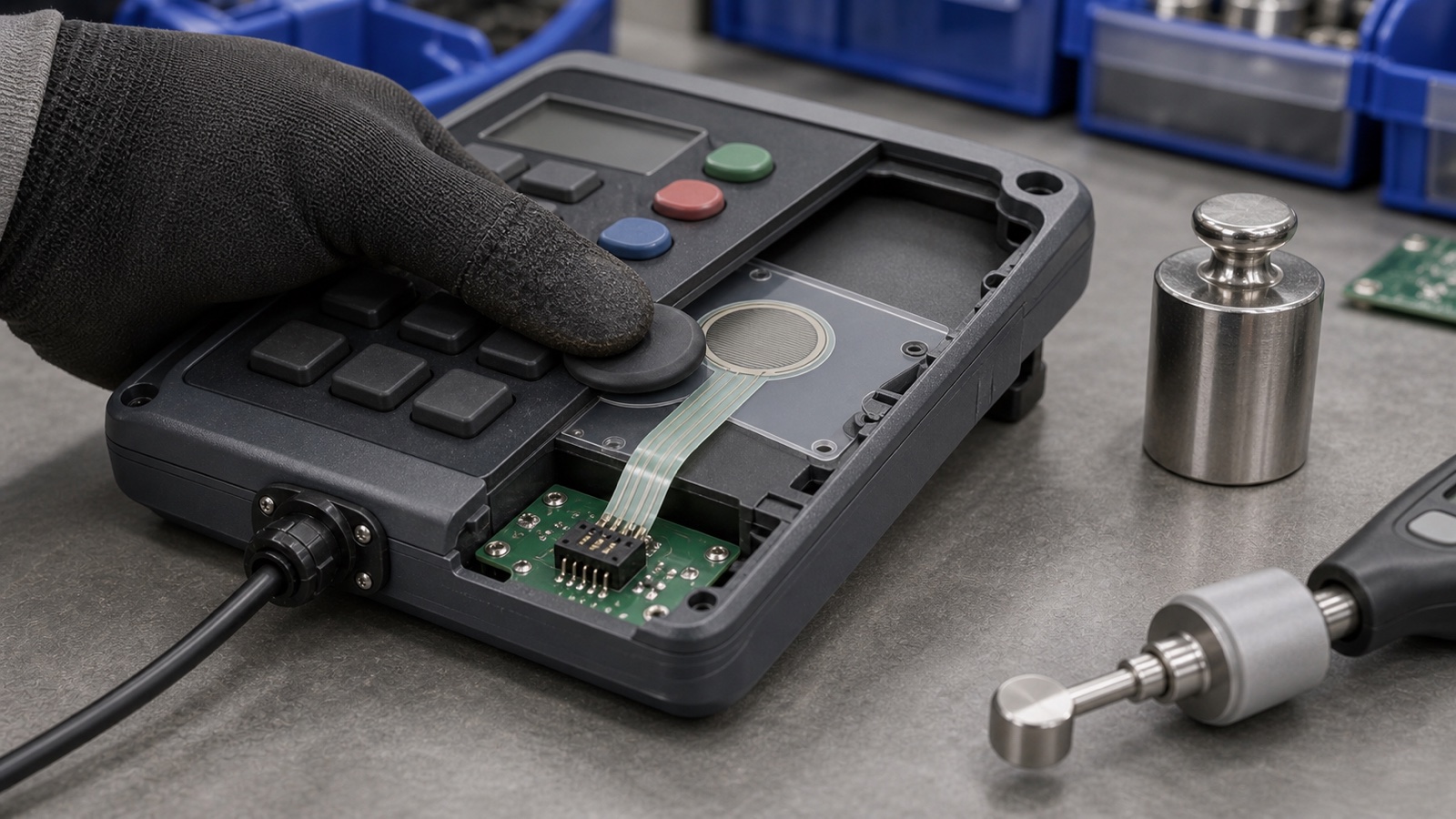
Direct answer: before ordering an FSR pressure sensor sample, define the useful force range, how the sensor will be pressed, how the circuit will read resistance change, and what test data will count as acceptance. The film sensor can be customized, but repeatable readings come from the full stack: actuator, spacer, adhesive, housing, fixture, firmware, and calibration method.
This guide is for overseas buyers and engineers who need a thin force-sensing input for equipment, wearables, medical accessories, seats, control panels, or compact HMI assemblies. For product capability and RFQ context, see Baoshengda's FSR pressure sensor manufacturing page.
What force range should the first sample answer?
Do not start only with the maximum force. Start with the force window that the product must actually detect.
Confirm these points before sample quotation:
- The lightest force that should trigger a response.
- The normal force during real user or machine operation.
- The overload force that may happen during misuse, drop impact, or long pressing.
- Whether the product needs threshold detection, relative force trend, or approximate force estimation.
- Whether the press is short, repeated, slow, or held for a long time.
A common sample-stage problem is choosing a sensitive structure from bench pressing, then discovering that assembly preload keeps the signal partly active after installation. A less sensitive stack may be steadier inside the housing, but it may miss light touches. The first sample should be matched to the useful operating window, not to a finger test alone.
How should calibration be discussed with the supplier?
Calibration is not one universal number. It depends on how the customer plans to read the sensor and how much variation the product can accept.
For an early RFQ, describe the intended reading method:
- Simple on-off threshold through a resistor divider.
- Relative pressure trend for low, medium, and high press levels.
- Multi-point test data for firmware mapping.
- Production screening with a fixed force fixture.
- Comparison against an existing sample or field unit.
If the sensor will be used only as a threshold input, the supplier needs the trigger point, allowed tolerance, and circuit condition. If the product needs force trend data, the buyer should prepare several force points and an acceptance curve. If the final firmware is not ready, use a temporary test circuit and label the data as sample-stage reference.
What fixture and actuator details affect repeatability?
The same FSR can read differently when pressed by a finger, rubber dome, plastic post, foam pad, metal pin, or molded housing rib. The contact geometry changes the load path.
Check these mechanical details before the sample drawing is released:
- Actuator material, hardness, end shape, and travel.
- Contact patch size and whether it can move off center.
- Spacer opening size and adhesive position around the active area.
- Housing ribs, screw posts, clips, or gasket lines near the sensor.
- Stack thickness above the sensing area, including overlay, foam, rubber, or support plate.
For repeatable sample review, use a simple fixture that presses the same area each time. The fixture does not need to be complex, but it should control position, force point, and travel better than hand pressing. If the buyer has no fixture yet, send photos of the intended actuator and housing so the first sensor layout does not guess the load path.
What circuit and data notes should be included?
An FSR changes resistance under pressure, but the usable signal depends on the readout circuit. Two buyers can test the same sensor and get different curves if the resistor value, voltage, ADC range, sample rate, or filtering are different.
Include these notes in the RFQ or sample review sheet:
- Supply voltage and planned resistor value if known.
- ADC or controller input method.
- Sampling rate and whether the product filters short spikes.
- Expected trigger threshold or useful signal range.
- Test points, such as no load, minimum force, normal force, overload, and recovery after release.
- Environmental checks, such as heat, humidity, cleaning exposure, vibration, or long press time.
A practical tradeoff is sensitivity versus noise margin. A stack that reacts to very light force may also react to vibration, foam compression, or assembly tolerance. A stack with a stronger trigger may be easier to screen in production, but it may feel less responsive in the final product.
What should buyers send for an FSR sample RFQ?
A clear RFQ package helps the first sample answer the right question instead of becoming only a shape sample.
Send Baoshengda the following if available:
- Sensor outline with active area, tail route, connector, holes, and keep-out zones.
- Housing or fixture drawing showing where the force enters the sensor.
- Actuator material, shape, contact patch, travel, and tolerance.
- Useful force range, trigger point, overload condition, and expected press duration.
- Circuit reading method, resistor value, ADC input, or firmware threshold if already defined.
- Stack-up above and below the sensor, including spacer, adhesive, rubber, foam, overlay, and support plate.
- Test method, fixture condition, sample quantity, and pass or fail data requirement.
- Environment, such as temperature, humidity, cleaning, sweat, vibration, or outdoor exposure.
If the design is still early, send the current housing photo and describe the buyer problem honestly. Baoshengda can help review whether the sensor shape, tail direction, active area, and connector plan are ready for sampling. For drawings and sample requests, use the Request Quote page.
What should be checked after samples arrive?
Treat the first sample as a structure and data check, not only a visual approval.
Use this review sequence:
- Check outline, tail length, connector direction, and active-area position against the drawing.
- Test no-load stability before installing the sensor.
- Test the sensor with the intended actuator or fixture, not only by finger.
- Record readings at the selected force points and after release.
- Install the sensor in the housing and repeat the same test.
- Compare installed behavior with bare-sensor behavior.
- Mark any preload, drift, off-center press, tail stress, or connector fit issue before requesting revision.
The biggest risk is approving the flat sensor shape while ignoring the installed response. If the installed fixture, actuator, or firmware changes later, the sensor may need another revision even if the film itself was made correctly.
Need help reviewing a structure?
Send your drawing, photos, application, and quantity. Baoshengda can help check the structure before sampling.
Send Drawing for Quote