
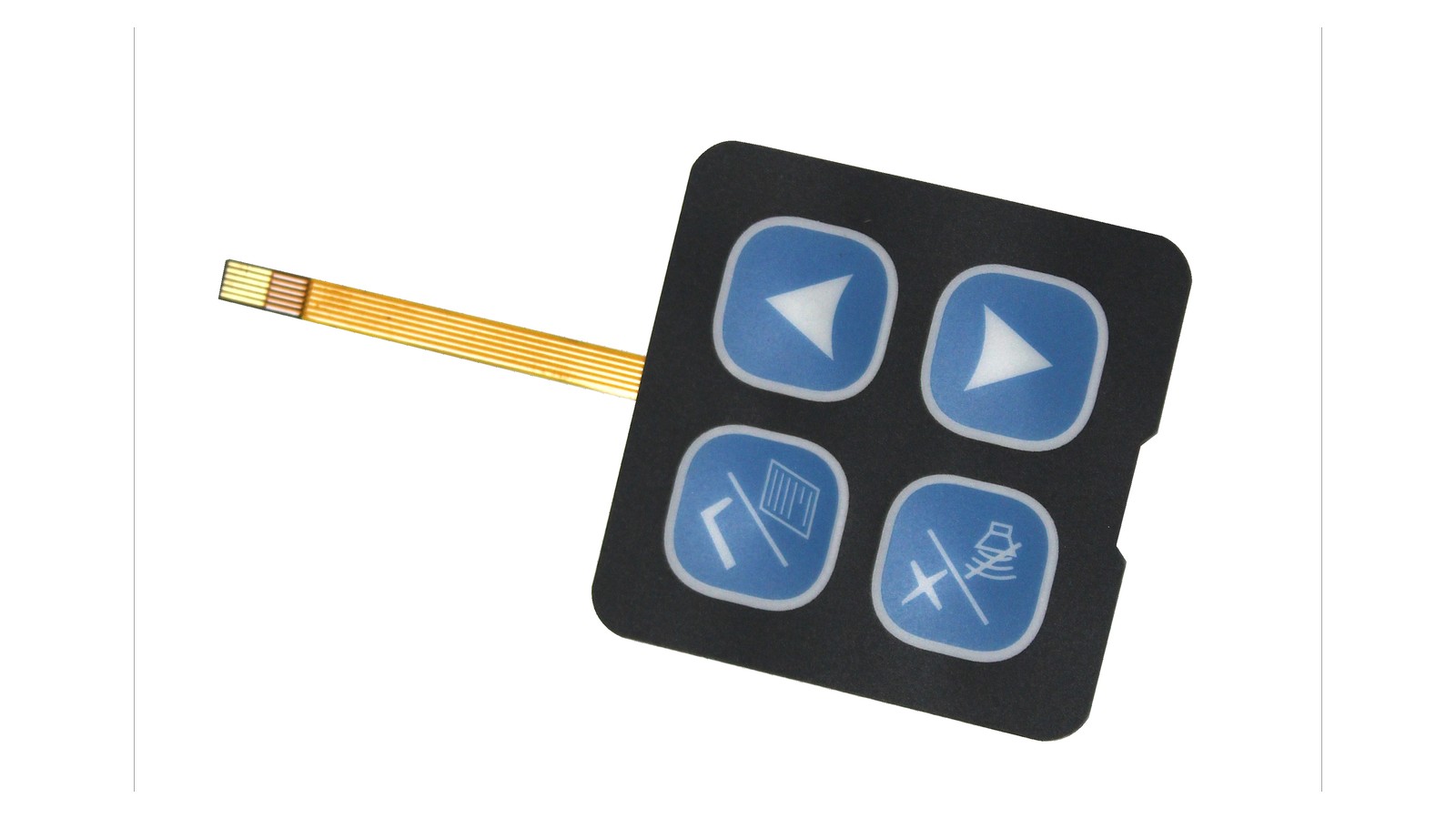
Compact robot housings create a simple failure pattern: the keypad looks correct on the front panel, but the flexible tail is folded too sharply, pulled sideways during service, or forced into a ZIF connector with poor access. For an FPC membrane switch, the first design review should follow the tail from the key area to the PCB, not only the visible artwork.
This matters for service robots, AMRs, compact medical equipment and handheld controllers because the housing may leave only a narrow path for the tail, stiffener and connector. The International Federation of Robotics describes transportation and logistics as a major professional service-robot application area in its World Robotics 2025 service-robot release. More compact equipment means more panels where a small routing mistake can become a repeat assembly issue.
Baoshengda's FPC membrane switch manufacturing page is the right starting point when a project needs a thin keypad, flexible circuit tail, ZIF connector review and housing-fit discussion before samples.
Failure mode 1: the bend starts at the wrong place
A flexible tail should not be treated as an unlimited hinge. A common failure begins when the housing edge, adhesive border or rear support plate forces the tail to bend immediately beside the active keypad area or beside the stiffener. The first sample may still pass a bench continuity test, but the same tail can crease during final assembly or after repeated service access.
Review these dimensions on the drawing before sampling:
- distance from the last circuit trace to the first bend area;
- available radius at the housing exit, not only the flat drawing radius;
- clearance between the tail and screw posts, ribs, battery covers or PCB brackets;
- whether the tail is bent once during assembly or flexed again during maintenance;
- whether the adhesive border supports the keypad without locking the tail into a sharp fold.
The product-specific detail is the relationship between the FPC copper trace path and the stiffener. If the stiffener ends exactly where the housing asks the tail to turn, the copper can see concentrated stress at the stiffener edge. Ask for a sample layout that shows the stiffener length and the planned first bend zone together.
Failure mode 2: the ZIF connector is correct but hard to assemble
A ZIF connector can match the pitch, pin count and contact side on paper while still causing field problems. The operator may need tweezers to insert the tail, the latch may face the wrong direction, or the stiffener may be too short for repeatable insertion. In compact robot panels, this often happens when the PCB is placed for electronics convenience rather than assembly access.
Before approving the connector choice, check the actual insertion path. The housing should allow a straight approach into the connector, enough finger or tool space to close the latch, and enough tail length to avoid tension after the panel is mounted. If the tail has to twist before insertion, confirm which side carries contacts and whether the twist changes the keypad orientation during installation.
A useful RFQ note is simple: provide the connector model, contact side, pitch, insertion depth and preferred stiffener thickness. If those details are missing, the supplier can quote a part that fits the artwork but not the assembly process.
Failure mode 3: the keypad floats because the rear support is missing
Compact robots often combine a small front keypad with a curved or ribbed plastic housing. If the rear of the membrane switch is not supported, pressing the key can flex the whole keypad instead of closing the dome or circuit cleanly. The buyer may describe this as weak tactile feel, double triggering, delayed response or uneven button force.
The support issue is different from artwork tolerance. The drawing should show whether each key sits over a flat backing surface, an adhesive land, a rubber spacer, a PCB standoff or an air gap. For a four-key FPC keypad, even a small unsupported corner can change the feel between the top and bottom keys.
Ask the supplier to review the sample in the real housing or in a printed fixture with the same rear support. A loose desktop sample can hide the problem because the operator presses against a flat bench instead of the final enclosure.
Failure mode 4: strain relief is added after the problem appears
Tail strain relief should be part of the first RFQ package, not a late repair. A narrow tail routed through a moving service door, a removable cover or a vibration-prone robot module needs a defined hold-down point. Without it, the ZIF connector and the stiffener edge absorb cable movement.
Possible strain-relief options include a wider adhesive tab, a clamp area inside the housing, a service loop with controlled bend radius, or a revised tail exit that avoids a screw boss. The correct option depends on the space available and how often the panel is opened. Avoid asking for a thicker tail as a universal fix. Extra thickness may improve handling, but it can also reduce flexibility or make the connector stack too tall.
What to send for a cleaner FPC membrane switch quote
Send enough evidence for the supplier to check the mechanical path, not just the front artwork. A practical RFQ package should include:
- front-panel artwork with key size, window position and embossing notes;
- 2D drawing or 3D housing view showing the tail exit, ribs, screw posts and PCB position;
- connector model, pitch, contact side, pin count and latch direction;
- required tail length, stiffener length and preferred insertion direction;
- expected assembly steps, including whether the panel is serviced after installation;
- operating environment, cleaning method, vibration or movement concerns;
- sample quantity, production quantity and any test fixture requirement.
If a robot panel is still early in design, share the housing constraints first. It is easier to adjust the tail route before the PCB, enclosure and adhesive stack are frozen.
Sample review before repeat production
When the first FPC membrane switch sample arrives, do not stop at appearance, key feel and continuity. Install it into the real or representative housing. Then open and close the service path as an operator would, confirm connector insertion, check whether the tail rubs against plastic edges, and look for any sharp bend near the stiffener.
The pass condition should be practical: the keypad sits flat, the tail has a controlled path, the connector can be assembled without force, and the rear support gives consistent response across the keys. If one of those conditions fails, revise the mechanical route before mass production instead of asking the production line to compensate.
For compact HMI projects that need this review, send the drawings and housing constraints through the Request Quote page. Include photos of the inside housing if the tail route is already limited.
Need help reviewing a structure?
Send your drawing, photos, application, and quantity. Baoshengda can help check the structure before sampling.
Send Drawing for Quote