
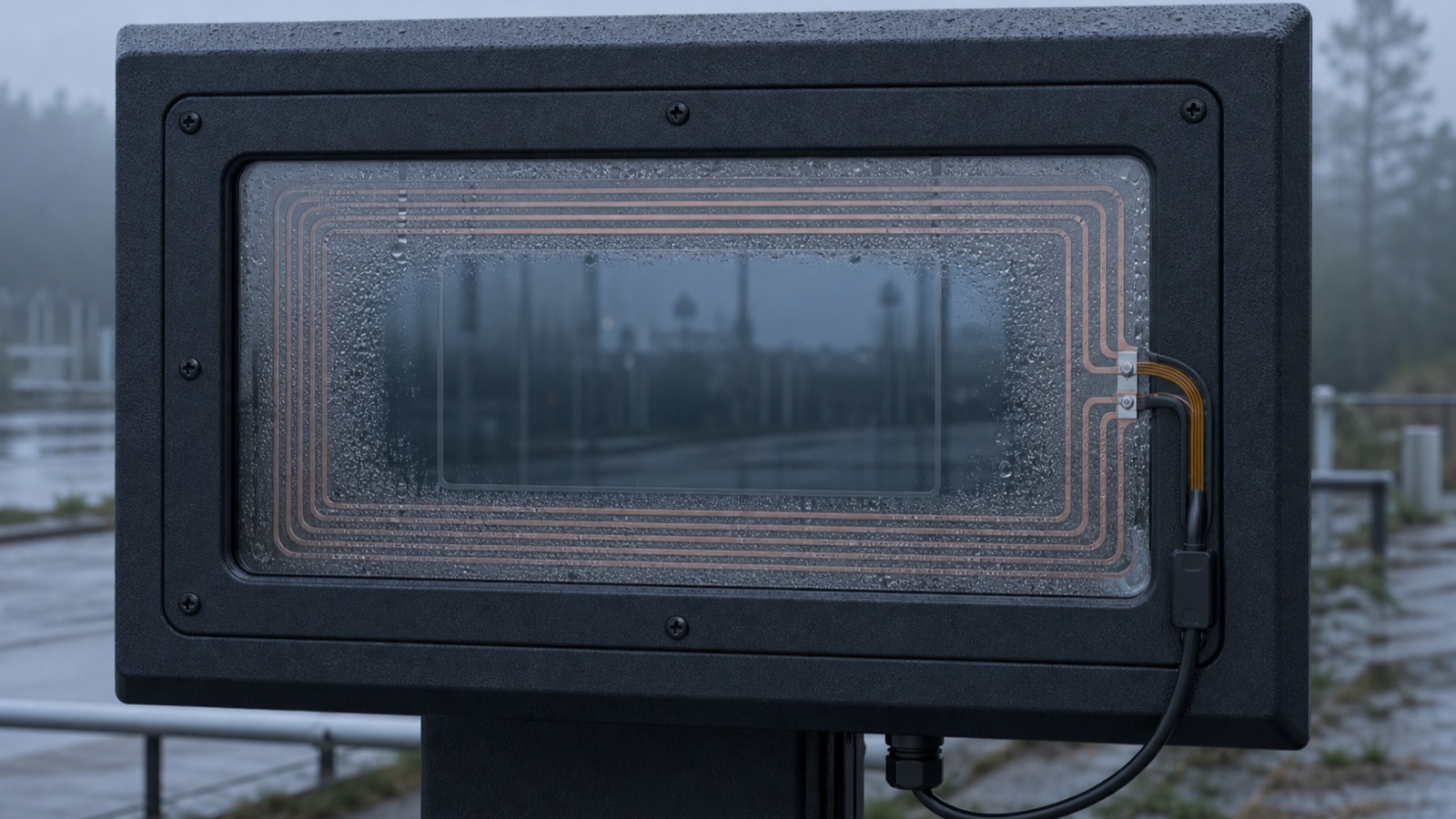
Quick answer: if your equipment has to clear a viewing window quickly at the start of a humid shift, do not approve a flexible heating film by resistance value alone. The checks that matter are where condensation stays longest, how evenly the border clears, what power budget is actually available during startup, and whether the heater tail, adhesive stack, and sensor logic still work after the film is installed on the real enclosure. If your project needs a custom heater layer instead of a generic warming pad, the flexible heating film page is the closest product reference.
Why this buyer question is current
On June 24, 2026, the Houston point forecast kept another hot and humid pattern in view, and the National Hurricane Center tropical weather outlook kept daily moisture and storm-season monitoring active. For buyers of outdoor meters, service terminals, utility cabinets, inspection windows, and camera housings, that is a practical reminder: the first failed moment is often not all-day operation. It is the first shift, when humid air and a cooler window meet before the housing has stabilized.
That is why the buyer question should be narrower than “does the film heat up.” The real question is whether the window becomes readable fast enough at startup, without leaving a wet border or overheating the surrounding structure.
The buyer problem is usually edge fog, not total heater failure
Many anti-fog samples pass a simple bench check because the center area warms up. The complaint comes later when the operator still cannot read the edge of the window, scan a code, or trust a camera view.
Common first-shift failure modes are:
- The center clears first but a cold border stays hazy for too long.
- Condensation returns at the lower edge after a short power-off cycle.
- The heater path clears the visible area unevenly because the busbar or tail steals heat from one side.
- Adhesive thickness or an air gap slows heat transfer more than the electrical design expected.
- The startup current needed for fast clearing is higher than the real control board can spare.
A sample that only proves “the film gets warm” does not answer any of those points.
Define the recovery target before you choose watt density
For first-shift equipment, the most useful RFQ input is a recovery target, not a generic request for anti-fog film.
Confirm:
- What must become readable first: full window, center area, camera zone, code area, or only a status band.
- How quickly the operator needs usable visibility after power-on.
- Whether the product starts outdoors, in a shaded cabinet, or after overnight cooling.
- Whether partial edge haze is acceptable for a short period or not acceptable at all.
- Whether the heater runs only at startup or must hold the clear state through repeated humidity swings.
This changes the design conversation. A buyer who asks for a two-minute readable center area may get a different layout from a buyer who needs the full border clear before a scan or inspection cycle can begin.
Layout details that decide border clearing
For condensation recovery, the outer path often matters more than the center path.
Check these structure points before approving the sample:
- Heater coverage relative to the true visible area, including the corners where fog tends to linger.
- Busbar width and entry point so one side does not become the warm side and the opposite side the slow side.
- Tail exit position and bend radius so the connection area does not force a cold keep-out zone into the wrong corner.
- Adhesive and insulation layers between the heater and the window, because thick stack-up slows recovery.
- Mounting pressure and flatness across the enclosure, especially if the window sits in a recessed bezel.
- Sensor location if the control logic uses an NTC or thermostat, because a badly placed sensor can report “warm enough” before the visible border is actually clear.
One common mistake is placing the sensing point near the easiest warm area instead of near the slowest clearing edge.
Startup power budget can reject an otherwise good heater pattern
A heating film that clears fast on a bench supply can still fail in the real product if startup power is limited.
Buyers should confirm:
- Available voltage during cold start.
- Current limit the board can spare when other loads wake up.
- Whether the film needs a short startup boost or only steady holding power.
- Highest allowed surface temperature for the lens, bezel, nearby adhesive, or user-touch zone.
- Whether the unit may cycle on and off many times during a shift.
This is where projects drift. The window team may ask for faster clearing while the electronics team assumes a lower startup load. If those numbers are not aligned before sampling, the first article review becomes misleading.
Sample tests that match the real first-shift condition
Do not approve the sample after a dry-room power photo.
A better check is:
- Mount the heater into the real housing or a close mechanical mockup.
- Start from a condensation-prone condition, not from a warm dry bench.
- Record time to usable visibility and time to full border clearing separately.
- Inspect whether the lower edge or cable-side corner stays wet longer than the rest.
- Check the hottest practical surface point after the clear state is reached.
- Run a short power-off and restart cycle to see whether recovery stays consistent.
- Reinspect the tail, connector, and adhesive edge after the installed sample has heated and cooled.
That sequence usually exposes whether the project is limited by layout, stack-up, or power control.
RFQ checklist for first-shift condensation recovery projects
Send these items before asking for quotation or the next sample:
- Window drawing with visible area, border width, and fog-prone zones marked.
- Section view or photo showing the window material, bezel depth, and heater position in the stack.
- Voltage, current limit, and whether startup boost control is available.
- Recovery target such as time to readable center area and time to fully clear border.
- Maximum allowed surface temperature near the user or nearby parts.
- Tail direction, connector requirement, and bend limitations inside the enclosure.
- Whether the unit faces rain, washdown, overnight cooling, or frequent restart cycles.
- Any failure photo from the old sample, especially border fog, slow restart, or hot-spot complaints.
If your team is ready for review, send the package through the Request Quote form so the heater layout, startup load, and installed window stack can be checked together.
Final approval decision
For humid outdoor equipment, a flexible heating film should be approved only after the buyer confirms startup recovery target, border-clearing uniformity, real power budget, and installed tail or adhesive behavior. That review is usually cheaper than discovering in field trials that the center clears on time while the edge the operator actually needs is still fogged.
Need help reviewing a structure?
Send your drawing, photos, application, and quantity. Baoshengda can help check the structure before sampling.
Send Drawing for Quote