
Approve an electroluminescent (EL) backlit keypad with its driver and switch-contact mapping identified. Record the lighting and contact results separately, then inspect the embossed symbols in the assembled stack. An illuminated icon does not confirm that the intended contact closes; contact closure does not establish symbol readability or the absence of unwanted light. Name the sample revision and viewing conditions so the results can be compared.
What the patent actually describes
Baoshengda’s CN217822500U utility-model grant-announcement document, dated 2022-11-15, describes a mechanical membrane switch for vehicle use. Claim 1 places a backlight layer between two separator layers. Connected phosphor regions face the light-transmitting key symbols. An alternating electric field excites the phosphor material to emit light; description paragraphs [0028]–[0030] identify this as electroluminescence. This is an EL construction, not an LED arrangement or a passive light guide.
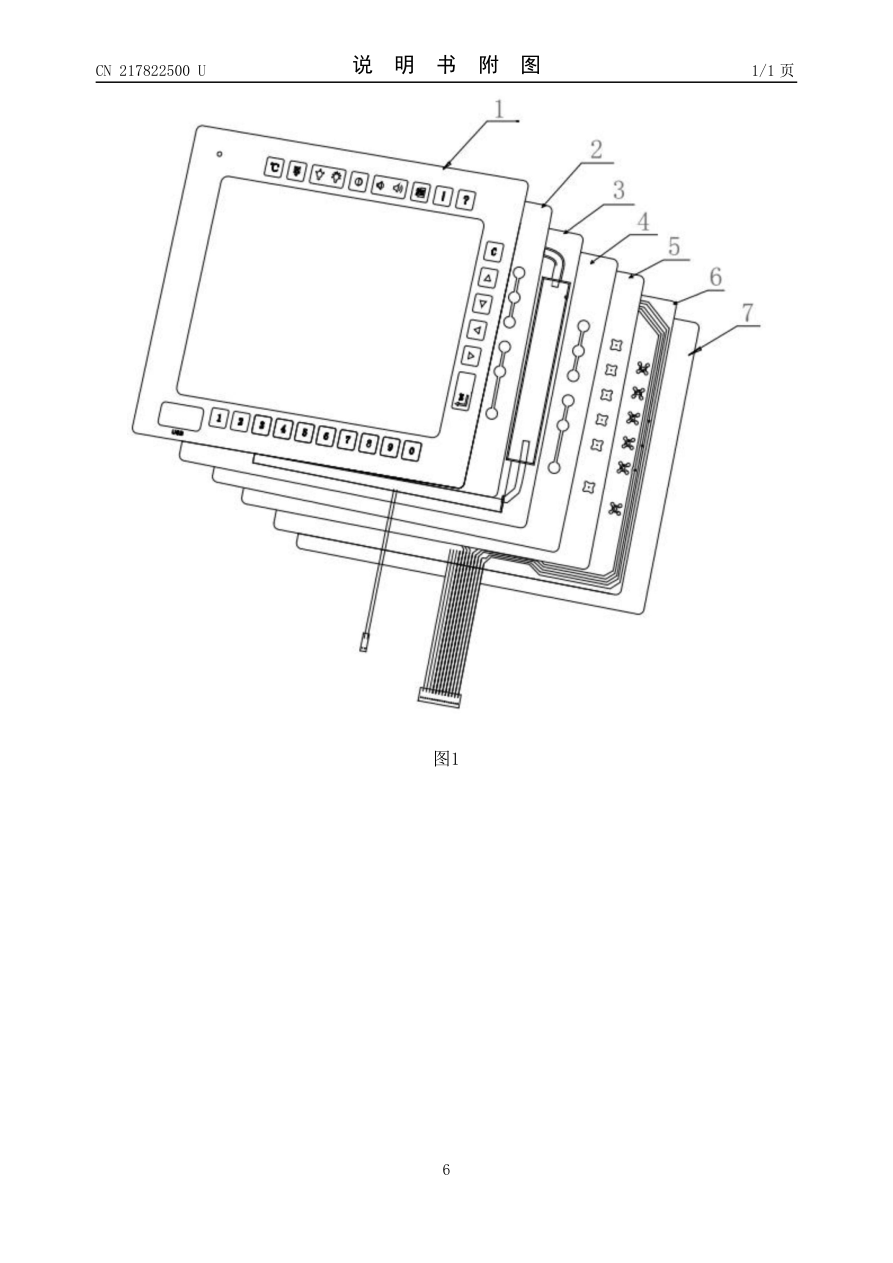
Claim 2 adds a dome layer corresponding to the key symbols; description paragraph [0031] identifies the domes as metal. Claims 7 and 8 specify a PC film panel and raised key regions. Figure 1 identifies the layers as panel (1), panel separator (2), backlight (3), circuit-panel separator (4), dome layer (5), circuit (6) and rear adhesive (7). The layer names above follow the document’s text.
The illustration is the original patent drawing, not a manufactured sample or an installed vehicle control. Open the original Figure 1 page at full size to read the small labels. It is an exploded construction view, not a dimensioned production drawing.
Put the EL drive interface in the sample request
The electrical review should name the intended EL driver and who supplies it. Record the proposed drive conditions and how the lighting is connected, switched and, if required, dimmed. Agree those conditions with the responsible electronics team rather than choosing a voltage or frequency from an unrelated panel.
The patent explains excitation by an AC electric field but does not provide a universal driver specification or a measured brightness curve. Use that description to define the lighting interface, then assess driver suitability for the intended equipment.
Keep the lighting connections and switch-contact mapping identifiable in the sample record. Do not infer the finished pin assignment, connector rating or electrical isolation from Figure 1. The equipment designer should define driver compatibility, electrical safety and electromagnetic-compatibility requirements for the actual assembly.
Inspect the symbols after embossing
Paragraph [0033], continuing onto the next description page, links the optical result to printing and forming. It describes transmitting ink at the symbols and calls for embossing without ink stretching or cracking, while preventing transmission outside the intended symbols.
For a buyer, that supports a specific comparison: inspect the same identified panel with the lighting off and on, under agreed viewing conditions. Look at the symbol strokes, the surrounding printed mask and the formed edges. Record any unwanted light near the raised area rather than accepting an overall photograph as proof that every symbol is satisfactory.
Use the intended housing or a defined representative support when reviewing the sample. Note the driver setting, viewing direction and ambient light with the photographs. These are proposed sample-review conditions, not tests or acceptance limits reported by the patent. Agree the allowed appearance with the buyer; a patent drawing supplies no brightness, color or uniformity threshold.
Retain evidence for lighting and key operation
Keep a record for each item below, tied to the identified sample and its conditions. These proposed checks are not a patent test report.
| Record | What to identify | What the record can establish |
|---|---|---|
| Lighting interface | Driver identity, agreed drive conditions and lighting connections | Which configuration produced the observed illumination |
| Switch contacts | Key-to-contact mapping, measurement method and sample revision | Whether each tested key produces the agreed electrical state |
| Printed and embossed symbols | Artwork revision, formed sample and lit/unlit observations | Where the tested sample transmits light or shows a print/forming defect |
| Mounted comparison | Housing or support, assembly condition and retained sample | Which installed condition was actually reviewed |
If a key lights but fails the contact check, keep those two observations separate while investigating. If the contact result is correct but the symbol shows a bright line at its formed edge, record that location and inspect the print and embossing condition. Neither symptom alone proves one cause. Retain the original observations before changing artwork, forming conditions or the electrical setup, then compare an identified revised sample under the same agreed conditions.
Start with the panel you need to review
The backlit membrane switch engineering page is the product route for discussing the illuminated panel stack. A first inquiry can include an existing photo or drawing if available, the intended use, an approximate quantity and the question that is still unresolved. There is no need to complete a production drawing before asking whether the proposed construction is worth reviewing.
As sampling progresses, identify the intended lighting driver, illuminated symbols, switch-contact map, panel support and the acceptance questions the sample must answer. Start a backlit-keypad sample-review inquiry with the information you already have, then agree which details are needed for the next step.
The 2022 document records a granted utility-model publication; its current legal status and current product implementation have not been verified here. It is not evidence of automotive qualification, approved brightness, lifetime or a completed customer test. Baoshengda can discuss the component construction and sample scope; the buyer’s equipment team remains responsible for the driver integration and final equipment validation.
Need help reviewing a structure?
Send your drawing, photos, application, and quantity. Baoshengda can help check the structure before sampling.
Send Drawing for Quote