
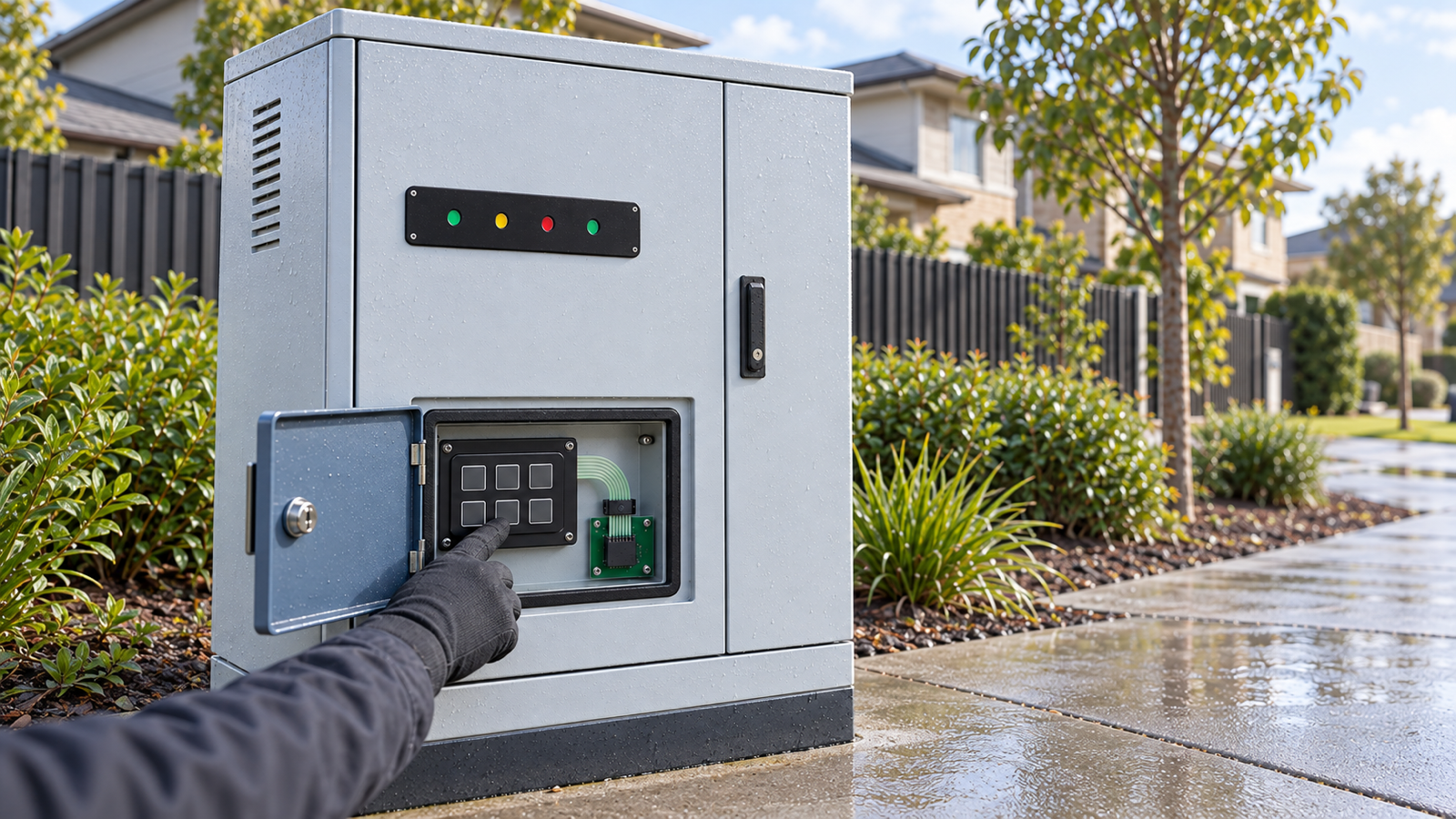
For most community battery cabinets, expose only the status information that an unauthorised passer-by is allowed to see and keep reset, override, mode and maintenance inputs behind controlled access. A passive outside strip can show agreed non-sensitive conditions; a recessed inner-door keypad can support authorised service. Use both only after the function-access matrix, environmental exposure, housing support, sealing, tail route and evidence owners are separated. Do not ask one panel sample to prove public-access policy, battery control logic or cabinet safety. The quotation should identify two physical interfaces, their permitted actions and the loose, mounted and complete-system checks owned by different parties.
Community deployment makes control placement a practical question
The Australian Renewable Energy Agency reported the installation of the 100th community battery under its funding initiative on September 2, 2026. The same update announced support for three further projects covering 47 community batteries and described the program as building real-world evidence about planning, delivery and operation.
That is useful context for cabinet teams because neighbourhood-scale equipment may sit closer to public routes than a restricted utility enclosure. It does not, however, prescribe a control panel. The ARENA notice does not identify a keypad, report an interface fault, name Baoshengda or establish a supplier relationship. The system integrator must decide what anyone may see, what only authorised service staff may operate and what should not be implemented as a local membrane input at all.
The component decision begins after that authority map exists. A thin status overlay or membrane keypad can provide a durable physical interface, but its location changes the environmental exposure, misuse risk, mounting stack and sample evidence.
Put each function where its user is authorised to act
Start with a function-access matrix, not with panel artwork. List every proposed indication and input, then name the permitted user, the intended consequence and the system owner. A public status surface may need to show only a small set of non-sensitive conditions. It should not inherit service commands simply because the artwork has room for more keys.
The protected interface is different. An authorised technician may need local navigation, acknowledgement, test selection or other service actions defined by the equipment owner. Those inputs belong behind the agreed access boundary unless the cabinet hazard analysis and operating procedure say otherwise. A physical lock is not proof that the function is safe; it is only one part of controlled access.
Emergency isolation, protection, charge and discharge authority, remote dispatch and firmware recovery should not be assigned to the membrane-panel supplier. Some functions may require dedicated devices, interlocks or system-level controls rather than a printed keypad. Keep those decisions in the complete-cabinet design and its applicable approval process.
Choose one of three physical interface patterns
Outside status only is the simplest public-facing arrangement. Use it when operators or the community need local visibility but have no reason to enter commands. A sealed graphic surface can carry blank windows, light apertures or approved legends. The equipment team still owns the meaning, brightness, alarm hierarchy and information policy behind those windows.
Protected service keypad only fits cabinets where all meaningful status is available remotely or only during authorised access. The keypad can sit behind the main door or a smaller lockable hatch. This reduces casual interaction, but it does not eliminate moisture brought in during service, condensation, glove-use limits, poor support behind keys or tail damage during repeated opening.
A split outside-and-inside arrangement fits designs that need simple public or field status plus separate maintenance inputs. Treat the two surfaces as different parts even if they share colors or materials. Their light paths, edge lands, adhesives, support plates, tails, connectors and inspection methods may differ. Do not copy one drawing and merely delete the keys.
Compare exposure, access and evidence before drawing release
| Decision item | Outside passive status surface | Protected service keypad | Buyer action before quotation |
|---|---|---|---|
| Intended user | Public observer, site operator or drive-by inspection | Authorised technician under the equipment owner's procedure | Name each role and prohibit ambiguous shared functions |
| Allowed action | Observation only | Defined local service inputs | Supply the function-access matrix and input consequence owner |
| Environmental load | Rain, sun, dust, cleaning and impact exposure as defined by the cabinet team | Door-open moisture, condensation, gloves, tools and repeated service access | State separate exposure and cleaning conditions for each location |
| Mechanical support | Exterior door flatness, window stack, adhesive or gasket land | Recess wall, back support, hatch gasket and press deflection | Provide door and hatch sections with datums and support features |
| Optical evidence | Window registration, surface finish and legibility under agreed lighting | Indicator visibility during service if any | Separate component-window checks from light-source and software-state checks |
| Interconnect | Tail route protected from the exposed door cycle or a passive overlay without a circuit | Tail bend, strain relief, connector and hatch-opening cycle | Freeze tail exit, bend keepout, contact side, pin map and mating reference |
| Approval boundary | Component dimensions, artwork and mounted seating | Component dimensions, keys, circuit, tail, connector and mounted operation | Reserve system behavior, safety and environmental claims for complete-cabinet evidence |
The table prevents two common quotation errors. The first is pricing an outside keypad before anyone has decided whether the public may operate it. The second is calling an inside panel protected without showing how service access, water transfer, gasket compression and the tail route actually work.
Mounting details can reverse a good placement decision
An outside status surface needs a controlled viewing area and continuous support. Show the finished door opening, window border, adhesive land or gasket, edge distance and any step in the metalwork. If status comes from separate LEDs or a display, define the optical gap and alignment stack. The panel supplier can hold the overlay window geometry; the equipment team must verify brightness, color meaning, software state and viewing performance in the assembled cabinet.
For the protected keypad, show the exact support behind every active key. A key over a recess, cable pocket or uneven bracket can feel different from the same switch on a flat test plate. Define the permitted press area, tactile or electrical acceptance method, glove condition and mounting pressure. Review the result after the panel is installed, not only as a loose sample.
Tail routing deserves its own section drawing. Record the exit position, length, first-bend keepout, conductor count, pitch, contact side, exposed-contact length, stiffener and mating connector. Then model the hatch or door through its service motion. The tail must not rub a sharp edge, tighten at full opening or become the only restraint on the connector. A small change to hinge side or service clearance can make a previously acceptable tail unusable.
Approve two interfaces through staged evidence
Use a loose component review first. For the outside surface, check the controlled outline, print, window and surface finish. For the service keypad, add key zones, circuit mapping, tail and connector. This stage finds drawing and manufacturing errors but says nothing about the final cabinet.
The mounted review is where placement becomes credible. Bond or gasket the outside surface to production-intent metalwork and inspect the full edge, window alignment and optical stack. Install the service keypad in its actual recess, close and reopen the hatch, press every key using the agreed glove condition and inspect the tail at all service positions. Record which party owns each result.
Complete-system review remains separate. The cabinet owner must verify displayed states, input consequences, access procedures, electrical safety, environmental performance, cybersecurity, emergency response and applicable compliance. A responsive keypad cannot prove those outcomes. A sealed component also cannot establish the ingress performance of the entire door, hatch or cabinet.
Supplier boundary and RFQ handoff
A membrane-interface supplier can review buyer-supplied panel outlines, window and key datums, artwork, adhesive or gasket land, circuit mapping, tail exit, connector details and staged sample requirements. Baoshengda can discuss a custom HMI panel solution for separately defined outside and protected cabinet interfaces after the equipment team has assigned the functions and access roles.
The supplier does not determine battery-management logic, charge or discharge authority, public-access policy, emergency functions, lockout procedures, electrical protection, cybersecurity, firmware compatibility, whole-cabinet ingress performance, regulatory compliance or permission to operate the installed system. These remain with the cabinet manufacturer, system integrator and other qualified owners.
Prepare this compact drawing, sample and RFQ package:
- cabinet model and each interface location, with controlled front and section drawings;
- function-access matrix separating status-only, service input and non-panel system functions;
- outside exposure, cleaning, viewing and optical-window requirements;
- protected hatch, gasket, support, glove-use and service-opening conditions;
- panel outline, key zones, window datums, artwork files and revision identifiers;
- circuit matrix, tail exit, length, bend keepout, conductor count and contact side;
- mating connector reference, pin map and strain-relief arrangement;
- loose, mounted and complete-system sample stages with acceptance owner and method;
- model variants, prototype and production quantities, destination and required timing.
If those inputs are available, send them through Request a Quote. The first useful output should be a clarified evidence and drawing list, not an unsupported promise about the finished battery cabinet.
Need help reviewing a structure?
Send your drawing, photos, application, and quantity. Baoshengda can help check the structure before sampling.
Send Drawing for Quote