
Use mounting or housing datums, not printed artwork alone, to control a CNC operator-panel FPC tail during a supplier handoff. Artwork can locate legends and visible key zones, but it may shift within the panel outline and does not define the installed connector position. A useful enquiry can begin with an authorized old sample, front/rear/edge photographs, the housing opening, tail direction and machine revision. Quotation assumptions should stay visible. Samples should be checked in the real mounting frame for tail exit, bend and connector reach. Production release needs one controlled mechanical datum scheme linked to artwork, circuit, stack-up and an approved mounted sample.
Why artwork is the wrong primary datum for a tail
A CNC operator panel can look simple from the front: a printed face, key zones and perhaps a display window. Behind that face, however, the flexible tail must leave the panel at a specific edge, clear the frame, bend without being pinched and reach a connector in the correct orientation. That path belongs to the mechanical installation, not to the printed legend pattern.
Artwork may include trim, bleed and print-registration tolerances. A replacement supplier can reproduce the visible graphic closely while locating the tail from a different origin. If the tail centerline is referenced only to a printed key or color boundary, ordinary print registration can become an unintended mechanical tolerance. The panel may then fit the cutout while the tail touches a sharp edge, misses the connector or requires a forced fold.
Select a stable housing edge, locating hole, mounting pin or controlled panel outline as the mechanical datum. Dimension the tail centerline, exit width and connector orientation from that feature. The artwork can still be related to the same datum structure, but it should not silently govern the hidden integration path.
Use current machine-tool integration as context, not component proof
A September 15 Siemens announcement about its Meet at the Machine initiative describes a connected workflow spanning engineering, programming, virtual validation and machine execution. It also describes preparing production while a machine is still being built. That is useful current context for a supplier-handoff lesson: interface decisions are cheaper to resolve in controlled drawings and samples than after the panel reaches final assembly.
The Siemens release does not identify Baoshengda, disclose an operator-panel membrane switch or establish a supply relationship. It cannot prove that any Siemens or TRAK panel uses the construction discussed here. The article therefore uses the source only to explain why pre-delivery interface control matters; the tail-datum guidance below is a general component-sourcing method.
Freeze three decisions before requesting a production quote
The first decision is the mechanical origin. Name the primary datum and its hierarchy: for example, the left and bottom housing edges, two mounting holes or a frame locating pin. Identify whether the panel outline itself is controlled tightly enough to be a datum after assembly.
The second decision is the tail path. Define exit edge, centerline, exposed length, stiffener length, keep-out zone and allowable bend direction. A nominal tail length without the installed path can be misleading. The routing must account for the frame thickness, adhesive boundary, service access and the connector's fixed position.
The third decision is the connector interface. Record connector family, contact count, pitch, pin-one convention, mating direction and allowed strain relief. A drawing that shows a black rectangle at the tail end does not release an electrical interface.
| Handoff decision | Evidence to provide | Supplier sample check | Owner-side release responsibility |
|---|---|---|---|
| Mechanical datum | Housing/frame drawing, locating holes or authorized mounting sample | Locate panel outline and tail centerline from the named datum | Confirm housing tolerances and assembly sequence |
| Tail exit and bend | Rear photo, exit width, keep-out and connector location | Install without edge contact, twist or forced fold | Approve final routing and service clearance |
| Connector and pinout | Connector identity, contact count, orientation and circuit map | Verify physical orientation, reach and key-to-contact mapping | Approve control logic and equipment interface |
| Artwork registration | Controlled artwork and visible-window/key-zone dimensions | Compare graphic registration after mounting | Approve legends, language, symbols and licensed content |
Separate enquiry inputs from quotation assumptions
An initial enquiry does not need a complete production package. Start with front, rear and edge photographs; an authorized old sample if available; housing-opening dimensions; the tail exit direction; the installed connector location; machine and panel revision; sample quantity; expected order quantity; and the reason for changing supplier. Mask customer-confidential legends or identifiers when they are not required for technical review.
Ask the supplier to return an assumption list with the quotation. It should say whether the scope is overlay-only or a complete membrane switch/FPC assembly, which dimensions are measured versus released, and which film, adhesive, stack-up, tail, stiffener and connector details remain provisional. Price and lead time cannot be fixed responsibly before construction, quantity and release evidence are known.
Baoshengda can review authorized samples and drawings, identify missing component inputs, propose a sample plan and manufacture to an approved component specification. The component supplier does not own CNC control logic, machine safety validation, licensed artwork, the housing tolerance stack or the final equipment release.
Check samples loose and in the mounting frame
A loose sample is useful for confirming outer dimensions, visual registration, tail construction, connector orientation and basic key-to-contact mapping. It cannot show whether the tail is pinched by the frame or reaches the installed connector without stress.
Mount the sample in a representative frame, backing plate or controlled mockup. Use the released datum to measure the tail exit rather than measuring from a printed key. Confirm that the full panel seats without distortion, the adhesive boundary does not overlap a moving or unsupported area, and the tail clears the cut edge. Route the tail to the actual or controlled mating location and check that it does not twist, fold sharply or carry connector load.
Record which checks were completed. A blank caliper display, a fixture light or a photograph cannot substitute for a released result. If a prototype uses hand-cut film, provisional adhesive or a temporary connector, mark those differences so they do not become accidental production standards.
Release one connected component package
Production release should connect the visible face to the hidden interface. Keep these items under revision control:
- mechanical drawing with datum hierarchy, outer profile, holes, windows and tail-exit dimensions;
- controlled artwork aligned to the mechanical datum scheme;
- circuit map, pinout and connector specification;
- layer stack, film, printing, spacer, adhesive, shielding and stiffener requirements;
- tail length, exit width, keep-out area, bend direction and strain-relief requirements;
- component inspection coverage, fixture revision and acceptance method;
- mounted approved sample, revision identity and change-notification rules.
Retain an approved sample only after it is linked to the drawing and circuit revision. For service spares, define how labels, packaging and stock segregation prevent a tail layout for one machine revision from entering another.
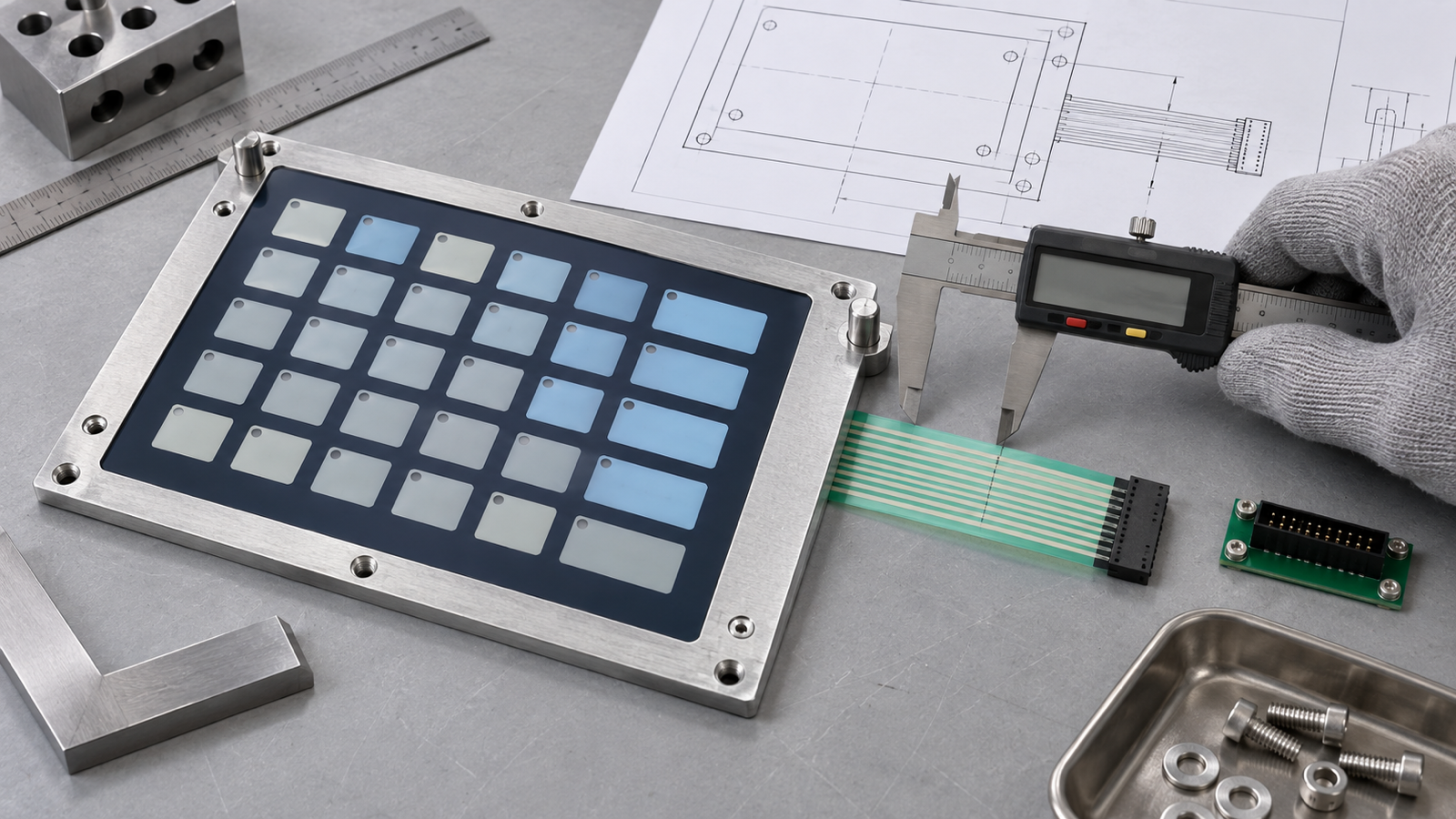
The generated cover illustrates a generic datum inspection of an unbranded membrane keypad and complete FPC tail on an engineering bench. It is not a customer factory photograph, dimensional result, compatibility test or CNC safety approval.
Review FPC membrane switch construction and integration options before freezing the replacement scope. Then send the authorized panel, housing and tail evidence for a supplier-handoff review and ask the response to separate quotation assumptions, sample checks and production-release requirements.
Need help reviewing a structure?
Send your drawing, photos, application, and quantity. Baoshengda can help check the structure before sampling.
Send Drawing for Quote