
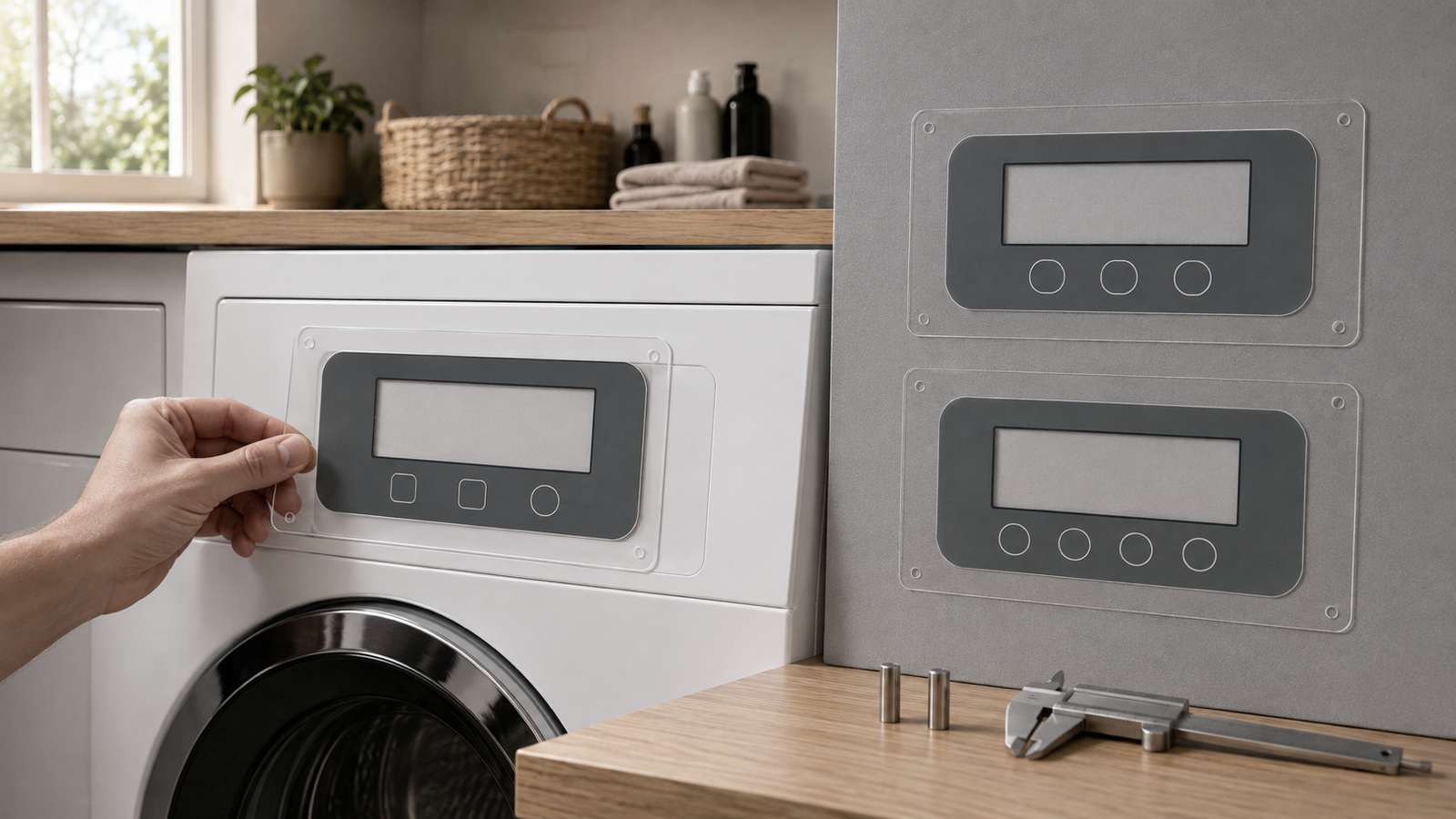
For a built-in appliance family, reuse one control-overlay artwork only when the physical control map, display window, symbols, language, indicator meanings and user sequence are genuinely identical. A shared fascia width or matching appliance styling is not enough. In most washer, dryer and dishwasher families, the safer sourcing decision is a controlled variant family: commonize the outer envelope, material stack, display-window datum, edge land and mounting method, but release separate artwork when functions or market requirements change. Approve one master mechanical sample, then approve each printed variant against its own light map and installed operating sequence before production.
A current built-in appliance expansion creates a variant-control question
A September 2 LG Electronics IFA release about its expanded Fit & Max appliance range says the built-in-style design, first applied to selected refrigerators, now spans washing machines, dryers and dishwashers. That is useful market context because a broader visual family often creates pressure to standardize front-panel components.
The release does not describe a Baoshengda graphic overlay, specify an overlay material or printing process, or identify Baoshengda as a supplier. It also does not prove that the cited appliances share a control-panel construction. The durable engineering question is narrower: when several appliance variants share a housing language, which overlay features may be common and which must remain variant controlled?
This matters before quotation. A common outer cutout can reduce tooling, fixture and inventory complexity. A falsely common artwork can place the wrong function over a key, expose a window that should remain hidden, use the wrong status color, or send a service replacement to the wrong appliance revision. At the other extreme, creating a separate unmanaged part number for every cosmetic change can fragment sampling and service stock. The buyer needs a deliberate split, not maximum commonality or maximum variation.
Commonize geometry first, not legends
Start with a commonization map. Put every overlay characteristic into one of three columns: shared, conditionally shared or variant specific. Do this before sending artwork for price comparison.
The strongest candidates for commonization are normally mechanical. They include the outer outline, corner radii, display-window datum, attachment holes, housing reference edge, perimeter adhesive land and the general material thickness. These items can remain common only if the underlying fascia, display and support surfaces are identical within the agreed tolerance.
Printing and optical behavior need a harder test. A button position may be mechanically shared but require a different legend. A status window may occupy the same datum but need a different mask, color or hidden-state requirement. A market-language change can alter text length and spacing. A washer and dryer may share a blank display aperture while using different program controls below it. Treat these as controlled artwork variants even if they use one die-cut envelope.
Do not use a common file name with informal notes such as “dryer version” or “EU text.” Give each released overlay a unique revision-controlled identity tied to the appliance model or approved option matrix.
Use a decision matrix for common and variant evidence
| Feature | Common candidate | Split the variant when | Approval evidence |
|---|---|---|---|
| Outer outline and corner radii | Housing cutout and support land are identical | Fascia step, gap or mounting datum changes | Housing drawing, overlay outline and fit sample |
| Display window | Display active area and viewing datum are identical | Window size, border, tint, dead-front mask or viewing angle changes | Display drawing, printed window sample and installed viewing check |
| Key or touch zones | Switch locations and active areas are identical | Function ownership, zone count, spacing or tactile construction changes | Function map, zone drawing and actuation sample |
| Legends and symbols | Same meaning, language and orientation | Appliance workflow, market language, regulatory mark or service instruction changes | Controlled artwork PDF plus native source and sign-off |
| Indicator windows | Same light source, position and meaning | Status color, brightness target, hidden state or lens stack changes | Light map, mask definition and powered fixture check |
| Material and finish | Same cleaning, abrasion and appearance requirements | Chemical, heat, gloss, texture or cosmetic target changes | Material identity, finish sample and agreed test method |
| Adhesive land | Same substrate, flatness and bond area | Housing material, recess depth, edge exposure or service removal changes | Bond-land drawing and mounted environmental sample |
The table prevents two common mistakes. First, teams assume a shared die-cut means the printed overlay is interchangeable. Second, teams create distinct artwork but fail to change the service part, package label or approval record. In both cases, the physical part can fit while the interface meaning is wrong.
Build a master sample plus controlled variants
Use a staged approval plan. The first sample should prove shared mechanics without creating false confidence in the final graphics. A transparent registration mask or neutral mechanical overlay can check the outer envelope, display window, corner clearance, datum holes and adhesive land across all intended fascias. Record the fit on each housing variant rather than testing only the flagship model.
Next, produce printed samples for every controlled artwork variant. Compare color, opacity, finish, legend placement, window border, hidden graphics and key-zone registration to the released file. A printed sample that looks correct on a light table can change when it sits over a dark housing, bright display or status LED. Review it installed.
Finally, run the appliance operating sequence with the correct controller and software revision. Press or touch every visible zone and confirm the appliance response and visible state. This system test remains the appliance manufacturer's responsibility, but it is the evidence that prevents a correctly printed overlay from being approved against the wrong function map.
Keep results separate:
1. mechanical fit and adhesive-land evidence for the common envelope;
2. print, optical and cosmetic evidence for each overlay variant;
3. installed function and state evidence for each appliance revision;
4. packaging and service-identification evidence for each released part number.
A failure in one layer should not be hidden by a general sample pass.
Control display windows, dead-front areas and cleaning exposure
Built-in appliances combine strong visual expectations with repeated household contact. Window borders must align with the real active area, not just the display glass outline. If a graphic is intended to remain hidden until illuminated, define the light source, viewing angle, ambient condition and acceptance method. Do not accept “dead front” as a color note without an installed sample.
Cleaning exposure also varies by product location. A laundry fascia may meet detergent residue and damp hands. A dishwasher control area may see kitchen soil, repeated wiping and heat near the door. The overlay supplier can review film, ink, coating and adhesive options against buyer-provided conditions, but the buyer must define the actual chemical list, temperature, wipe method, dwell time and acceptance limit. A material name alone does not prove whole-appliance cleaning performance.
For a custom graphic overlay with controlled windows, finish, adhesive lands and die-cut datums, quotation quality depends on the complete stack and the variant matrix. A product page can show manufacturing capability, but it cannot replace the model-specific artwork and fascia evidence.
Keep supplier scope and appliance responsibility explicit
A graphic-overlay supplier can review the overlay outline, substrate family, thickness, surface finish, ink system, transparent or tinted windows, dead-front masks, adhesive pattern, die cutting, embossing and agreed component-level inspection. It can manufacture separate revisions and maintain an approved sample or color reference when those controls are defined.
The supplier cannot decide which appliance function belongs under a key, approve firmware behavior, translate safety or regulatory language, certify the finished washer, dryer or dishwasher, or prove cleaning, heat and electrical safety for the complete appliance. It also cannot determine whether two housings are interchangeable from photographs. Those decisions require the buyer's controlled drawings, function map, market requirements and installed test evidence.
Assign owners in the approval record. Product engineering owns the function map and housing compatibility. Regulatory and localization owners approve required symbols and language. Industrial design approves appearance. The overlay supplier owns production to the released component drawing and agreed inspection plan. Service planning owns replacement identification and stock segregation.
Send a variant matrix with the drawing, sample request and RFQ
A useful quotation package should include:
- appliance models, markets and control revisions covered by the request;
- one variant matrix showing what is shared and what changes;
- controlled native artwork and a view-only PDF for every printed variant;
- outer outline, display active area, window datum, corner radii and attachment references;
- material, thickness, gloss or texture, color targets and permitted tolerances;
- legend, symbol, indicator and dead-front light maps by variant;
- housing material, recess depth, edge exposure and adhesive land;
- cleaning agents, temperature, humidity, abrasion and wipe conditions with test methods;
- sample stages for transparent mechanical fit, printed overlay and installed operation;
- packaging, label, service-part and change-control rules that prevent variant mixing;
- forecast quantity by variant, pilot quantity and production quantity range;
- acceptance owners and evidence required before production release.
Send the package through the Request Quote page. A supplier can then identify which features may share tooling or material, which artwork revisions need separate control, what samples are required and which appliance-level decisions remain with your team.
Need help reviewing a structure?
Send your drawing, photos, application, and quantity. Baoshengda can help check the structure before sampling.
Send Drawing for Quote