
Matching cold resistance is a useful incoming check, but it is not enough to release a replacement heating film for a battery energy storage cabinet. Two heaters can draw similar initial power yet warm the protected surface differently because their active area, printed pattern, bond layer or sensor position differs. Approve the substitute against the installed assembly: the same supply conditions, representative mounting plate, adhesive stack, temperature-measurement points and control behavior. Keep the old and new build records linked. If only resistance and an outline are available, quote a comparison-sample program rather than call the new part an interchangeable production spare.
Faster commissioning makes unapproved substitutions expensive
In its September 9, 2026 project announcement, FlexGen reported that SMT Houston IV had entered operation after a six-week commissioning phase. The announcement attributes the delivery approach to preconfigured and laboratory-tested systems followed by coordinated field commissioning. It is a deployment report, not a heating-film specification or a validation report for an individual cabinet component.
The useful procurement connection is the separation between proving a configuration and deploying it. A substitute part ordered late in a cabinet build can move unresolved engineering work into installation. For an auxiliary film heater, a purchase description such as “same size, same resistance” leaves the thermal interface outside the comparison. A cabinet may pass an electrical check while the replacement warms the wrong area or reaches a control limit differently.
That is a component-level inference from the integration approach, not a claim that the cited project uses these heaters. Neither the announcement nor this article establishes a Baoshengda supply relationship with the project. The decision below concerns a buyer-defined, low-voltage auxiliary heater on an enclosure surface, not battery-cell heating or complete battery-system qualification.
Separate the resistance screen from the thermal release
A resistance check answers a narrow question: does the electrical path fall inside its specified range at the stated measurement temperature? For a resistive load at a fixed voltage, initial power follows voltage squared divided by resistance. That relationship does not describe where the heat goes. Record the meter method, connector reference points and sample temperature so the old and new readings are comparable.
Now compare active heating area, not just the cut outline. The border may be unheated. Cutouts, busbars and local pattern spacing may put similar total power into different areas. A smaller active area can raise local heat loading even when total resistance matches. Resistance may also change with temperature, so a room-temperature match does not establish the same operating current or control cycle.
Do not infer the construction from a supplier's nominal wattage alone. Ask which drawing controls the pattern, insulation, lead junction and adhesive. A buyer considering a new carbon heating film for a bonded enclosure surface should keep those construction details linked to the comparison samples rather than treat them as interchangeable purchasing descriptions.
Reproduce the bond, the cold location and the sensor position
Use the same representative plate material, thickness, coating and support arrangement for both builds. Record the cleaned surface, adhesive type and bond thickness, application method and any specified dwell before testing. A loose heater on a bench is not an adequate reference for a heater bonded behind a metal service plate. An air pocket or lifted edge can change heat transfer without opening the circuit.
Agree on the locations that matter before energizing a sample in an approved test setup. These may include the protected cold area, the heater surface, the lead termination and the control sensor. The coldest useful point and the hottest limiting point are different acceptance questions. Measuring only beside the heater can hide poor heat delivery farther along the plate.
Control the initial temperature, airflow, supply range, time sequence and enclosure condition. Compare recovery time and temperature distribution under those conditions. Keep control-sensor position, attachment and controller settings unchanged unless the transfer explicitly includes their redesign. A moved sensor can make an unchanged heater look faster or cooler. Set acceptance limits with the cabinet design owner before the trial, rather than choosing them after seeing the result.
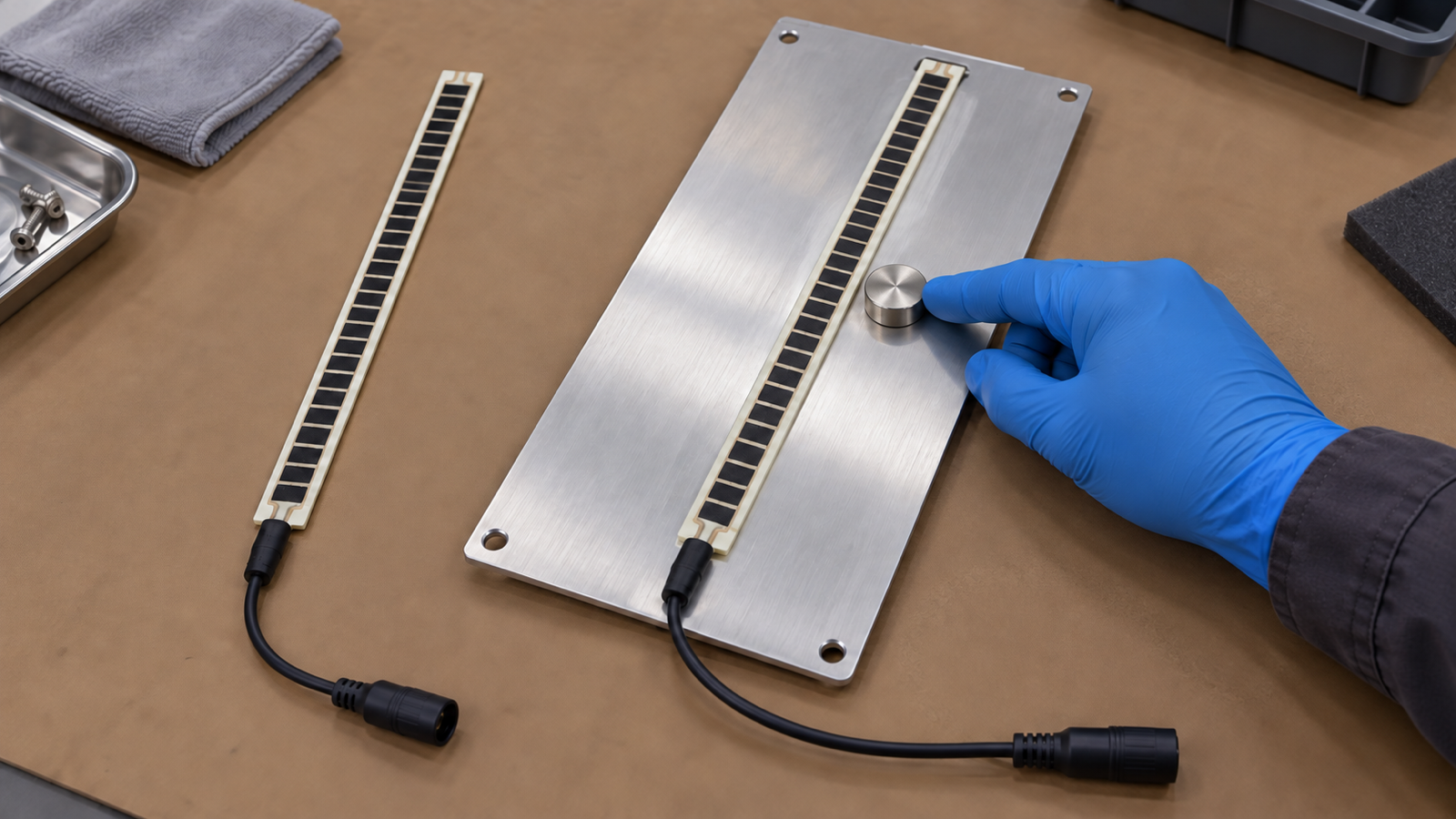
The cover is an unpowered engineering illustration of strip placement and a sensor-location mockup on a representative plate. It is not a thermal test, a temperature reading or evidence of field performance.
Use the mismatch to decide what happens next
The following table is a disposition guide, not a set of reported test results. It helps purchasing separate a correctable assembly difference from a part that needs a new design review.
| Comparison evidence | What it does and does not establish | Transfer decision |
|---|---|---|
| Cold resistance matches at the same stated temperature | Supports the electrical screen, not equivalent installed heating | Continue to the mounted comparison |
| Total input is similar but the protected surface warms more slowly | Heat may be distributed or transferred differently | Review active pattern, bond contact, plate and airflow before changing wattage |
| Heater surface is hotter while the plate remains cooler | A thermal-interface difference is possible; the readings alone do not identify its cause | Check bond thickness, voids and measurement locations |
| Control cutoff occurs earlier after a sensor move | The comparison setup has changed | Restore the agreed sensor position or qualify the new control arrangement separately |
| Temperature response matches but the lead exits into a pinch point | Thermal evidence does not establish service fit | Correct the lead route and repeat affected mechanical and electrical checks |
| Samples pass but the first production lot uses another adhesive or pattern revision | The approved build no longer represents production | Hold transfer release until the deviation is reviewed and evidence is updated |
Keep the approved sample connected to the first production lot
Supplier transfer is not complete when one pair of samples looks similar. Identify the reference sample and the proposed substitute by drawing revision, material stack, circuit or pattern revision, lead termination and manufacturing lot. Record permitted tolerances and agreed incoming checks without copying an undocumented limit from an old purchase order.
Define which changes require notification. Changing the laminate, adhesive, carbon pattern, busbar geometry, insulation or lead attachment can affect a different part of the evidence. The response need not always be a full repeat of every test, but the design owner needs a recorded impact decision. A commercial promise to provide an “equivalent” material is not that decision.
For the initial production lot, agree on traceability, sample retention and the verification method before placing the order. Keep an approved reference and its mounted test record available for comparison. If the original reference is damaged or its construction is unknown, state that limitation and qualify against buyer-defined requirements instead of claiming a proven like-for-like transfer.
Ask for a transfer comparison, not an unsupported equivalence claim
Baoshengda can review a custom carbon heating-film layout, power and resistance requirements, insulation and adhesive options, lead exit and a proposed component sample package. Final construction and feasible evidence need project review. The cabinet designer remains responsible for the supply and protection system, thermal controls, installation conditions, acceptable temperature limits and finished-equipment validation. A component quotation does not approve BESS safety or establish a complete thermal-management solution.
Send a compact transfer package with:
- the existing drawing revision, available reference sample and what is genuinely known about its build;
- film outline, active heated area, keep-outs, mounting plate and the complete bonding stack;
- voltage range, resistance measurement condition, power requirement and agreed temperature limits;
- control-sensor position and the comparison procedure, including initial condition and measurement locations;
- complete lead length, connector specification, insulation, strain relief and service access;
- proposed substitutions, comparison-sample quantity, first-lot quantity and release authority.
If the thermal comparison has not yet been defined, request a heater transfer review with the reference build and mounting details. Ask the quotation to separate component samples, agreed component checks and the cabinet-level work still needed. Release production only when the actual substitute and the approved evidence describe the same build.
Need help reviewing a structure?
Send your drawing, photos, application, and quantity. Baoshengda can help check the structure before sampling.
Send Drawing for Quote