
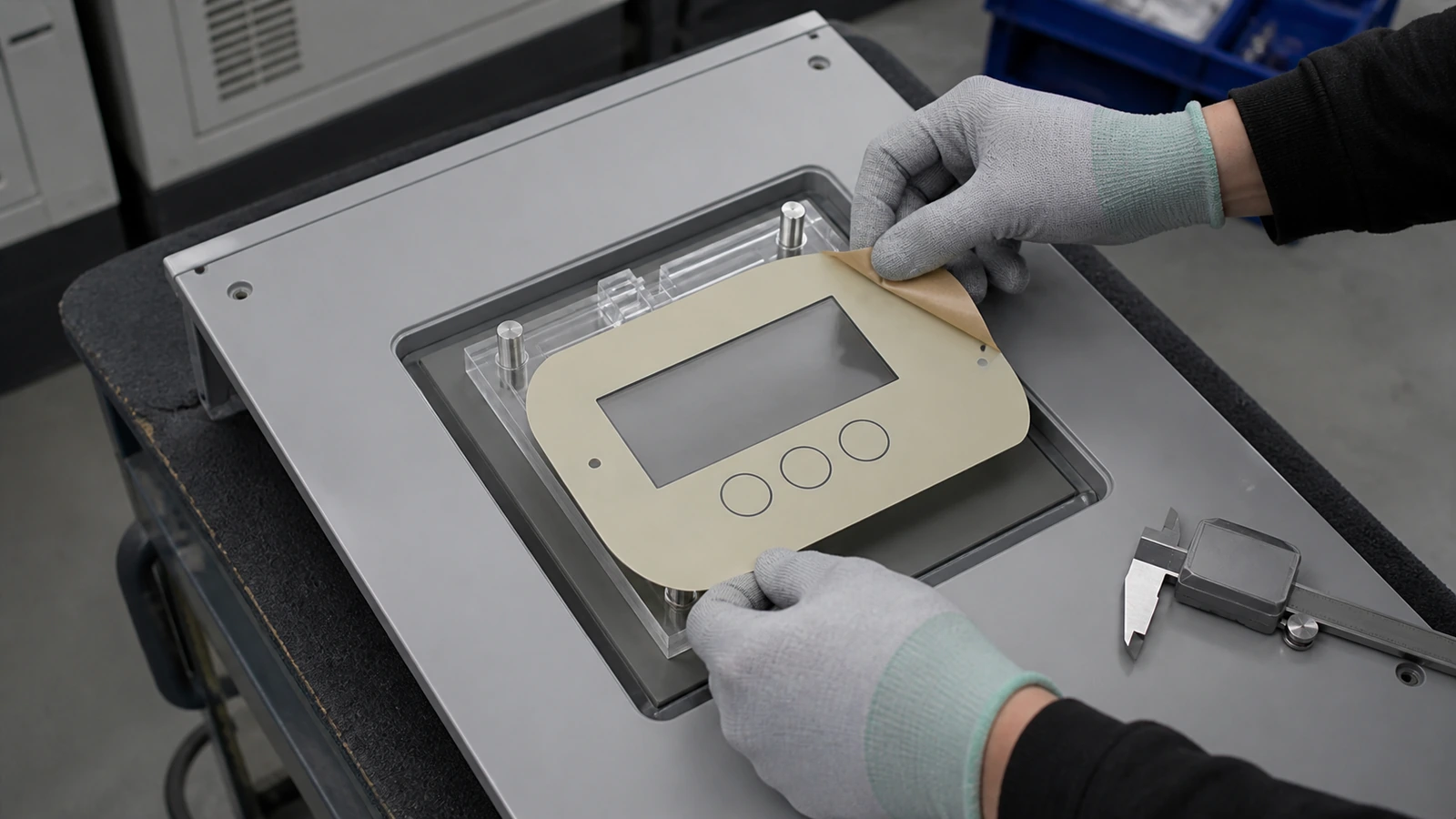
For a battery-storage cabinet overlay supplier transfer, do not quote from face artwork alone. Freeze the receiving-door datum scheme, complete die-cut outline, display and indicator apertures, embossed control zones, adhesive land, material and finish, cleaning exposure, golden unit and revision tuple before comparing suppliers. Approve the replacement through a staged fit record on the actual service-door revision. On August 28, SECI posted a request for selection for utilization of a 100 MWh standalone energy storage system. That notice is a current storage-procurement signal, not evidence that SECI or any bidder uses a particular front panel. Its useful sourcing lesson is that deployment activity increases the value of repeatable service-spare documentation.
Start with the cabinet door, not the visible graphic
Two overlays can look identical in a PDF and still fit differently on a cabinet. The receiving surface controls whether the display window lands over the active display area, whether indicator apertures uncover the intended light pipes, whether embossed zones sit over supported controls and whether the adhesive perimeter remains continuous.
Create one datum map owned by the cabinet or equipment team. Identify the primary horizontal and vertical datums, the reference corner, the service-door orientation and the installed viewing direction. Dimension the overlay outline, window, apertures and control zones from those datums rather than from a chain of adjacent features. Chain dimensions can accumulate tolerance and hide which feature is supposed to be authoritative.
Also capture the physical landing. Record the recess depth, corner radii, coating, surface texture, flatness, nearby fasteners and any edge that can interrupt the adhesive. A powder-coated sample coupon may help screen adhesion, but it cannot replace a dry fit on a representative door. The final sample record should name the door drawing and finish revisions.
| Transfer item | Evidence the buyer should freeze | Sample decision | Failure this prevents |
|---|---|---|---|
| Outer die-cut outline | Coordinates from two cabinet datums, corner radii and edge clearance | Overlay sits inside the recess without forced stretch or exposed gaps | Edge interference, lifted corners or a visible unequal border |
| Display window | Active-area drawing, bezel opening and optical border | Window reveals the intended display area at the real viewing angle | Cropped characters, exposed bezel or a miscentered dead border |
| Indicator apertures | Light-pipe centers, diameters and masking boundary | Every state aperture aligns on the installed door sample | Light bleed, a hidden indicator or the wrong state appearing active |
| Control zones | Center coordinates, embossing geometry and rigid support | Press zones align with the underlying switch or control structure | Poor feel, off-center actuation or false sample acceptance on a loose film |
| Adhesive land | Continuous bonded area, keepouts, liner and surface preparation | No unsupported edge, screw break or coating step crosses the bond path | Early edge lift, dirt traps or inconsistent field replacement |
| Revision tuple | Artwork, overlay drawing, door, display, light pipe and installed unit IDs | One approved combination is named in the report | A service spare that fits one build but not another |
Separate the graphic overlay from the electrical HMI
A graphic overlay is the printed front film. It can provide legends, color fields, a transparent display window, indicator apertures, embossed or flat control zones, texture and an adhesive interface. It does not automatically include a printed circuit, flexible tail, connector, controller or light source.
State the quoted product family before the supplier compares construction. If the replacement scope is overlay only, do not allow a drawing note or product photograph to imply that a circuit tail is included. If the project actually needs a complete membrane switch, issue a separate electrical package with contact map, tail, stiffener, connector, voltage and current limits, tactile stack and controller-side acceptance.
The distinction matters during service. A front film may be replaced while the switch assembly remains installed, or the overlay may be permanently bonded to a complete keypad that is replaced as one unit. These two service concepts require different adhesive choices, removal methods, traceability and sample tests. Put the intended replacement level in the RFQ so the supplier does not solve the wrong assembly.
Make artwork ownership usable for a second source
A screenshot, flattened PDF or photograph of the installed cabinet is not a controlled artwork master. A replacement supplier needs editable vector artwork or an agreed reconstruction scope, with fonts, symbols, spot colors, transparent and opaque regions, print side, texture, gloss windows, dead-front areas and revision history defined.
List which elements the equipment owner controls and which the overlay supplier may optimize. The owner should approve legends, language, safety-related symbols, state meaning and interface with the cabinet. The supplier may propose print separations, trapping, ink system, film thickness, texture method, adhesive geometry and manufacturing tolerances, but those changes should return through revision control.
For a service spare, compare the new sample against both the controlled files and an approved installed or golden unit. The golden unit is physical evidence, not the only definition. Age, cleaning, UV exposure and previous manufacturing variation can make an old part a poor color or gloss master. Record what the golden unit is used to judge and what remains governed by the drawing.
Color assessment should name lighting, background, viewing angle and measurement method where color is critical. Window appearance should be checked with the intended display off and on. A border that looks centered on a white bench can expose a bezel or crop an active display area after assembly.
Use three sample gates instead of one cosmetic approval
The supplier-transfer plan should allow a bad assumption to fail before production quantities are committed.
**Gate 1: dimensional and print proof.** Review the drawing, vector master, color targets, opaque and transparent regions, cutouts, window border, embossing notes and adhesive keepouts. Use a print or cutting proof to confirm geometry without treating it as production-process evidence.
**Gate 2: mounted engineering sample.** Fit a production-intent sample to the named cabinet-door revision. Use the intended surface preparation and assembly method. Inspect the complete perimeter, window, indicator apertures, control-zone position, edge height and any interference with screws, hinges or door hardware. Photograph the assembly from controlled angles, but keep measured pass criteria in the report.
**Gate 3: service-spare trial.** Have an authorized technician remove and replace the overlay or overlay assembly using the intended tools and access sequence. Check residue removal, surface damage, alignment repeatability, trapped air, edge contact and whether the replacement process can be completed without disturbing unrelated electrical or sealing functions. Repeat the relevant fit and appearance checks after the service action.
Environmental screening should match the project, not a generic slogan. Define expected cabinet temperature, condensation risk, cleaning agent, wipe frequency, UV exposure if outdoors and contact with oils or service chemicals. The component supplier can test the film, ink and adhesive against controlled inputs. It cannot infer complete cabinet ingress, fire, thermal-runaway or electrical-safety performance from the front film.
Build evidence that purchasing can compare
A quotation comparison is useful only when all suppliers receive the same controlled package and return evidence against the same acceptance points. Ask each supplier to identify the proposed film, finish, print process, adhesive family, dimensional tolerances, color-control method, window construction, tooling assumptions, sample stages, change-notification rule and excluded scope.
Do not compare only piece price. Separate one-time artwork reconstruction, tooling, color setup, first-article inspection, mounted sample support, production part price, service-spare packaging and expected traceability. A lower unit price can be misleading if the buyer must repeat cabinet fitting or recreate missing artwork later.
Use a transfer evidence matrix with one row per controlled item. Give it a buyer owner, supplier evidence, acceptance method, current status and open action. Keep unknown items marked open rather than allowing either party to infer them. Close the matrix only for the exact overlay, door, display, light-pipe and cabinet revisions named in the approval.
Keep the supplier boundary explicit
A graphic-overlay supplier can manufacture the printed PET or polycarbonate front film, controlled opaque and transparent areas, display window, indicator apertures, embossing, texture, adhesive geometry, liner, die-cut outline and agreed appearance features. The supplier can inspect dimensions, print registration, color under the agreed method, window transmission or haze when specified, surface appearance and component-level adhesion against controlled coupons or assemblies.
The supplier does not own battery cells, BMS or PCS logic, alarm strategy, emergency response, fire detection or suppression, cabinet thermal design, electrical safety, cybersecurity, complete enclosure ingress performance, grid compliance, tender requirements, field maintenance authorization or final system validation. The SECI notice does not transfer any of those responsibilities to an overlay manufacturer.
Put the boundary in the quotation and sample report. It prevents a passing overlay fit check from being read as approval of the cabinet controls or storage system, and it tells the buyer which open decisions must remain with the equipment integrator.
Send one drawing, sample and RFQ package
For a custom graphic overlay and film panel supplier-transfer review, send:
- front and rear vector artwork with revision, print side, colors, texture, transparent and dead-front regions;
- the complete die-cut outline, corner radii, display window, indicator apertures, control zones and embossing details;
- primary and secondary cabinet datums, receiving recess, coating, flatness, edge clearance, fasteners and installed orientation;
- continuous adhesive land, keepouts, liner preference, surface preparation and intended removal or replacement process;
- display active area, bezel, light-pipe and underlying control coordinates owned by the equipment team;
- film, finish, gloss-window, cleaning, temperature, condensation, UV and service-chemical inputs;
- golden-unit status, what it controls, photographs approved for supplier use and the full artwork history;
- the exact overlay, cabinet door, display, indicator, switch assembly and installed-unit revision tuple;
- dimensional proof, mounted engineering sample and service-spare trial acceptance criteria;
- prototype quantity, annual quantity range, packaging, traceability, change notification and requested quotation breakdown.
Submit the controlled package through the Request Quote page. A supplier can then quote the overlay, tooling and sample evidence without guessing about cabinet geometry, system safety or service ownership.
Need help reviewing a structure?
Send your drawing, photos, application, and quantity. Baoshengda can help check the structure before sampling.
Send Drawing for Quote