
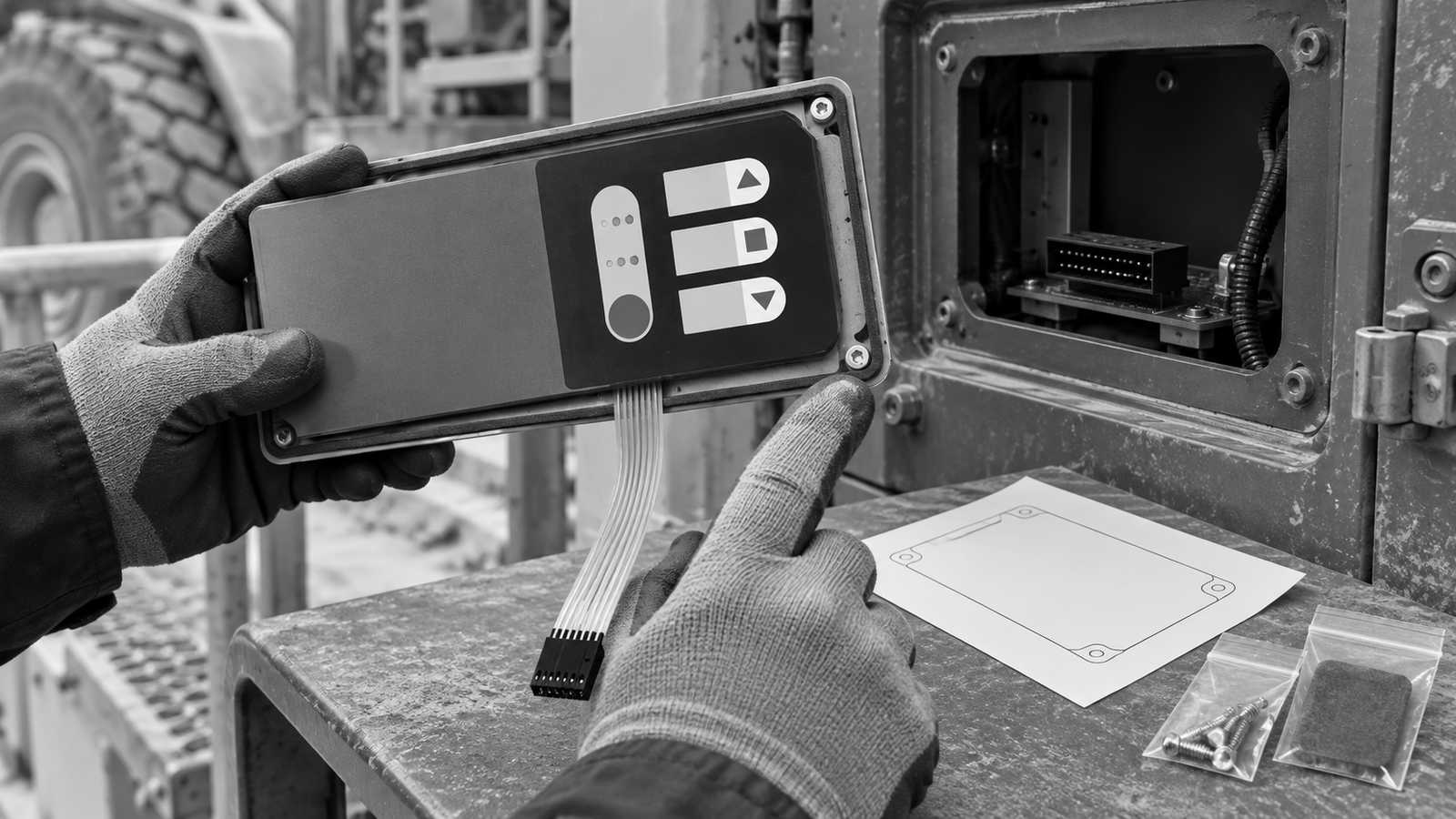
Define the replacement service panel as a named component package before asking for price. A supplier can quote the graphic face, membrane circuit, backer, gasket, flexible tail and connector together, or quote only selected parts, but the boundary must be explicit. The equipment maker should retain ownership of the enclosure, mating PCB or harness, software behavior, machine safety and final release. A useful first enquiry can begin with an authorized old sample, front/rear/edge photographs, panel-opening dimensions, connector location, equipment revision and quantities. The sample then needs a mounted interface review, not just a front-view appearance check.
Why autonomous-haul expansion makes scope clarity practical
Caterpillar's official corporate press-release listing reported on September 15, 2026 that Luck Stone and Caterpillar were expanding autonomous hauling technology to two additional Virginia operations after an earlier deployment. That current item is useful context for installed fleets, service continuity and replacement planning. It does not say that Caterpillar uses a Baoshengda panel, and this article does not infer any component relationship from the release.
As equipment is deployed across more sites, a local maintenance or recovery panel may need service spares long after the original component drawing was created. The risk is not that a new supplier cannot make a black panel. The risk is that the word panel hides several interfaces with different owners. One buyer may mean a printed overlay. Another may expect a complete membrane-switch assembly with adhesive, backer, gasket, tail and connector. If that difference remains hidden until sampling, price, timing and test expectations all move.
Freeze the component boundary before the quotation
Start by naming each part that is inside the supplier scope. For a complete front-panel assembly, that may include the graphic overlay, spacer and circuit layers, tactile elements, adhesive, rigid backer, perimeter gasket, flexible tail, stiffener and connector. If lamps, a display window, shielding or a separate PCB are included, identify them individually rather than relying on one product label.
Then name the equipment-owned interfaces. These normally include the enclosure opening, locating features, fastening method, backing support, mating header or harness, controller input logic, software labels, equipment power, safety functions and final machine validation. A component supplier can work to released interface data, but it cannot approve the complete autonomous machine or decide which recovery action is safe.
| Scope decision | Evidence for the supplier | Sample-stage check | Equipment-owner responsibility |
|---|---|---|---|
| Panel outline and mounting | Housing opening, locating datums, backer and fastening details | Seat the complete assembly without distortion or edge interference | Release enclosure tolerances and assembly sequence |
| Front face and actuation | Controlled artwork, key zones, window boundaries and required feel | Check registration and actuation in the real support condition | Approve labels, symbols, operator logic and licensed content |
| Sealing interface | Gasket land, surface finish, compression target and drainage assumptions | Inspect continuous contact after mounting; document gaps or roll-over | Validate the complete enclosure and environmental rating |
| Tail and connector | Exit location, bend keep-out, reach, connector identity and pin map | Route to the controlled mating point without twist or connector load | Release PCB or harness location, circuit behavior and strain relief |
| Revision identity | Equipment model, panel revision, approved sample and packaging rule | Match sample label and controlled records before fit checks | Prevent incompatible spares from entering another machine revision |
Separate enquiry inputs from quotation assumptions
The first enquiry does not need to pretend that every production detail is known. Send front, rear and edge photographs; an authorized sample if available; the panel opening and stable mounting datums; the location of the mating connector; known stack-up or backer details; the equipment and panel revision; sample quantity; expected order quantity; and the reason for changing suppliers. Remove customer-confidential names or legends when they are not needed for the technical review.
Ask the supplier to return an assumption list with the quotation. It should state whether the offer is for an overlay, a membrane switch, or a complete panel assembly. It should identify measured dimensions versus released dimensions, provisional materials, proposed adhesive and gasket construction, assumed connector and pinout, excluded electronics, tooling basis, inspection coverage and open questions. Price and lead time should remain conditional where construction, quantity or verification scope is unresolved.
Baoshengda can review authorized samples and drawings, identify missing component-interface inputs, propose a component sample plan and manufacture to an approved specification. It does not own autonomous-control logic, vehicle or quarry safety, enclosure certification, software, the mating electronics, field installation or final equipment release.
Check one loose sample and one mounted interface
A loose sample is useful for confirming the outer profile, visible registration, stack thickness, tail construction, connector orientation and basic key-to-contact mapping. It cannot prove that the gasket compresses evenly, that the panel sits flat against the real enclosure, or that the tail reaches the installed header without stress.
Mount the sample in the actual enclosure or a controlled representative fixture. Confirm that locating features establish the intended position before fasteners or adhesive force the part into place. Inspect the full perimeter, not one convenient corner. Check that the gasket does not roll, bridge a fastener, cross an unsupported gap or block a drainage path. Route the tail through the released exit and to the controlled mating point. It should not scrape a cut edge, fold sharply, twist, carry the connector's weight or interfere with a service cover.
Record the mounted condition, fixture or enclosure revision, sample revision and every deviation. A photograph can document what was checked, but it is not a sealing certificate or an electrical result. If a prototype uses a temporary connector, hand-cut gasket or substitute backer, mark that difference so it cannot become an accidental production standard.
Release mechanical, visual and electrical records together
The production package should connect the visible face to the hidden interface. Keep the following items under revision control:
- mechanical drawing with outer profile, datums, holes, backer, gasket land and tail exit;
- controlled artwork with key zones, windows, colors, legends and alignment to the mechanical datum scheme;
- circuit map, connector specification, pinout and key-to-contact matrix;
- layer stack, film, spacer, adhesive, tactile element, shielding and stiffener requirements;
- gasket material, geometry and the sample-stage compression or contact check;
- tail length, bend keep-out, routing direction, connector reach and strain-relief boundary;
- inspection plan, fixture revision, approved mounted sample and change-notification rule;
- service-spare label, packaging and stock-segregation method linked to the equipment revision.
Do not let a visually similar spare inherit approval from another machine revision. A changed enclosure opening, connector position, firmware map or service function can make the earlier panel package incompatible even when the front face still fits.
Use the RFQ to expose ownership, not hide uncertainty
A strong RFQ gives the supplier enough evidence to identify the component boundary and enough freedom to flag missing inputs. Request a response in four parts: initial enquiry inputs received, quotation assumptions, sample checks, and production-release requirements. That structure makes it clear which decisions are provisional and which must be controlled before a production order.
The generated cover shows a generic unbranded service-panel assembly beside a rugged maintenance enclosure. It illustrates a buyer checking the panel, gasket boundary, full flexible tail and connector. It is not a customer-site photograph and cannot prove compatibility, sealing, electrical performance, environmental qualification, machine safety or production approval.
Review integrated HMI panel solution scope and component options before freezing the replacement package. Then send the authorized panel, enclosure interface and connector evidence for a supplier-scope review and ask the response to keep quotation assumptions, mounted-sample checks and production-release items separate.
Need help reviewing a structure?
Send your drawing, photos, application, and quantity. Baoshengda can help check the structure before sampling.
Send Drawing for Quote