Overview
Backlit membrane switches are used when the operator needs to find keys, read symbols, or see operating states in dim environments. Common projects include automotive accessories, industrial machines, medical devices, instruments, home appliances, and smart equipment.
The lighting method should be chosen early because it affects the overlay design, circuit, spacer, adhesive, thickness, power requirement, and sometimes the housing.
Backlighting options
- Single LED indicators for status symbols or simple illuminated windows.
- LED backlighting under selected keys or icons.
- Light guide film for wider and thinner illuminated areas.
- EL backlighting for some special thin-panel applications when suitable.
- Dead-front graphics where symbols remain hidden until light is turned on.
LED backlighting
LED backlighting is practical for indicator windows, symbols, or selected key areas. The design must consider LED position, color, brightness, current, heat, diffusion, and whether the light creates hot spots. If the LED is too close to a small transparent area, the result can look uneven.
Buyers should mark which areas need light, which colors are needed, and whether the light is always on, controlled by the PCB, or used only as an indicator.
Light guide film
Light guide film can help distribute light over a wider area while keeping the assembly thin. It is useful when several legends or keys need more uniform illumination. The layout must be designed with LED position, light path, printed blocking layers, and housing thickness in mind.
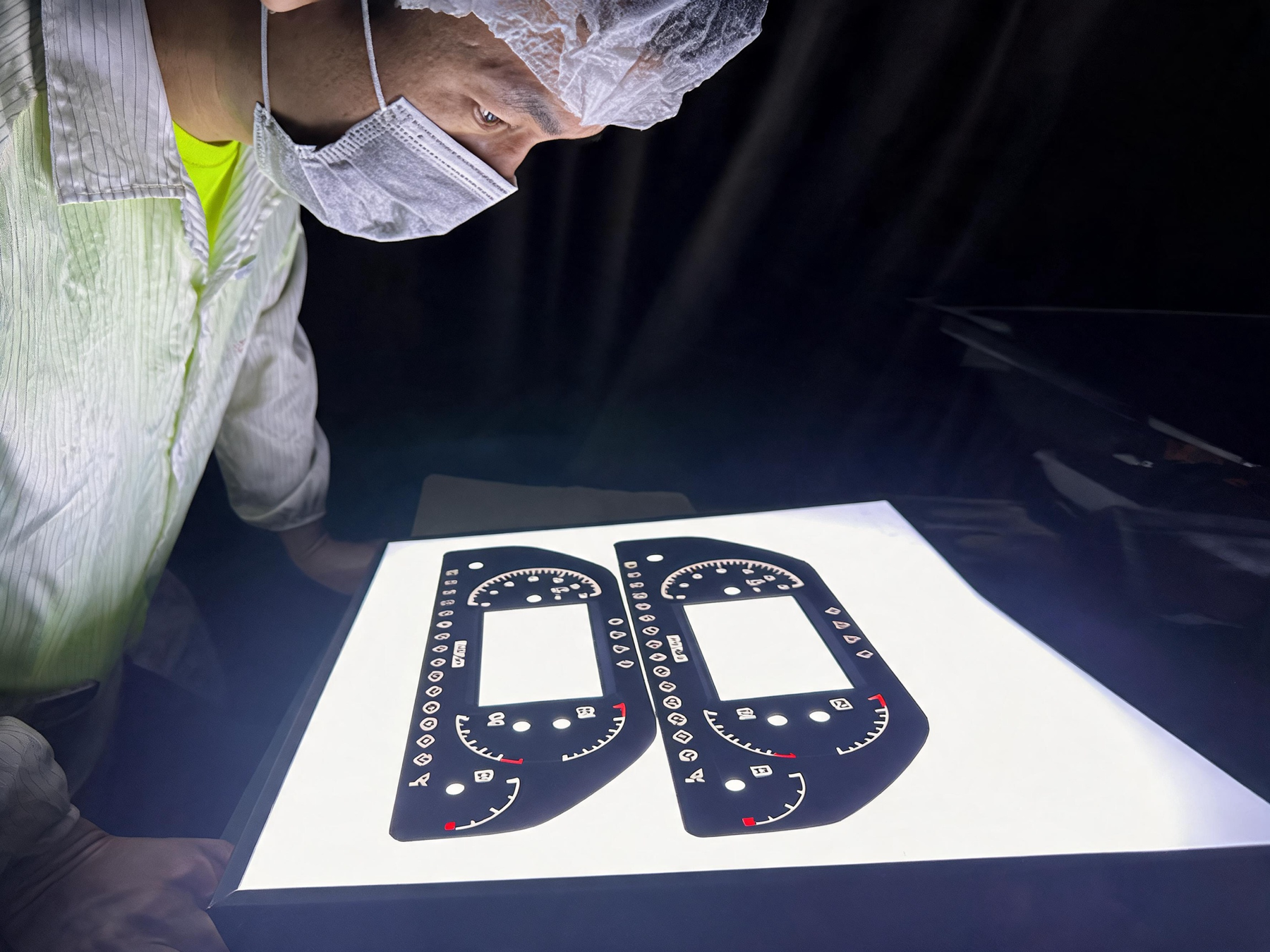
A sample is important because light uniformity is visual. The same drawing can look different depending on overlay color, ink opacity, diffusion layer, and viewing environment.
EL backlighting if applicable
EL backlighting may be considered for certain thin-area lighting needs, but it has different power, driver, lifetime, and brightness considerations compared with LED. It should be discussed based on the actual application, not selected only because it sounds thin.
For most current OEM projects, LED and light guide structures are more common. Baoshengda can review the structure based on the buyer's brightness, thickness, and circuit requirements.
Light uniformity considerations
- LED position and distance from the illuminated area.
- Ink opacity and printed blocking layers.
- Transparent or translucent window design.
- Overlay color and surface finish.
- Light guide dot pattern or diffusion method if used.
- Housing color, internal reflection, and viewing angle.
Overlay printing for backlit areas
Backlit graphics require careful printing. Some areas must block light completely, some must pass light, and some need controlled diffusion. Dead-front graphics need especially clear definition between hidden and illuminated states.
Send artwork that marks lit symbols, non-lit graphics, window areas, LED colors, and required brightness priority. If a previous sample exists, photos in both on and off states help the factory understand the target.
Circuit and power design
Backlighting adds electrical design questions. The circuit must route LED power, maintain switch function, avoid interference, and connect reliably to the PCB. The buyer should provide voltage, current expectations, LED color, control method, connector pin count, and any PCB-side limitations.
If the membrane switch tail also carries LED lines, pinout direction and connector orientation must be confirmed carefully.
Applications
- Automotive and mobility control panels used at night.
- Industrial machines and instruments in low-light locations.
- Medical and laboratory devices with status indicators.
- Home appliances and smart devices with illuminated icons.
- HMI panels with dead-front symbols, LED windows, or key lighting.
Quality control
Backlit membrane switch inspection includes normal membrane switch function plus LED function, brightness appearance, hot spots, color consistency, printing alignment, window clarity, circuit continuity, connector fit, and final surface appearance.
Light inspection should be done under realistic viewing conditions. If the product is used in a dark vehicle cabin or dim room, sample photos should be checked in a similar environment.
What to send for quotation
A clear quotation starts with ordinary project facts. If some files are not available yet, send what you have and mark the missing items as open for review.
- 2D drawing with size, outline, button positions, window areas, and tail exit.
- 3D file or housing photos if available.
- Sample photos or an old part if the project is a replacement.
- Application environment, including indoor, outdoor, cleaning, moisture, oil, or heat exposure.
- Prototype quantity and expected production quantity.
- Material requirement, surface finish, color reference, and artwork files.
- Connector requirement, tail direction, pin count, and mating board details.
- Waterproof, backlight, LED, FPC, adhesive, or special reliability requirements.
- Target lead time for samples and mass production.
Related resources
FAQ
What backlighting options can you support?
Common options include LED indicators, LED backlighting, light guide film, and certain EL structures when suitable for the application.
How do you reduce light hot spots?
LED position, diffusion, light guide design, ink opacity, overlay color, and window shape all affect hot spots. Samples should be reviewed visually.
Can you make dead-front graphics?
Yes. Dead-front graphics can hide symbols until light is on, but the artwork and printing layers must be designed carefully.
What information is needed for quotation?
Send artwork, drawing, lit area markings, LED color, voltage or current requirement, connector details, quantity, application environment, and target lead time.
Can backlit membrane switches be waterproof?
Yes, but waterproof and backlit requirements must be reviewed together because windows, LEDs, tail exit, and sealing design all interact.
Can you provide samples before production?
Yes. Samples are important for checking brightness, uniformity, color, tactile feel, circuit function, and assembly fit.
Can the LED lines share the membrane switch tail?
Yes, in many designs they can, but pin count, pinout direction, connector orientation, and circuit layout must be confirmed.