
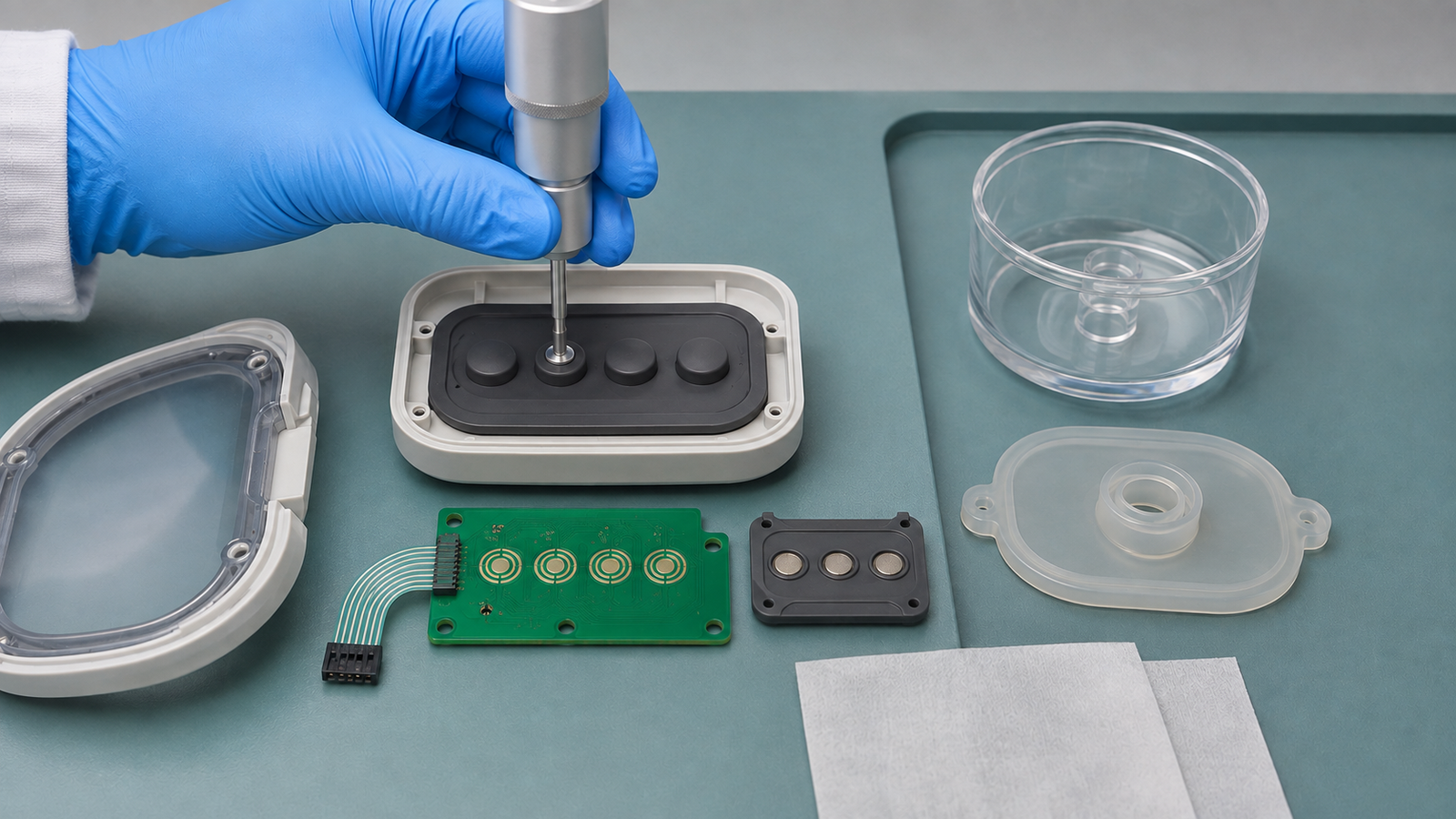
For a wearable pump RFQ, do not use one broad “medical-grade silicone” line for every soft part in the device. Quote the dry user-control keypad separately from the skin-contact shield, fluid cup, valve or other wetted component. The keypad package should define key geometry, force and travel, conductive contact method, PCB datum, enclosure compression, cleaning exposure and mounted sample evidence. Skin-contact compatibility, fluid-path materials, pump performance and finished-device validation belong to different owners unless the supplier is separately qualified for them. This separation makes quotations comparable and prevents a material label from hiding incompatible test and documentation scopes.
Why a wearable launch creates a component-scope question
A September 1 Philips Avent wearable-pump announcement emphasizes a compact body-worn format, silicone shields and practical cleaning and assembly. It is useful downstream context because a small home-health device can place several visually similar soft materials close together while asking them to perform very different jobs.
The announcement does not disclose an internal keypad construction, and it does not identify Baoshengda or any component supplier. The procurement lesson applies to OEM teams designing compact pumps or controllers that do use physical keys: the control keymat should not inherit fluid-contact assumptions simply because it is also made from silicone. A clean drawing package begins by naming which side of the housing each part serves and what can actually touch it.
Split the soft parts into four responsibility zones
A single material name is not an engineering boundary. The table below separates the decisions that should be frozen before suppliers quote or build samples.
| Zone | What the buyer must define | Evidence for quotation or sample approval | Responsibility boundary |
|---|---|---|---|
| Dry control keymat | Key count, web and key geometry, travel, force, conductive pill or contact method, legend method and perimeter lip | Controlled keymat drawing, PCB contact-pad view, force window and mounted actuation check | Keypad supplier can address the defined component and mounted fit, not device therapy or pump control logic |
| Housing and electronics | Recess depth, compression land, PCB datum, support ribs, screw or snap locations and connector access | Section drawing, tolerance stack, PCB file or pad drawing and assembled enclosure sample | OEM owns enclosure tolerances, electrical design and integration release |
| Skin-contact interface | Contact surface, cleaning method, wear period and applicable material documentation | Separate specification and validation plan for the intended contact | Must not be inferred from the dry keypad material callout |
| Fluid path or collection parts | Wetted surfaces, liquid compatibility, cleaning, leakage controls and assembly method | Separate fluid-path drawings, material records and system test plan | Pump, valve, cup, seal and fluid-path performance stay outside a keypad quotation |
This structure prevents two common errors. One is asking the keypad supplier to certify a contact or fluid function that the keypad never performs. The other is assuming that a skin-contact silicone grade will automatically deliver the key feel, rebound, conductive contact and compression behavior needed by the control interface.
Freeze the keypad stack before comparing prices
A credible keypad quote needs more than an outer outline. Start with the installed stack and work inward.
- Identify the operator side, the dry electronics side and every cleaning path across the housing.
- Dimension the key top, web, base thickness, molded perimeter lip and any light or indicator aperture.
- State the desired key force and travel as an acceptance window, not only as “soft” or “tactile.”
- Show the conductive pill or other contact geometry against the PCB pads and datum features.
- Provide the recess depth, compression land, support ribs and fastener positions that can change key feel.
- Define whether legends are molded, printed, laser marked or omitted, plus the actual wipe chemistry and frequency.
- Mark connector and service access if the PCB or interconnect must be removed without disturbing the fluid-side parts.
The custom silicone rubber keypad manufacturing page is the relevant product route for reviewing molded key geometry, tactile feel, conductive contacts and enclosure fit. It should not be treated as a claim that one component supplier owns the complete wearable pump.
Make cleaning exposure specific to the dry control side
“Easy to clean” is not a sample method. The RFQ should identify what reaches the key surface, how long it remains there and whether liquid can migrate around the keymat edge. A dry control keypad may see hand oils, lint, disinfectant wipes or occasional splash, while the collection cup and skin-contact parts may follow a different cleaning process entirely.
For the keymat, ask the supplier to inspect appearance, tackiness, swelling, legend change and return force after the agreed wipe sequence. Repeat the check in the real bezel because compression and trapped residue can alter the result. Keep any fluid-path cleaning or sterilization requirement in its own specification and validation package. Combining the two can either over-specify the keypad or under-specify the wetted parts.
Approve evidence in a three-stage sample sequence
A loose molded sample is useful for checking color, surface finish and obvious flash, but it cannot prove assembled behavior. Use three evidence stages.
1. **Loose-part review:** confirm dimensions, key count, molded lip, surface finish, conductive contact position and material identification against the controlled drawing.
2. **PCB alignment review:** place the keymat over the intended contact pads and check datums, support, off-center presses and corner-key return. Record force and travel with the agreed fixture.
3. **Mounted and cleaned review:** assemble the enclosure at the intended compression, perform the wipe exposure, repeat force and electrical actuation checks, then inspect the perimeter and contact side for residue or distortion.
Define the sample quantity, conditioning, measuring tool and pass criteria before the samples arrive. Otherwise, one team may judge hand feel while another measures peak force, and neither result will explain why a later build differs.
Keep the supplier boundary explicit
A rubber-keypad supplier can quote the molded keymat, surface treatment, conductive contacts, legends and defined dimensional inspections. When the enclosure section and PCB data are supplied, the supplier can also support a mounted-fit review and component-level sample evidence.
The supplier cannot confirm skin-contact suitability, fluid compatibility, cleaning validation, pumping accuracy, leakage performance, battery behavior, firmware, alarms, therapy delivery or finished medical-device approval from the keypad drawing alone. Those decisions remain with the device owner and the appropriately qualified material, fluid-path, electronics and system partners. Any broader scope must be stated and qualified separately instead of being implied by the word “silicone.”
RFQ checklist for a separate control-keypad package
Send a compact evidence package rather than a mixed set of soft-part drawings:
- controlled keypad outline and section with key, web, base and perimeter-lip dimensions;
- key-force and travel window, tactile preference and measurement method;
- conductive pill or contact choice, PCB pad drawing and mechanical datums;
- housing recess, compression land, support ribs, fastening and assembly sequence;
- key legends, surface treatment, color limits and light or indicator openings if used;
- dry-side cleaning agent, wipe frequency, splash exposure and inspection criteria;
- loose, aligned and mounted sample quantities with acceptance records;
- clear exclusion or separate specification for skin-contact and fluid-path parts;
- annual quantity range, tooling ownership, revision level and required delivery stages.
When these items are ready, use the Request Quote form to send the keypad drawing, enclosure section, PCB contact view, cleaning exposure and sample plan. The result should be a quotation for a defined control component, not an unsupported promise about the complete pump.
Need help reviewing a structure?
Send your drawing, photos, application, and quantity. Baoshengda can help check the structure before sampling.
Send Drawing for Quote