
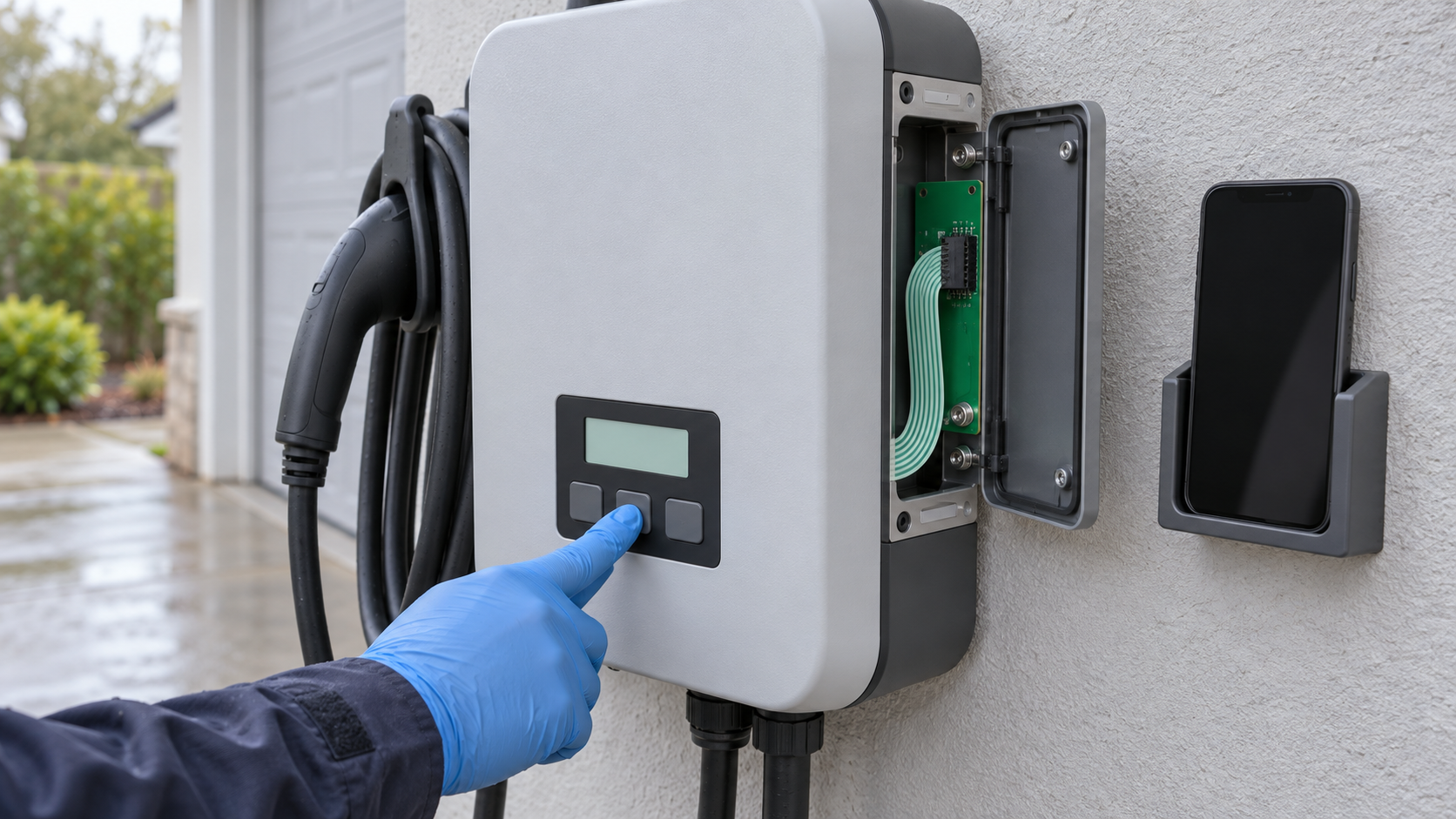
An outdoor home V2X charger does not need a row of local keys just because the app might be unavailable. Keep an action physical only when someone must perform it beside the charger, can see the equipment state, and needs a stable response during commissioning, maintenance or a defined limited-connectivity condition. Put schedules, tariff choices, charging history and account settings in the authenticated app. Keep emergency isolation and other safety functions in the validated electrical system. This separation gives the small membrane keypad a testable job: request or acknowledge a controller-defined action, not replace the energy-management software or safety architecture.
Why app-managed V2X changes the front-panel question
A September 7 Hoymiles V2X DC charger product release describes a standalone charger integrated with home solar, battery storage and an app-based energy ecosystem. The release presents the app as the place to view and control energy functions. It also says the charger is intended for flexible installation and outdoor use.
The release does not say that its charger uses a membrane keypad, and it does not establish any Baoshengda supply relationship. Its useful design signal is the control split. As charging, home energy and bidirectional energy flows move into one software environment, the charger team must decide whether every action belongs in the app or whether a few equipment-side actions still deserve stable local controls.
Adding keys without that decision creates duplication. Removing all keys without that decision can leave commissioning or service work dependent on a phone workflow that was never designed for the person standing beside the enclosure.
Decide who must act beside the charger
Start with the user and location, not the desired number of keys. A homeowner choosing a charging schedule can usually work in an authenticated app with enough space for explanation and confirmation. An installer checking wiring, network enrollment or controller state may be standing at the open enclosure. A service technician may need to request a controller-defined reset or acknowledge a diagnostic step while watching a status indication at the charger.
Those jobs should not automatically share the same interface. If a local action is needed only after opening a protected service cover, placing it on the public front can create an unnecessary control. If an action is frequent and must be taken while looking at the charger, burying it several screens deep can make the local task harder to validate.
A compact three-key membrane panel can support a deliberately small action set. The system owner might allocate selection, acknowledge and a defined service request, for example. Those are only candidates. The charger designer must decide the function, authorization and permitted system states before a keypad supplier freezes artwork or circuitry.
State feedback matters more than the key legend
A clear icon does not prove that a physical key has a clear job. For each local action, define what the charger shows before the press, what request the key sends, how the controller accepts or rejects it, what feedback appears, and what happens if communication is interrupted.
This is especially important when the app and local panel can refer to the same operating mode. The two interfaces should not silently compete. If a local key requests a change, the app, charger indicator and controller state need one agreed source of truth. If the action is unavailable, the local panel should not look as though it succeeded merely because the dome clicked.
The membrane switch can provide tactile feedback and a stable touch target. It cannot determine whether energy transfer is allowed, whether a vehicle is compatible, whether a user is authorized or whether the requested mode is safe. Those decisions belong to the charger controller and the responsible system design.
Choose the interface by task and access level
| Interface location | Suitable task | Design risk to resolve | Evidence for a mounted sample |
|---|---|---|---|
| Authenticated mobile app | Schedules, tariff preferences, charging history, account settings and detailed guidance | Connectivity loss, account access and delayed state updates can make it unsuitable for an immediate equipment-side task | Verify the complete software workflow and loss-of-connection behavior with the app and controller owners |
| Public front membrane keypad | A very small set of frequent, non-safety local requests that need stable tactile targets | Duplicate commands or weak feedback can make app and local control ownership ambiguous | Check mounted actuation, active-zone separation, status mapping, front sealing land and controller transitions |
| Protected service keypad | Installer or maintenance actions allowed only with controlled physical access | Putting service functions on the public face can expose the wrong workflow | Check hatch clearance, tail bend, connector access, authorization assumptions and return-to-service state |
| Separate electrical or safety hardware | Isolation and safety functions defined by the validated charger architecture | Treating an ordinary membrane key as isolation or a safety-rated control creates a false boundary | Validate this hardware and its circuit independently with the responsible electrical and safety parties |
The table does not require every charger to use all four locations. An app-only charger may be correct when no local workflow needs a physical request. A front keypad may be correct when a few repeated actions remain truly local. A protected service interface may be better when the control should never be available to a general user.
Treat the keypad as part of the enclosure stack
Once the action set is small and stable, the next risk is mechanical. A loose overlay sample cannot tell the buyer how the key will feel after it is bonded to the charger.
Define the front film, graphic layers, spacer and circuit construction together with the enclosure opening, adhesive land and rear support. A tactile dome needs consistent support beneath its active area. A large unsupported cutout can change actuation feel and make adjacent keys behave differently. The display or status window needs an agreed visible area, border and stack so that the final housing does not cover the intended indication.
The flex tail is also part of the layout decision. Show its exit location, first bend, strain relief, connector orientation and protected service path. Keep the connector away from runoff and condensation paths, and keep the low-voltage interface separated from power hardware according to the charger designer's electrical architecture. A front face that wipes clean does not by itself prove that the rear connector or enclosure is sealed.
For a custom waterproof membrane switch used in an outdoor control enclosure, the drawing should therefore connect the visible key layout with the hidden support, adhesive perimeter and tail route.
Make the mounted sample prove the real interaction
A useful application sample should be installed on a representative housing or fixture. Check whether each active zone registers only after the intended press, whether the tactile response remains distinguishable with the expected glove, and whether the panel returns without sticking or rocking on an unsupported surface.
Then run the controller-defined transitions. A press that produces electrical continuity is not enough. Confirm the requested state, accepted state, rejected state and interrupted state using the real controller or an agreed simulator owned by the buyer. Observe the local indication and the app view together when both interfaces are in scope.
Environmental evidence must match the actual component claim. A wipe test can assess whether the chosen film, printing and edge construction remain legible and intact under an agreed cleaning method. A controlled splash or moisture test may reveal enclosure integration problems. Neither test automatically proves a finished charger ingress rating, outdoor lifetime or regulatory compliance.
Send one action map with the drawing package
Before asking suppliers to compare constructions, prepare one package that keeps the equipment decision and component decision aligned:
- user roles and the location where each action is performed;
- app, public-front, protected-service and separate hardware responsibilities;
- local key names, permitted charger states and controller responses;
- status-window or indicator mapping for accepted, rejected and unavailable actions;
- front-panel dimensions, active zones, embossing and graphic requirements;
- enclosure opening, adhesive land, rear support and sealing boundary;
- flex-tail outline, first bend, strain relief, connector type, contact side and pin ownership;
- operating environment, glove and cleaning assumptions;
- representative housing or fixture, sample quantity and transition-based acceptance plan;
- forecast quantities, revision owner and approval signoffs.
This is more useful than sending a front graphic alone. It lets the supplier quote the physical panel while the charger team retains control of software, energy behavior and system validation.
Keep the component and system boundaries explicit
Baoshengda can review membrane-panel materials, key layout, tactile construction, display or status windows, adhesive perimeter, rear support assumptions, flex-tail routing and connector termination against the supplied drawing. A mounted sample can be prepared for the buyer's mechanical, electrical and transition checks.
The charger owner remains responsible for V2X functions, power electronics, isolation, energy metering, firmware, app behavior, network security, user authorization, emergency functions, ingress and impact ratings, vehicle compatibility and regulatory approval. The cited product release is context for the interface decision, not evidence that one keypad architecture is universal.
If the control split is already defined, send the action and state map with the mounted-panel drawing for a component review. That gives the local keypad a narrow, verifiable purpose instead of turning it into a second, incomplete version of the app.
Need help reviewing a structure?
Send your drawing, photos, application, and quantity. Baoshengda can help check the structure before sampling.
Send Drawing for Quote