
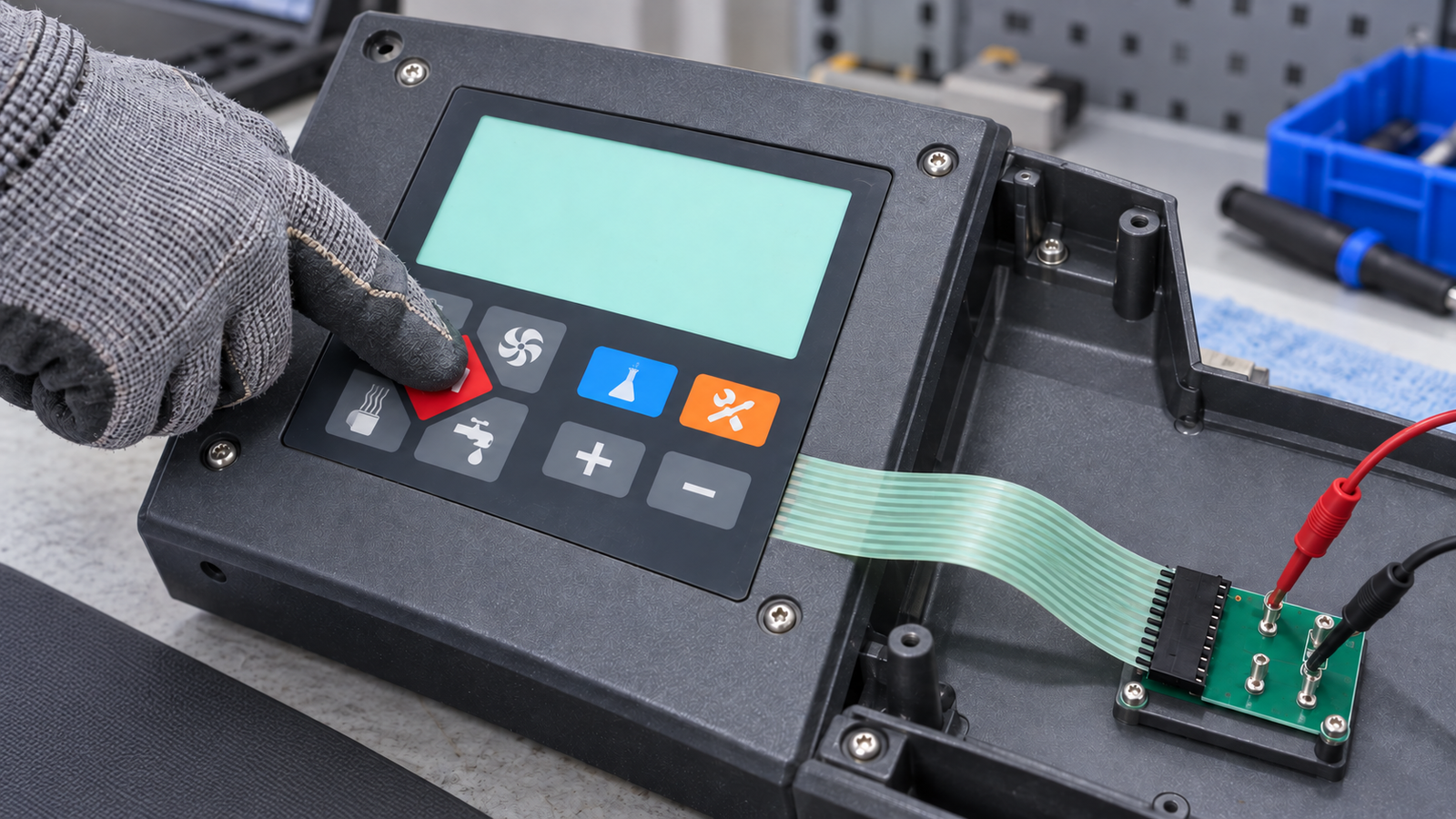
A missed command at a truck charger should be split into three observations before you blame the glove or order a replacement keypad: did the finger land on the intended key, did the membrane contact close, and did the controller acknowledge the input? Start with a representative keypad mounted in the intended surround and connected to a safe low-voltage test interface. Compare gloved and bare-finger presses without changing several variables at once. If the finger lands off-center, review target size, spacing and reach. If the intended contact does not close, inspect the keypad, mounting stack and connection. If closure is valid but the charger does not respond, the keypad alone is not proven faulty.
A missed command can happen at three different points
The operator sees one outcome: the requested action did not occur. The engineering team needs three separate records.
First is targeting. A thick work glove changes the apparent fingertip width and can hide the boundary between neighboring key zones. A person may touch the face but not load the intended active area. A photograph or video from a fixed angle can help show where the glove lands, provided it is treated as observation rather than dimensional proof.
Second is contact closure. The intended membrane-switch circuit must change state when the key is pressed in the actual mounting condition. Check this at an agreed low-voltage interface. The result may differ when the flexible panel is unsupported on a bench, bonded to a rigid plate or compressed by an enclosure lip. Record the support, adhesive condition and connector used with the sample.
Third is controller acknowledgement. A valid electrical closure does not by itself prove that the charger software, input mapping, interlock state or communications path accepted the command. Those are equipment-level questions. Separating the three observations prevents a complete keypad from being replaced when the failure is elsewhere, and prevents a targeting problem from being hidden by simply asking for a lower operating force.
Megawatt charging raises the value of ordinary interface checks
The September 13 IAA Transportation announcement about public megawatt-charging demonstrations describes charging demonstrations involving Daimler Truck, MAN, Scania and Milence during IAA Transportation 2026. The source focuses on heavy-duty charging infrastructure and the demonstration program. It does not describe a keypad construction, glove test or membrane-switch supplier.
The practical component lesson is narrower than the charging headline. A high-power charging system may still include ordinary local actions such as service navigation, confirmation or maintenance control. If an OEM chooses a membrane keypad for one of those non-safety-critical interface functions, the human target, electrical contact and controller response still need separate evidence. A successful charging demonstration is not approval of a particular keypad, and this article does not imply that the named companies use Baoshengda parts.
Use the planned glove and the installed surround
Do not evaluate glove access on an isolated flat sample if the final key field sits behind a bezel, beside a display or near a raised enclosure feature. Mount the representative panel in a surround that reproduces the intended support and approach angle closely enough for the decision being made.
Ask the operator to touch a specified key without coaching the finger into position. Mark the intended active zone on a private review drawing, not on the public product. Observe whether the glove repeatedly covers a neighboring key, contacts the bezel first or approaches at an angle. Repeat with the same glove condition before changing the key artwork, embossing, spacer or switch construction.
A bare-finger comparison is useful as a control, but it does not replace the gloved check. If bare and gloved targeting both miss in the same direction, the layout or installation position may be the stronger clue. If targeting is centered but the contact remains intermittent, move the investigation to the mounted switch and connection rather than assuming that the glove is the cause.
Let the observed path choose the next action
| Observation in a controlled sample check | What it supports | Next useful action |
|---|---|---|
| Glove lands partly on an adjacent zone; intended contact never closes | Targeting or reach is not yet reliable | Review key-zone size, spacing, bezel clearance and approach angle |
| Glove is centered; intended contact closes consistently; controller gives no response | Keypad contact is not the only remaining cause | Check input mapping, connector mating and controller acknowledgement in the OEM system |
| Glove is centered; intended contact is intermittent in the mounted sample | A component, mounting or connection issue needs isolation | Repeat on a defined support, inspect tail and connector, then compare an identified sample |
| Bare finger closes the contact but the planned glove does not, with the same centered target | The interaction needs a representative glove-specific review | Compare operating construction and mounting support; do not approve a lower force from sensation alone |
| Neither bare nor gloved press closes the intended contact | The complaint is not explained by glove targeting | Check circuit identity, connection, assembly pressure and an identified replacement sample |
This table is a diagnosis map, not a universal acceptance specification. The number of repetitions, electrical threshold and environmental conditions must come from the equipment program. Do not convert an operator comment such as “too hard with gloves” directly into a force value without defining the sample, mounting and measurement method.
Keep the component boundary clear
A custom membrane keypad supplier can review the panel outline, key-zone arrangement, flexible tail, connector requirement and proposed switch construction. A supplier can also prepare an identified sample and agree which contact checks belong to that component scope. The charger OEM remains responsible for enclosure design, electrical integration, software interpretation, high-voltage safety, emergency functions and whole-system validation.
Use a safe, de-energized or appropriately isolated low-voltage setup for the component investigation. Do not open or probe energized charging equipment merely to decide whether a replacement keypad is needed. The generated cover for this article illustrates a generic bench check; it is not a field photograph, test result or customer installation.
For a proposed waterproof membrane switch used in an outdoor control assembly, sealing performance also depends on the complete panel stack, cable exit, enclosure and assembly process. A front film that appears continuous in a picture does not establish an ingress rating or final outdoor suitability.
Start with evidence you already have
You do not need a complete production drawing to begin a technical enquiry. Send enough information to identify the problem and state what is still unknown:
- A photo of the control face and its mounting surround, with customer and asset markings removed when necessary.
- The intended key and the observed symptom: off-target press, no contact closure, intermittent closure or valid closure without system response.
- The glove type or a physical glove sample used in the check.
- Available panel dimensions, key-zone positions, tail exit direction and connector information.
- Whether the existing part, drawing or circuit map can be supplied for private review.
- The quantity needed for investigation and the later production context, if known.
For an indicative quotation, identify the assumed construction, included parts, connector scope and unresolved dimensions. For a fit or functional sample, agree the mounting support, glove interaction, contact checks and any temporary differences. Production release requires the approved drawing revision, materials and print definition, circuit and connector definition, accepted sample reference and inspection criteria.
Baoshengda can review the available keypad evidence and help define a component sample that separates targeting from contact behavior. That review does not promise compatibility, price, lead time or whole-charger performance before the inputs are assessed. Send the current evidence for a membrane-keypad review and state which of the three observations you need the next sample to resolve.
Need help reviewing a structure?
Send your drawing, photos, application, and quantity. Baoshengda can help check the structure before sampling.
Send Drawing for Quote