
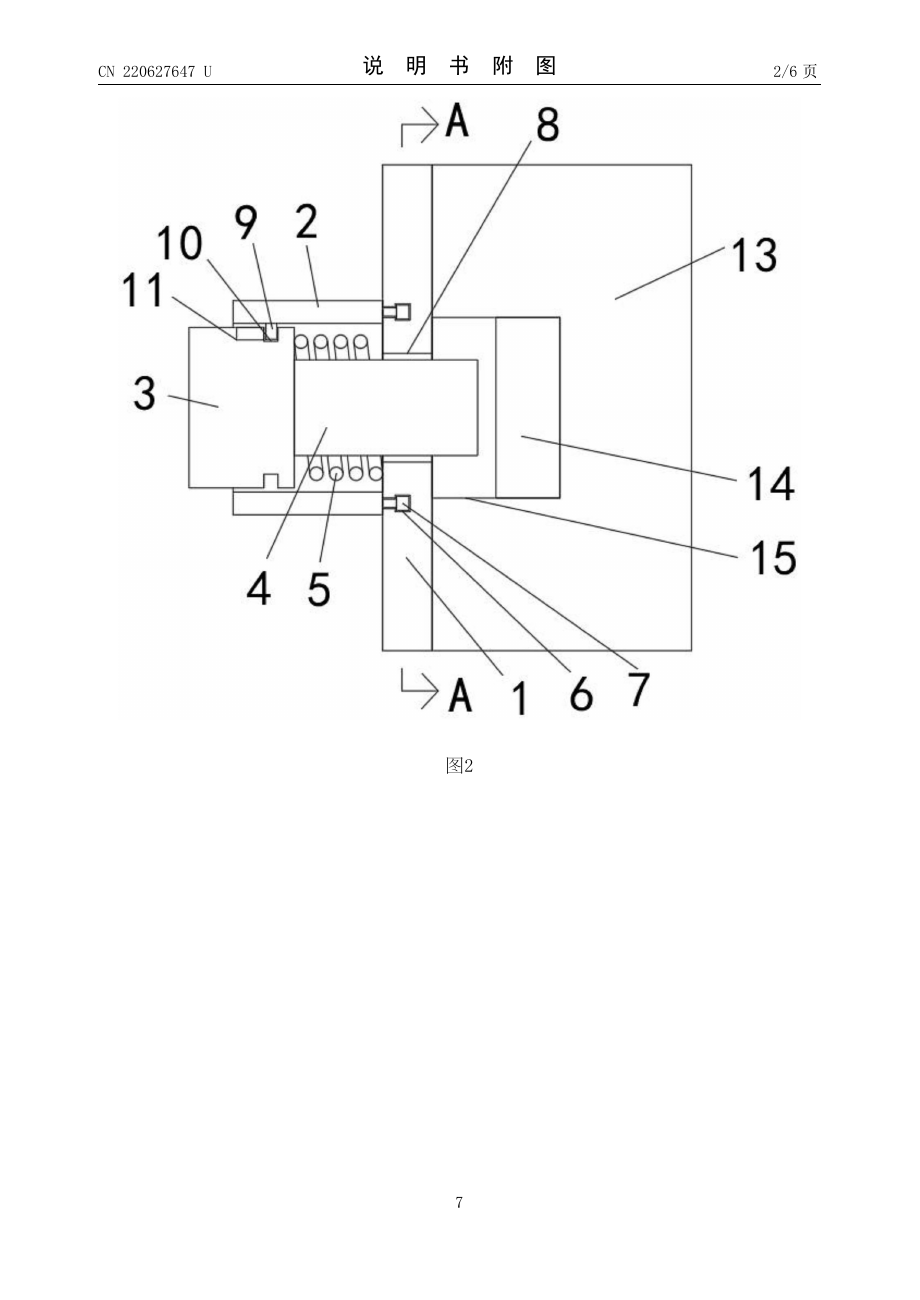
A rotating collar that permits a button to be pressed needs two separate checks: whether the mechanical path allows or blocks the intended movement, and what the electrical contacts do during that movement. Draw the blocked, aligned and returned positions before approving a sample. Agree the operating sequence and acceptance conditions with the equipment owner before testing the sample.
What CN220627647U actually describes
Baoshengda's utility-model grant publication **CN220627647U**, published on **2024-03-19**, describes a limiting structure for a push-button switch. The original published patent text and drawings are provided as a copy of the historical document from the company archive. This is not a claim that a live legal register was checked today. Current legal status and implementation in a particular supplied product are not established by the document alone.
Claim 1 describes a button block with an axial limiting groove. A limiting member can move into that groove, allowing the button to be pressed. Claims 4–7 add a rotating sleeve or collar, two sliders guided in curved grooves, return springs and a circumferential groove on the button block. The axial groove meets the circumferential groove.
The cover is the document's full drawing page 7, Figure 2, not a photograph of a manufactured sample. Open Figure 2 at its original size to inspect the labels on a small screen. Its numbered parts help explain the arrangement, but the drawing is not a dimensioned production drawing or a measured test result.

Follow the mechanical path before interpreting the contact labels
In paragraphs 0028–0034, rotating the collar **(2)** moves the limiting member **(9)** around the button's circumferential groove **(10)**. When that member aligns with the axial groove **(11)**, the button block **(3)** can move inward. Outside that alignment, the description says the button cannot be pressed.
The Chinese term for part 9 can be translated as contact head. Here, that part serves the mechanical limiting function. The moving electrical contact is **(4)** and the fixed electrical contact is **(14)**. A drawing review that treats part 9 as the electrical contact would mix the permission-to-press mechanism with the switching circuit.
The document also separates two return functions. A first spring **(5)** between the button and panel returns the button outward after release. Second springs **(12)** in the curved grooves return the collar's sliders and limiting member. Those descriptions explain the proposed return path. They do not prove that every manufactured sample will return reliably under contamination, side load or wear.
Ask for a controlled assembly drawing showing how the collar, button block, grooves, sliders and panel fit together. Mark the intended direction of rotation and the positions in which axial travel is possible. Do not estimate an operating angle, travel distance or spring force from the patent illustration.
Review three positions on the same controlled sample
Use the patent as a basis for questions, then agree a sample procedure for the actual design. The following checks are proposed buyer-review work, not tests reported in the patent.
| Position or transition | Mechanical observation | Electrical observation | Information to retain |
|---|---|---|---|
| Limiting member outside the axial groove | Confirm the intended restriction without forcing or overloading the assembly | Record the actual contact output; do not infer it from collar position | Assembly revision, position and owner-approved test method |
| Collar rotated into alignment, then button pressed | Observe alignment and permitted button movement without binding | Record contact engagement and controller interpretation separately | Collar position, button movement, contact map and circuit revision |
| Button and collar released in the agreed sequence | Observe button return and collar/limiting-member return separately | Record contact release and any unintended input | Release order, observed return and remaining fault condition |
Include the real panel support and mounting condition. A loose mechanism can behave differently when a fascia, fastener or adjacent part restricts its movement. Use a controlled drawing for clearances and tolerances; this article does not assign them.
If the intended user may release the button before the collar, or the collar before the button, ask the design owner which sequences are permitted. Document the response to each permitted sequence instead of assuming that the two springs make all release orders equivalent. Any abnormal-state checks require an agreed procedure suitable for the equipment and sample.
Keep mechanical return, electrical release and safety separate
A button may appear to return while an electrical contact or controller input behaves differently. Record the contact state and the system's interpretation with the mechanical observation. Where the requirement concerns unwanted activation, the equipment owner must define the relevant system behavior and approval criteria.
The patent does not establish a certified safety interlock, emergency-stop function, energy isolation or lockout/tagout capability. A press restriction must not be substituted for those functions on the strength of the drawing. Nor does the document provide a verified lifetime, environmental rating or universal force specification for a purchased assembly.
For sample acceptance, separate the drawing-defined construction from the evidence still needed: permitted operating sequence, contact behavior, mounted clearances and the conditions under which return is evaluated. Any numeric limit should come from the controlled requirement and its supporting test evidence, not from the patent title.
Start the RFQ with the unresolved decision
For an initial discussion, send an existing photo or drawing if available, the intended use, approximate quantity and the issue you need to resolve. Explain whether the concern is accidental pressing, alignment, return, electrical release or integration with the panel. Complete production drawings are not required just to begin that conversation.
For a production-intent sample, agree the assembly revision, collar and groove geometry, mounting interface, contact map, permitted sequence and acceptance criteria. Identify which party supplies the mechanical hardware, electrical interface and system-level evaluation. A preliminary quote should state its assumptions and exclusions while those inputs remain open.
The custom membrane switch and control-panel review page is a route for discussing the surrounding interface and the component scope. A membrane interface alone does not reproduce the rotating mechanism shown in this patent. State whether the enquiry concerns that interface, separate mechanical button hardware or a proposed assembly, and confirm the supply scope before pricing. Use Request a Quote to share the available information and the unanswered question.
Need help reviewing a structure?
Send your drawing, photos, application, and quantity. Baoshengda can help check the structure before sampling.
Send Drawing for Quote