
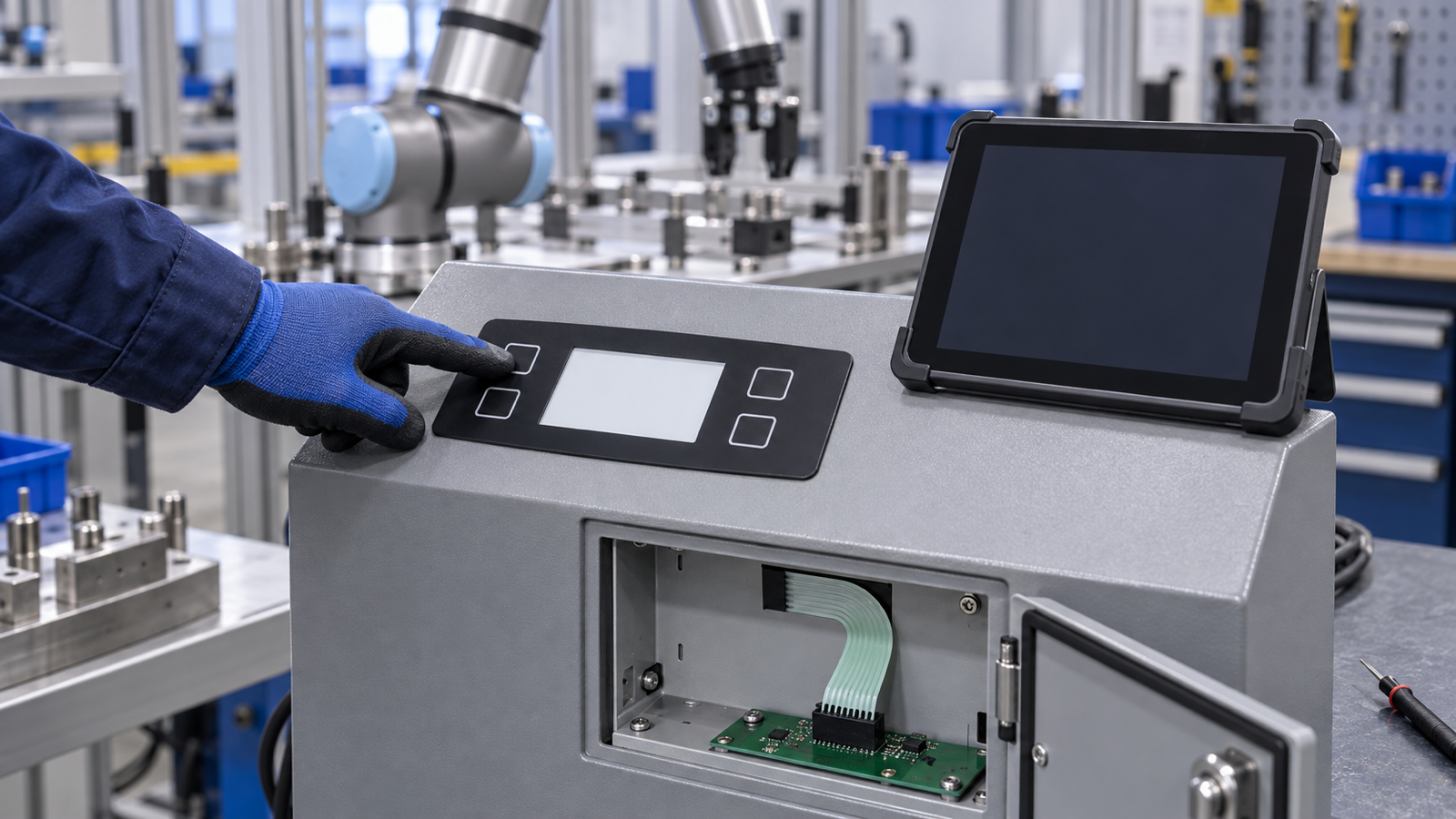
A robot teaching station should not add fixed keys simply because a tablet feels slow, and it should not remove them simply because a touch interface can display every function. Use fixed local keys when a technician must stand at a known station, see the machine state directly and repeat a small set of non-safety actions without navigating a shared screen. Keep path editing, detailed diagnostics and teaching on the pendant or tablet. Keep emergency stops, enabling devices and safety-rated mode control in the validated machine safety system. This division gives each interface a testable job before the front panel is frozen.
Start with the operator's location and the machine state
A September 8 Palladyne AI and FANUC America collaboration announcement lists teleoperation, human-assisted learning, simulation and standardized deployment workflows among its planned work. The release does not describe a keypad, identify a membrane-switch construction or establish a Baoshengda supply relationship. It does show why interface roles need to be defined as robots gain more software-driven setup and adaptation.
The first question is where the operator stands when the action is taken. A tablet works well for recipe detail, camera views, logs and guided procedures. A teach pendant can combine motion control with system-specific enabling and authorization. A small fixed keypad earns space when the person is already beside one station and must act while looking at the fixture, part or robot state rather than at a menu.
Typical fixed-key candidates include station selection, a non-safety acknowledge, a request to home after the controller has confirmed the permitted state, fixture selection or a guided recovery step. The machine builder must define the actual logic. A membrane keypad supplier cannot decide whether any of those actions are safe or authorized.
Give the fixed keypad a smaller job than the tablet
The strongest fixed panel is usually not a miniature copy of the tablet. It holds only the actions that benefit from a stable physical location and repeatable touch target.
A four-key panel might use two keys for local selection, one for acknowledge and one for a controller-defined request. The display window beside those keys can show the active station or prompt, but the controller owns the meaning and sequence. If the same panel tries to carry recipes, maintenance pages, user management and robot teaching, the layout grows, legends change and the supposed simplicity disappears.
This separation also helps revision control. Software teams can change tablet workflows without automatically changing the local key matrix. Panel revisions remain tied to a controlled action map, artwork, circuit, tail and connector. Buyers can then ask suppliers to quote the same physical scope rather than comparing one keypad-only offer with another offer that quietly includes a display, controller or safety hardware.
Compare the interface by job, not by screen size
| Interface option | Primary use | Main risk if it is asked to do too much | Sample evidence to request |
|---|---|---|---|
| Tablet only | Rich instructions, logs, remote views and changing software workflows | The operator may need to navigate while watching the cell, and the device may not remain at the station | Confirm screen flow, connection loss behavior and who owns the device mount and charging |
| Teach pendant | Robot teaching, controlled motion and system-specific authorized tasks | A portable pendant can become the default for unrelated station actions, which complicates roles and access | Validate the complete pendant and machine safety concept with the robot-system owner |
| Fixed membrane keypad | A short list of nearby, repeatable non-safety actions with stable tactile locations | Too many keys or unclear state feedback can create an ambiguous local control station | Test mounted actuation, key separation, display prompt mapping, circuit continuity and tail strain relief |
| Separate safety hardware | Emergency stop, enabling and other safety-rated functions defined by the machine design | Treating a standard membrane key as a safety device creates a false boundary | Obtain system-level validation from the responsible safety and controls parties |
The table is an allocation tool, not a rule that every cell needs all four interfaces. A compact machine may need only a pendant and a small local panel. Another may use a tablet plus separate safety hardware. The correct set follows the operating states and responsibility map.
Mounting changes how a local key feels and reads
A loose keypad sample can pass continuity checks and still fail in the pedestal. The front overlay, spacer stack, dome or tactile element, support plate, adhesive and enclosure opening all affect actuation. A flexible or unsupported bezel can change force and travel between the center and edge keys.
Tail routing matters too. The tail needs a defined exit, bend direction, strain-relief area and connector position. A hatch that pinches the bend or pulls the connector during service can turn a sound circuit into an intermittent field fault. The connector contact side, pin order and mating retention should be controlled in the drawing, not inferred from a photo.
For an industrial automation HMI panel, the mounted sample should be reviewed with the real front opening, support surface and cable route. That makes tactile feel, alignment, connector access and service handling part of the same approval package.
Approve operating transitions, not just individual keys
A useful sample review follows short transitions that a technician will actually perform. The controller and machine builder define the states; the panel supplier provides the agreed electrical input and visible construction.
Test at least these examples:
- The wrong station is selected, so the action remains blocked and the display prompt is unambiguous.
- A local acknowledge is pressed once with the specified glove, and the controller records one intended input rather than a repeated contact.
- The tablet connection is unavailable, and the fixed panel does only the limited actions assigned to it rather than becoming an undocumented fallback controller.
- The service hatch is opened and closed several times without pulling the tail, lifting the adhesive edge or loosening the connector.
- A revised tablet workflow is installed while the fixed key matrix remains unchanged, proving which interface revision actually moved.
These checks reveal ownership gaps before production. They do not validate robot motion, guarding or functional safety.
Keep the component supplier boundary explicit
Baoshengda can review a custom membrane keypad or front-panel scope when the buyer provides the local action map, panel opening, support stack, tail route, connector and electrical interface. Supported work can include overlay construction, tactile-zone layout, circuit matrix, tail geometry, connector termination and sample-level visual or continuity evidence.
The component supplier does not define robot trajectories, AI behavior, teleoperation authorization, emergency-stop architecture, enabling devices, access control, guarding or whole-cell compliance. Those decisions remain with the machine builder, robot supplier, controls integrator and responsible safety parties.
Send one interface allocation package for quotation
Before requesting a sample or quote, collect:
- a cell-state and operator-action map showing which actions belong to the tablet, teach pendant, fixed panel and safety hardware;
- the exact list of non-safety fixed keys and the display or indicator state paired with each key;
- front artwork, active-zone dimensions, panel opening, rear support and adhesive land;
- tactile force or feel targets, glove assumptions and cleaning exposure;
- circuit matrix, tail exit, bend direction, connector part or mating definition, contact side and pin map;
- service-hatch clearance and strain-relief details;
- sample quantity, fixture, operating transitions and pass criteria;
- forecast quantities, revision rules and the party that approves electrical and system behavior.
A short fixed panel is useful only when its job is clear. Send the interface allocation, panel drawing and sample plan for engineering review so the keypad quote covers a defined component rather than an undefined share of the robot control system.
Need help reviewing a structure?
Send your drawing, photos, application, and quantity. Baoshengda can help check the structure before sampling.
Send Drawing for Quote