
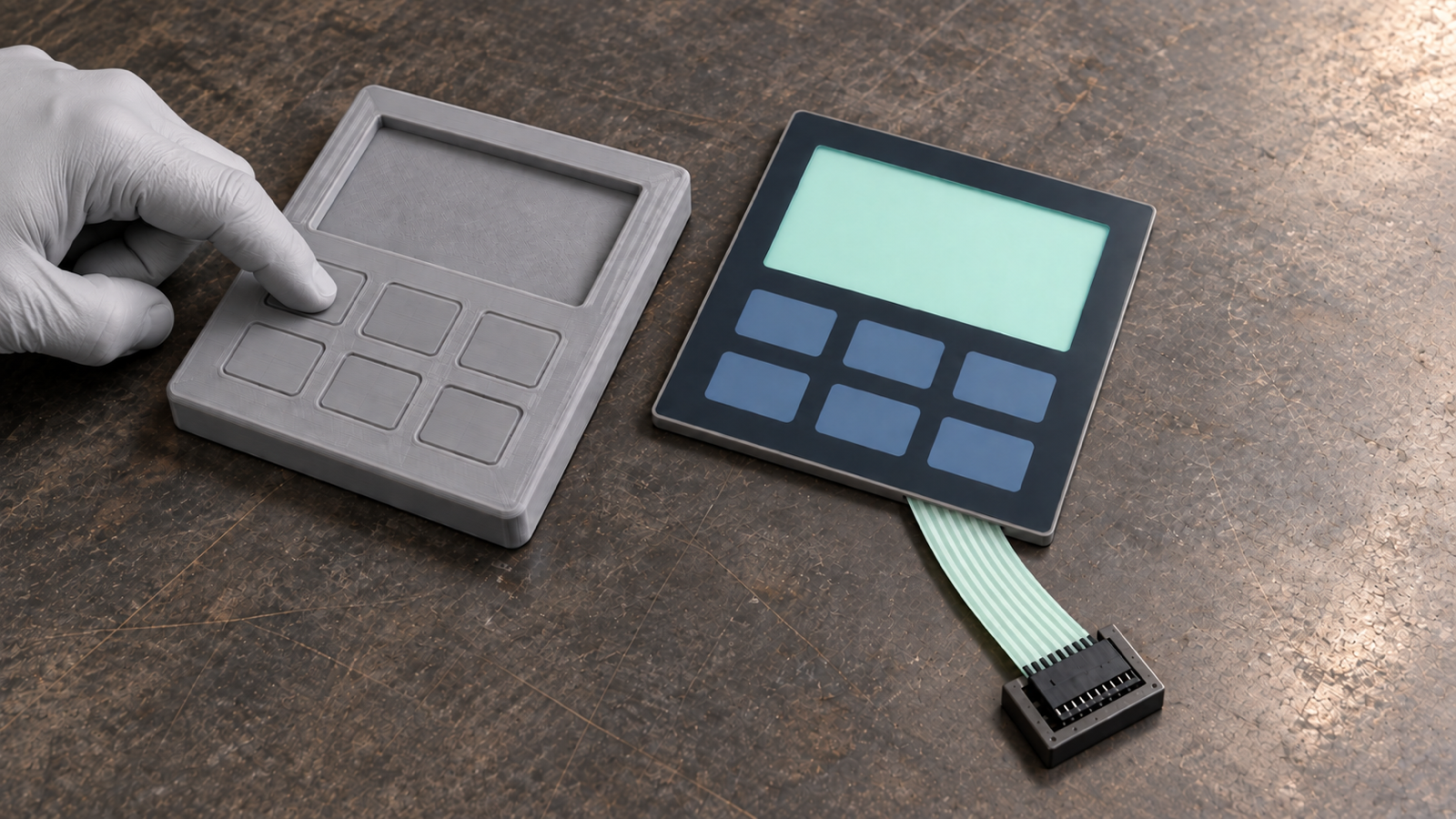
A rigid mock-up can help you approve the size, reach and arrangement of a robot operator keypad, but it cannot approve the feel or electrical behavior of a membrane switch that it does not contain. Use the model to check how the panel fits the enclosure and how an operator reaches the controls. Then request a functional sample with the intended switch construction, backing support and connection. You can start that discussion with an early drawing, photographs or the model you already have. The useful next step is to identify which decisions are settled and which still need representative hardware, not to label every prototype production-ready.
Use the mock-up for reach, not for a switch verdict
A panel model is useful even when it has no working circuit. Put it where the control panel will sit, rather than reviewing it only on a desk. Can the operator reach the outer keys while holding the enclosure? Does the hand obscure a display area? Is there room around a key when the intended glove is worn? Does the enclosure obstruct a connector exit or the fastener access needed for assembly?
These are layout questions. A correctly scaled model can expose a conflict before a custom keypad is made. Record the dimensions and installation position used in the trial, including anything represented approximately. A thick printed ridge standing in for a shallow embossed key may help locate that key, but it does not reproduce its final surface.
Avoid an approval note that simply says “prototype accepted.” State what was accepted: the external envelope, the location of a window, a key spacing decision or an assembly access route. A model with a deliberate simplification can still do its job if the simplification is visible in the record.
New operator hardware makes prototype labels matter
Universal Robots' September 15 Gen 7 announcement describes a redesigned control box, teach pendant and tool-flange interface. Its TP7 Core pendant combines multiple grip positions, configurable smart buttons and a display; the separate SP7 interface places configurable inputs at the tool flange. The release also identifies the platform's September 14 launch at IMTS in Chicago. Those are different dates, not evidence of two product launches.
For an OEM planning a separate operator interface, the relevant point is where a person holds the equipment and makes an input. A control that works on a flat desk may be harder to reach on a handheld enclosure or near the task. Early models can help investigate that arrangement. The announcement does not identify a membrane-switch construction or a component supplier, and it does not validate another manufacturer's sample. The prototype distinctions below apply to custom interface development, not to replacement of the named robot's certified controls.
Give each prototype a job it can actually perform
Agree the question before choosing the sample. Otherwise a buyer may pay for a detailed cosmetic model and still lack the evidence needed to release the switch construction.
| Prototype or evidence | Useful decision it can support | What remains unresolved |
|---|---|---|
| Rigid, correctly scaled panel model | Enclosure envelope, key positions, hand reach and access | Membrane key force, electrical switching and durability |
| Printed artwork on the proposed front-panel outline | Legend placement and alignment with key or window locations | Final ink, surface texture, lighting and wear behavior |
| Functional membrane-keypad sample on a defined support | Key operation, return and agreed contact checks in that setup | Differences introduced by the final enclosure or mounting stack |
| Identified keypad sample installed in the intended assembly | Mounted fit, access, input mapping and agreed operator checks | Untested environmental conditions and production variation |
| Approved build record with agreed inspection criteria | A reference for the next supplied samples or production lot | Whole-machine validation outside the supplier's component scope |
A functional sample is not necessarily a complete robot controller. It can be a representative keypad connected to an agreed test interface. Its value comes from knowing what it represents. If the sample uses a temporary spacer, a different overlay or a substitute connector, list that difference and the decision it prevents you from closing.
What changes between a model and a working keypad
For a membrane-keypad sample, the front film, embossing where used, spacer arrangement, switching element and backing support form a physical construction. A rigid model that imitates the outline does not recreate that construction. Even adding a click mechanism to a model does not make its operating behavior representative unless that mechanism and its installation match the proposed part.
Ask for two separate checks. First, determine whether the intended key can be pressed and released in the mounted assembly without obstruction. Second, verify the agreed electrical result at the connection. A tactile sensation and a registered input are related observations, not interchangeable evidence. Record the sample identity and test setup so that a later revision can be compared meaningfully.
For context, N&H Technology's silicone-keypad design guide distinguishes structural features such as the keytop, web, contact area and PCB support, and discusses force and travel. That is a different keypad technology, but it illustrates why appearance alone does not define switching behavior. Do not transfer its silicone dimensions or force values to a membrane-switch design. Use the actual construction and agreed requirements for the component being purchased.
Keep any safety-related enabling device, emergency-stop function or robot motion validation within the equipment manufacturer's approved system process. An ordinary custom membrane-keypad sample is not evidence that those functions have been validated.
Start the enquiry with a model and the unresolved questions
For a first conversation about a custom industrial operator HMI and keypad assembly, send the information already available. A photograph of the model beside a dimensioned outline can establish the intended arrangement. An incomplete drawing is useful when missing dimensions are identified rather than estimated from perspective.
A short initial package can include:
- The equipment application and where the operator will use the panel.
- The available drawing, model photographs or existing sample, with known overall dimensions.
- The key and window positions already agreed, plus the points still being discussed.
- Whether the next sample must demonstrate layout only, working key contacts or a mounted interface.
- The expected sample quantity and any known future production need.
For a quotation, identify the proposed sample construction, included parts and unresolved assumptions. Ask whether enclosure pieces, the mating connector or test electronics are included or supplied separately. Sample approval then needs an identified build and checks appropriate to its purpose. Production release needs the agreed drawing revision, material and circuit definition, accepted sample references and inspection criteria. These are successive decisions, not prerequisites for sending the first message.
Baoshengda can review the keypad layout, available construction information and interface requirements for a proposed component or HMI scope. The review must establish what can be supplied and what representative samples are needed; a model alone does not establish feasibility, cost or delivery time. Start a prototype review enquiry with what you have and tell us the next decision you need the sample to answer.
Need help reviewing a structure?
Send your drawing, photos, application, and quantity. Baoshengda can help check the structure before sampling.
Send Drawing for Quote