
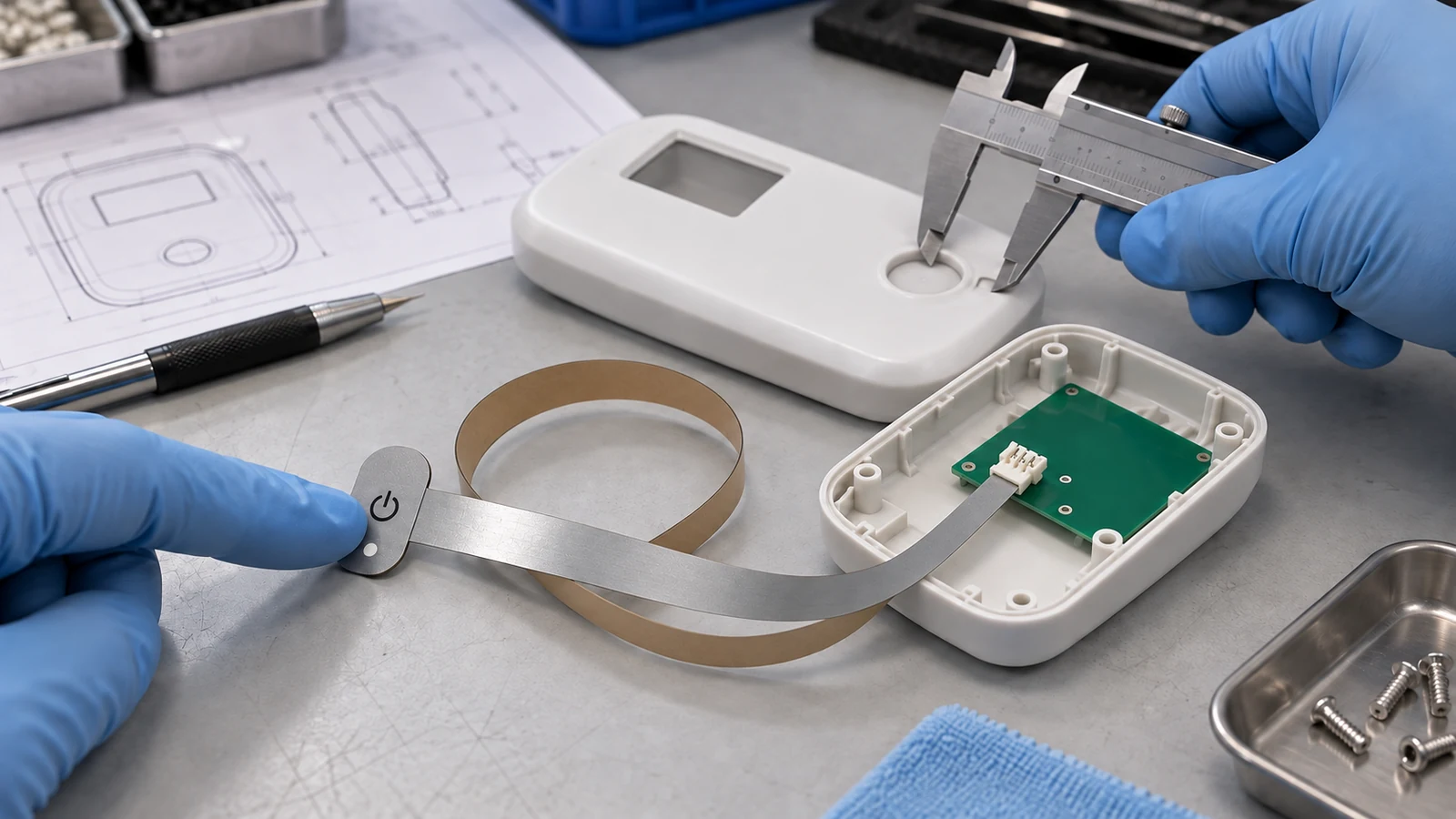
One visible button is not a complete membrane-switch RFQ. First decide whether the supplier is being asked for a passive input with an overlay and tail, or for a powered pressure-control device; these are different scopes. For the component, define the action, front-face size and recess, tail path, connector or contact landing, and expected cleaning contact. An initial enquiry can begin with a marked device photo and provisional drawing. A priced construction needs declared assumptions. A mounted sample must check fit, actuation and electrical mapping. The device maker, not the film-interface supplier, validates pressure control, clinical use and production release.
A current launch illustrates the component boundary
QinFlow's September 21 announcement describes a compact, battery-powered controller for pressure bags. Its product page describes single-button operation. Those are facts about QinFlow's device, not a Baoshengda project, specification or endorsement. The release does not disclose its switch stack, circuit, tail or supplier. It cannot be used as a drawing for another OEM's part.
The transferable buyer problem is narrower: a purchaser sees one local input on a portable device and asks a film-interface manufacturer to “quote the button.” That request leaves both the commercial scope and the mating interface undefined. Baoshengda's public medical-device HMI page describes membrane switches, printed overlays, tail and connector-ready interfaces, housing-fit review and component inspection planning. This first-party evidence supports a discussion of a custom passive interface. It does not prove that Baoshengda makes the announced device, its software, pressure mechanism, clinical functions or regulatory file.
Decide the input boundary before choosing materials
The first decision is what the drawing calls the part. A decorative one-button overlay can supply a printed or shaped front surface without switching contacts. A membrane switch adds a defined contact circuit and flexible interconnect. A complete controller adds power, sensing, pressure regulation, software and device-level behavior. An RFQ should not bundle those meanings into one word.
The second decision is how the one control behaves. Is it an on/off input, a mode selector, or a press-and-hold action? The equipment team owns the state machine, status feedback, unintended-actuation analysis and any safety function. The component supplier needs the number of electrical contacts, target contact behavior, tactile preference, actuation area and the interface drawing. A power pictogram on a sample photograph is not evidence of actual electrical function.
The third decision is whether the part can be mounted and connected as drawn. The front recess, edge land, display-window relationship if any, tail exit and bend clearance can change the construction and tooling. A button count alone cannot price that fit.
| Buyer decision | Evidence for an initial enquiry | Assumption for an indicative quote | Check on the mounted sample |
|---|---|---|---|
| Overlay only or switch circuit | Marked front view, one-button function and requested supply boundary | Layer stack, artwork, embossing and circuit inclusion stated separately | Confirm key zone and contact response only if a circuit was ordered |
| Front fit and feel | Housing photo, recess or bezel drawing, target actuation area | Proposed film outline, adhesive land and tactile construction | Check edge seating, finger access, unintended edge presses and repeatable feel on the actual shell |
| Electrical handoff | PCB location, draft pin map, tail direction and connector preference | Quoted tail length, exit, termination and circuit map | Confirm connector engagement, orientation and contact-to-pin mapping on the actual board |
| Cleaning contact | Expected wipe method, liquid or chemical exposure and frequency, if known | Named surface and sealing assumptions, with open conditions called out | Check the chosen surface and assembled edge against the OEM's defined method |
This table is a way to separate evidence, not a universal design or tolerance. A supplier can identify missing component inputs, but cannot infer a medical device's accepted cleaning protocol or safety criteria from a press release.
A first enquiry can be incomplete without being vague
To start a useful conversation, send a marked front photo or concept drawing, approximate panel envelope, intended key action, enclosure material or photo, PCB position, expected tail direction and connector preference, expected annual and prototype quantities, and the likely wipe or handling environment. Mark uncertain values as provisional. If a previous component exists, note its revision and whether it is a reference or an approved design.
Ask two questions explicitly: “Is the supply item a printed overlay, a passive membrane switch, or both?” and “Where will the tail terminate in the enclosure?” The answers change the proposed construction more than the fact that the interface has one button. Baoshengda can review its component stack, artwork, switch layout and tail options from this initial package. It cannot quote or approve an entire pressure-control system from it.
Put open assumptions in the quotation, not in the sample verdict
An indicative component quote should name the version of the artwork and outline used, active key-zone size, film and surface proposal, embossing or tactile structure if requested, adhesive pattern, tail construction, circuit and connector scope, sample quantity and production quantity. If the enclosure, PCB or cleaning method is unfinished, state the assumed condition and the revision still required. Do not write an unspecified “medical grade” performance promise in place of a defined contact and test plan.
A drawing-ready RFQ then adds datums for the outer profile and recess, key center, adhesive keep-out, window if present, tail exit and bend region, contact map, pin numbers, connector mating reference and acceptance criteria. Purchasing can compare suppliers on the same scope only when each offer uses the same controlled revision. The OEM remains responsible for device-level electrical design, firmware logic, pressure behavior, clinical workflow and applicable approval.
Use the mounted sample to separate fit from system performance
Before approving a sample, place it on the representative enclosure and connect the specified tail to the intended board or fixture. Check that the front face sits in the recess, the active zone can be pressed without rubbing the edge, the tail is not pinched, and the connector reaches without an unsupported tight bend. Compare contact response with the agreed pin map and action definition. If cleaning is a requirement, evaluate the assembled surface and edge against the exact method supplied by the OEM; a loose sample cannot establish installed sealing or chemical resistance.
Record sample revision, shell revision, PCB revision, test fixture and observed result. A passing component sample supports the reviewed configuration, not an untested pressure algorithm, patient-use claim or released device. Production release requires approved drawings and artwork, material and adhesive decisions, electrical map, inspection criteria, traceable sample reference and change-control owners. A later change to the shell, board or cleaning method can reopen the component validation.
Review the medical-device HMI component options and send the available front drawing, mating-interface information and open questions through Request a Quote. Start with the passive component boundary; add quotation assumptions, sample evidence and production-release files as each becomes available.
Need help reviewing a structure?
Send your drawing, photos, application, and quantity. Baoshengda can help check the structure before sampling.
Send Drawing for Quote