
For a personal exoskeleton controller that uses a passive membrane keypad, approve service spares against one controlled interface baseline rather than the front appearance alone. Freeze the face and key identities, support and stack, tail exit and bend zone, connector orientation and contact map. A first enquiry can begin with controller photos, an available sample, equipment revision, key-function list and required quantity. Label missing dimensions or circuit details as quotation assumptions. Compare loose samples first, then let the equipment owner repeat fit and function checks in the released controller before production release. Motion control, software, emergency behavior and medical-device approval remain outside the keypad supplier's scope.
Controller operation creates a service-spare question
Wandercraft's Eve product page states that the prescription personal exoskeleton became commercially available in the United States on September 17, 2026. It also says that the user operates the device with a controller and a trained companion remains present. That current source makes controller service continuity visible, but it does not identify a membrane keypad, a Baoshengda component or any supplier relationship.
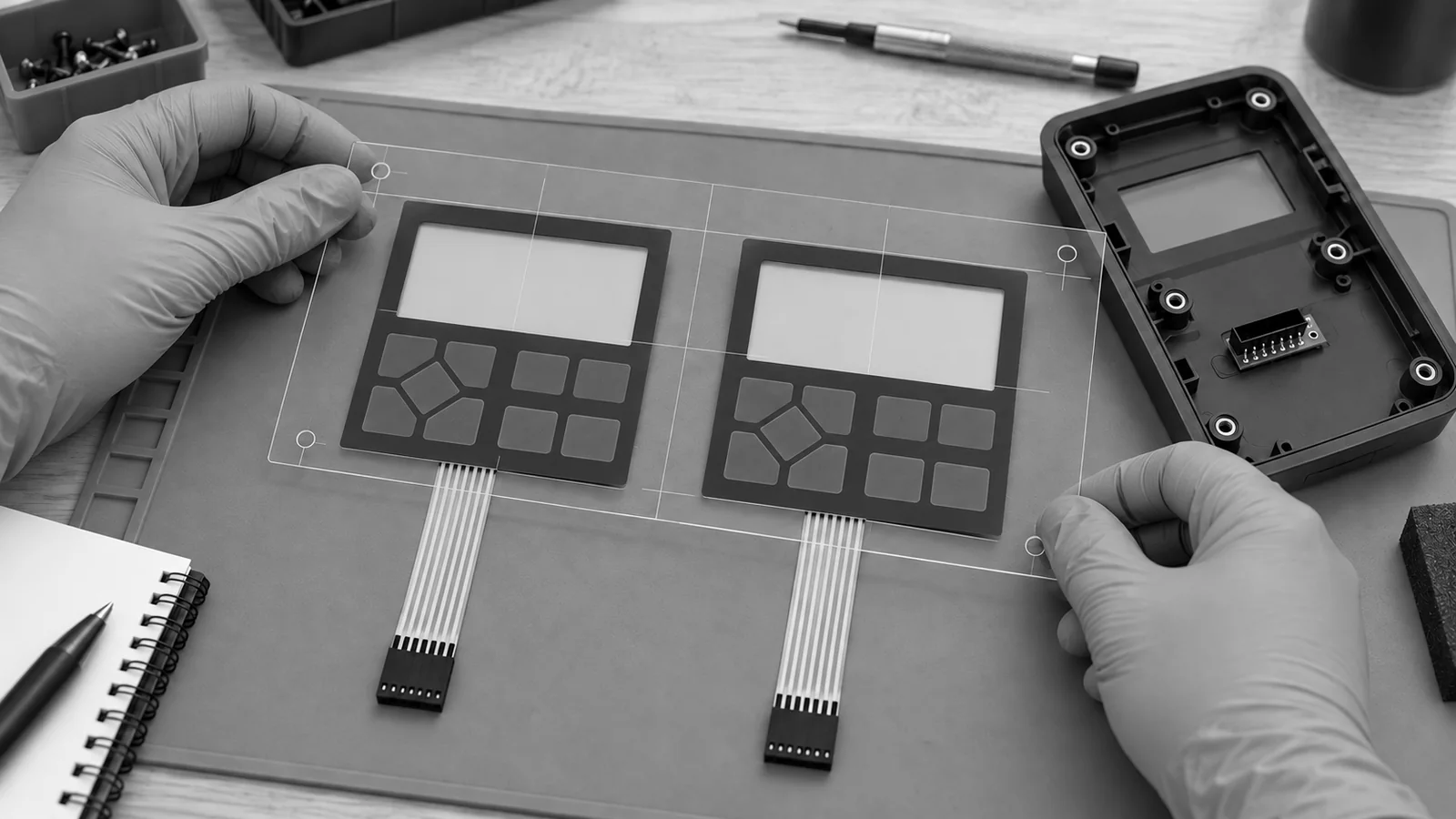
Here is the evidence-based component decision. If a separate controller face uses a passive custom membrane keypad, approve its spare against the complete mechanical and electrical interface, not color and outline alone. Baoshengda's first-party reference photos visibly show thin membrane faces with display windows, bounded key zones, pale-green flexible tails and compact connectors. Those photos support the construction vocabulary in this article. They do not prove fit in Eve, compatibility with any exoskeleton, a released key map, medical approval or field performance. The equipment owner must supply and approve the actual controller evidence.
Define one passive-interface baseline
A baseline should identify which face, circuit and rear interface belong together. Start with one released drawing package, controlled golden sample or reconciled service record. Name the equipment revision and controller revision so that a visually similar spare is not accepted against the wrong enclosure or electronics.
The mechanical portion should include the complete outer profile, display-window position, key-center locations, support lands, available depth and any adhesive, gasket or backer interface. The electrical portion should include key identities, contact map, tail exit, contact side, bend-free zone, stiffener, connector family and connector orientation. Record which values came from released files, which were measured from an available sample and which remain unknown.
| Service-spare decision | Enough to begin an enquiry | Labelled quotation assumption | Check before release |
|---|---|---|---|
| Component identity | Authorized controller photos, available sample and equipment revision | Which legacy sample or file is controlling | One reconciled interface baseline approved by the equipment owner |
| Mechanical fit | Outer profile, opening, support and available depth | Measured dimensions without released tolerances | Loose outline comparison and representative installed seating |
| Key and circuit mapping | Key-function list and any available continuity record | Missing key-to-contact or common-line detail | Controlled circuit map and agreed continuity criteria |
| Tail and connector | Tail direction, approximate reach, contact side and visible connector evidence | Unreleased connector part, pinout or bend zone | Connector orientation, reach, strain and mating-owner approval |
| Construction control | Known face, tactile, adhesive, backer or gasket evidence | Unconfirmed material grade or total stack | Approved stack, inspection points and change-notification rule |
This format lets a supplier start useful review without pretending that an incomplete service sample is a production drawing.
Compare the master and spare as loose samples first
A loose comparison should answer component questions before the controller is involved. Place the approved reference and candidate on the same datum template or fixture. Compare the complete outline, display window, key centers, artwork registration if applicable, stack thickness, surface condition, tail exit, tail length, contact side, stiffener and connector orientation. Check the key-to-contact map with an agreed fixture or continuity method.
The comparison record should identify both sample revisions and the method used. A photo can show alignment and completeness, but it is not a tolerance result unless the drawing, fixture and acceptance criteria are also controlled. An inspection method is not evidence that a particular sample passed. Keep that distinction visible in the report.
Repeat fit and function checks in the released controller
The equipment owner should then install the same traceable sample in a representative released controller. Confirm that the face seats on the intended support, the display window aligns, the tail stays within its bend zone and the connector reaches the approved mating interface without strain. Exercise the declared key functions through the controller's approved verification procedure and record the controller, firmware, fixture and sample revisions used.
This installed stage is not interchangeable with loose inspection. A sample may match the drawing yet expose a support, routing or connector-access problem inside the housing. Conversely, a single controller fit does not establish production tolerances or broad compatibility. Resolve both evidence levels before service spares are released.
Keep keypad scope separate from device control and safety
A membrane-keypad supplier can review the graphic face, tactile construction, membrane circuit, support or backer, adhesive or gasket interface, flexible tail, connector and component-level inspection inputs. The equipment maker or designated system owner must retain the housing, mating PCB or harness, controller input behavior, software, motion commands, alarms, emergency behavior, charging, companion procedures, electrical and medical safety, cleaning validation, EMC and final device release.
That boundary should also appear in an indicative quotation. If the connector part, mating header or released contact map is missing, the supplier can state a provisional construction and list the missing approval evidence. It should not promise controller compatibility or infer a safe motion response from a keypad drawing.
Move from enquiry to production release in four stages
For the initial enquiry, send authorized front, rear and edge evidence; controller and equipment revision; available sample history; approximate size; key-function list; visible tail and connector condition; service-spare quantity and expected production quantity. Identify any sample that has been repaired, trimmed or relabeled in service.
For an indicative quotation, require a written assumptions list covering measured versus released geometry, surface and artwork, tactile method, circuit, adhesive, backer or gasket, tail direction, connector, tooling, sample quantity and inspection coverage. Do not treat those assumptions as approved design inputs.
For samples, define the loose master-to-spare comparison and the equipment owner's installed checks as separate acceptance stages. Before production release, approve the mechanical drawing, artwork if used, circuit and contact map, construction stack, tail and connector specification, inspection method, approved sample identity, change-notification rule and service-spare traceability.
Baoshengda can help review a custom membrane switch component package and expose missing passive-interface evidence before samples are built. The practical next step is to send the available controller evidence and required quantities, while marking which files are released, which values were measured and which questions the loose and installed samples must answer.
Need help reviewing a structure?
Send your drawing, photos, application, and quantity. Baoshengda can help check the structure before sampling.
Send Drawing for Quote