
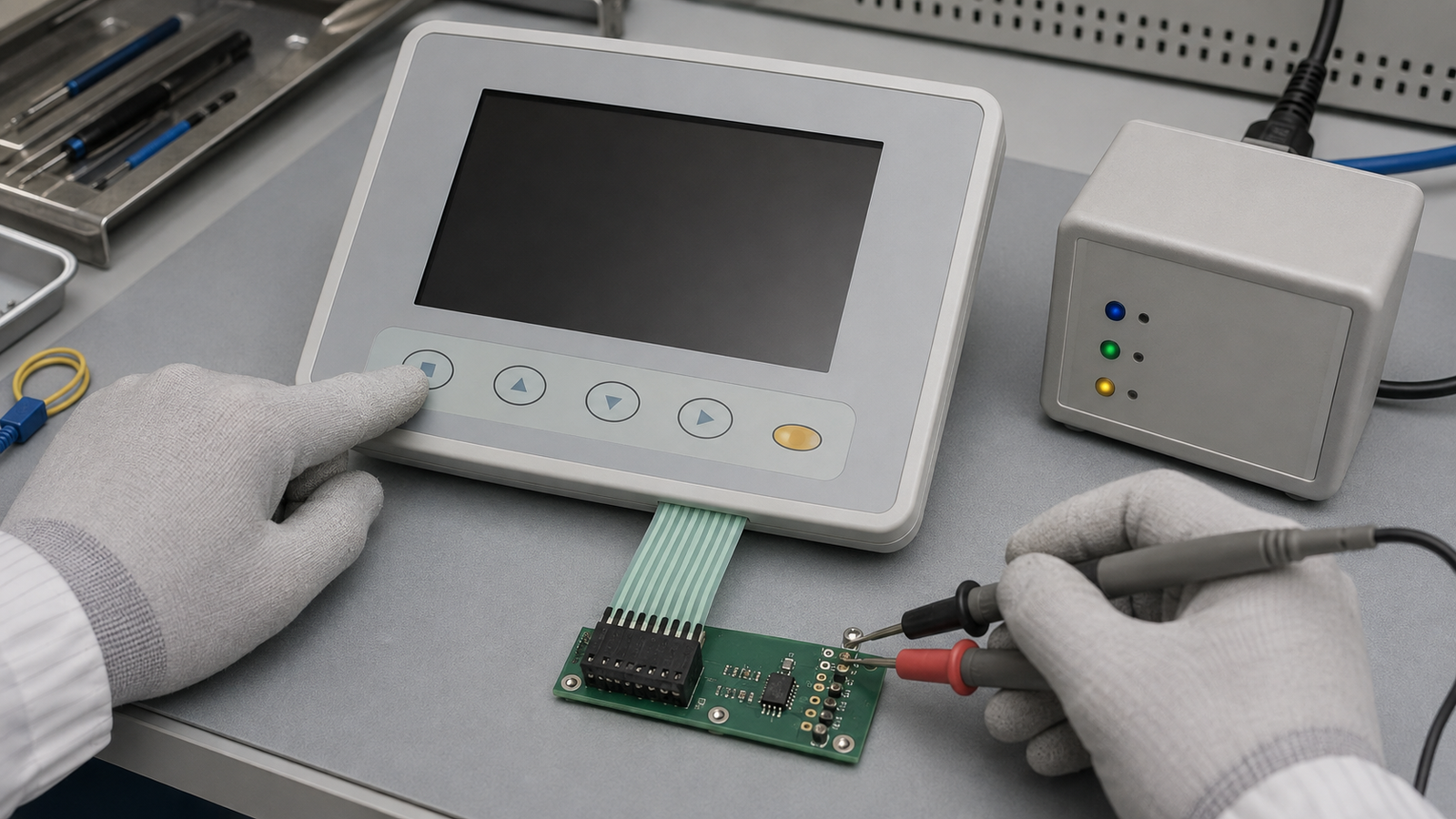
A patient monitor keypad should be replaced only when a required key fails a repeatable physical-input test. Loss of a monitored patient, alarm setting or application state after software service is a separate fault path. Before requesting a replacement quote, map each suspect key to its electrical contact, flexible tail, connector pin and PCB input. Then verify software-state persistence and recovery under the monitor manufacturer's controlled update procedure. This separation prevents a good keypad from being blamed for a software-state problem, and it also prevents a visible screen response from hiding an intermittent key circuit. The RFQ should define both evidence paths, but the keypad supplier should be asked to own only the component-level path it can actually test.
Did the key fail, or did the monitor lose state?
A September 3 FDA monitoring-system correction update describes a software-service situation in which some patients may be discharged from monitoring and alarm settings may reset. The FDA recommends using alternative monitoring before starting the update. The notice does not identify a membrane keypad defect, and it does not imply any relationship between Baoshengda and the named device manufacturer.
For a buyer, the useful lesson is the diagnostic boundary. A key press is a physical event. Patient association, alarm configuration and application recovery are software-controlled states. The two paths can meet at the user interface, but they do not become the same failure simply because the operator notices both on the front of the monitor.
Start by writing the exact symptom without interpretation. "The alarm-silence key does not close on the connector pins" is physical evidence. "The alarm setting returned to a default value after an update" is software-state evidence. "The screen did not change when the key was pressed" is only an observation until both paths have been tested.
Build two evidence trails before asking for a price
Use one record for the physical input path and another for monitor-state behavior. Do not collapse them into a single pass or fail result. The table below assigns each observation to a test and an owner.
| Observation | First check | Evidence to retain | RFQ consequence |
|---|---|---|---|
| One key never closes electrically | Probe the specified matrix pair at the loose tail | Key ID, pin pair, open and closed resistance, actuation location, repeat count | Include the failed key and electrical limits in the replacement request |
| Key closes at the loose tail but not through the installed connector | Inspect tail alignment, connector lock, contact contamination and pin continuity | Photos of the unmated and mated connector, continuity results, insertion condition | Quote only after connector and tail ownership are defined |
| PCB input toggles but the application does not respond | Compare the input event with the software state and command mapping | Software version, input log or controlled observation, expected command | Keep the keypad out of the root-cause claim until application testing is complete |
| Alarm or patient state changes after software service | Follow the monitor manufacturer's update and recovery instructions | Before and after configuration record, update step, recovery result | Treat as a monitor-level acceptance issue, not proof of a keypad fault |
| Failure appears only after mounting | Repeat the key map in the actual enclosure | Bezel compression, adhesive stack, flatness, actuation position and mounted results | Add the housing stack and compression condition to the sample drawing |
This split also improves supplier comparisons. Two quotations are not comparable if one supplier prices a keypad against a pinout while another assumes responsibility for monitor software, alarm behavior or a finished medical-device validation program.
Prove the physical input path without assuming the outcome
A useful keypad investigation moves from the least integrated state to the most integrated state. First test the loose keypad at its exposed tail or specified connector pins. Record the released condition and the pressed condition for every required key, not just the one reported as faulty. Use the agreed actuation point and enough repetitions to expose intermittent behavior. Do not invent an acceptance resistance after the samples arrive. Put the target and measurement method on the drawing or sample plan.
Next connect the keypad to the intended PCB or a controlled fixture. Confirm matrix mapping, common lines, LED or indicator circuits if present, connector orientation and the transition seen at the PCB input. A contact that is healthy at the tail but absent at the PCB points toward the interconnect, mating process or PCB path. A correct PCB input that produces the wrong command points beyond the keypad circuit.
Finally repeat the test in the enclosure. Bezel pressure, local adhesive thickness, a stepped support surface, tail bending or connector strain can change the result. Record the housing revision, gasket or adhesive stack, fastener condition and key location. A loose sample pass is not enough when the reported failure is mounted-only.
Buyers evaluating a custom medical-device HMI and membrane keypad can use this staged method to define what the component sample must demonstrate before it is approved for a replacement build.
Treat software-state recovery as separate acceptance work
Once the physical input is proven, run the monitor manufacturer's controlled procedure for the software service event. Record the software version, prerequisites, configuration backup, alternative-monitoring condition, patient-state handling, alarm-state handling and recovery result. This work belongs with the device OEM, software owner and responsible safety process.
Do not use a successful contact-resistance test to claim that alarm behavior is safe. Do not use a correct application response once to claim that every key contact is stable. The evidence can be linked by time and command, but each layer needs its own acceptance criterion.
A practical regression set can include a normal key press, press and hold if applicable, repeated actuation, update interruption handling, configuration restoration and the expected response after restart. The exact set depends on the finished device. A keypad supplier can provide samples, construction details and electrical results, but it cannot validate patient monitoring, alarm priority or software recovery without the complete system and the OEM's controlled requirements.
Define the keypad supplier boundary before replacement approval
The component supplier can reasonably confirm the overlay and key geometry, circuit stack, contact construction, matrix mapping, tail route, connector interface, adhesive outline and sample-level electrical behavior. It can also review evidence of local wear, crease damage, contamination, connector damage or mounting pressure when the buyer provides controlled samples and drawings.
The keypad supplier cannot determine whether a patient was correctly monitored, whether an alarm policy is clinically appropriate, whether software state persisted through an update, or whether the finished device meets medical-device safety and regulatory requirements. Those conclusions require the complete monitor, its software, the intended workflow and the manufacturer's verification process.
This boundary is especially important in supplier replacement. A new keypad built to an incomplete sample may reproduce the visible artwork while changing the tail datum, matrix, connector orientation or mounted feel. A quotation should therefore be conditional when the original controlled drawing, pinout or acceptance criteria are missing.
Stage samples so each result has one meaning
Use a small first stage to prove the electrical and dimensional assumptions. Approve artwork, perimeter, window, key centers, tail exit, connector orientation and matrix mapping before using a larger lot to judge long-run assembly behavior. If the project starts from an old sample, measure and document it, but mark every inferred dimension for confirmation.
A second stage can test the keypad on the intended PCB and in the intended housing. Record the same evidence for passing and failing units. If a reported problem occurs only after software service, retain a known-good keypad as a control while the OEM runs the software-state procedure. If it occurs only after mounting, keep a loose-keypad result from the same sample. Controls make the two fault paths visible instead of turning every front-panel symptom into a replacement request.
Send this drawing, sample and RFQ evidence packet
Include the following items so the quotation and sample plan answer the actual fault:
- Controlled front artwork and mechanical outline, including display and indicator windows.
- Key IDs, key centers, embossing or spacer details, and required actuation condition.
- Circuit schematic or matrix table with every key mapped to connector pins.
- Released and pressed electrical limits, measurement points, method and repeat count.
- Full tail drawing with exit location, bend restriction, contact side, pitch and connector orientation.
- PCB mating interface, input-voltage context and any pull-up, debounce or scanning assumptions the buyer can disclose.
- Enclosure section showing support surface, adhesive or gasket stack, bezel compression and flatness.
- Failure evidence that separates loose, connected and mounted results for the same sample.
- Monitor software version and service-event context, kept as device-level evidence rather than assigned to the keypad supplier.
- Separate acceptance criteria for the keypad circuit and for software-state or alarm recovery.
- Quantity, prototype and production stages, required records, change-control expectations and sample return plan.
If the key circuit fails the agreed staged test, the package is ready for a focused replacement quotation. If the circuit passes and the monitor still loses application or alarm state, keep the keypad as a control and continue with the monitor OEM's software investigation. To review a controlled drawing and sample plan, request a quotation with the physical-input evidence separated from the device-level symptom.
Need help reviewing a structure?
Send your drawing, photos, application, and quantity. Baoshengda can help check the structure before sampling.
Send Drawing for Quote