
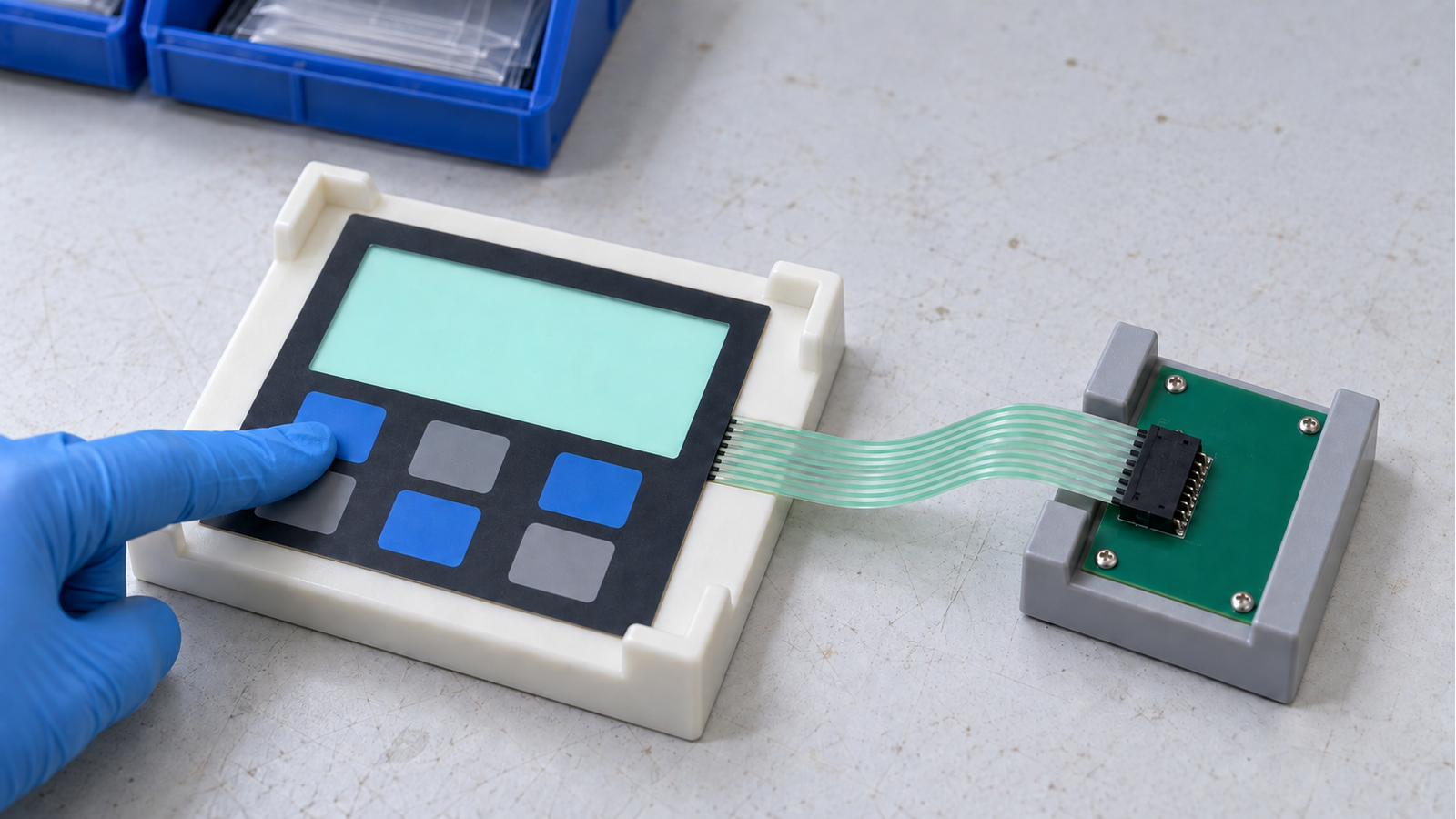
For medical membrane-keypad sourcing, ask a supplier to define both how many parts are tested and which electrical conditions are checked. “100% tested” should mean every supplied unit receives an agreed test; it does not automatically mean every key, unwanted connection or release condition is covered. Start with a key-to-contact map and a short description of the test sequence. If those documents are incomplete, send the existing panel information and ask what the proposed inspection would actually detect. Compare the coverage and retained evidence before comparing prices. A pass label without a defined test recipe leaves incoming acceptance open to interpretation.
Every unit is not the same as every condition
A useful quotation separates unit coverage from test coverage. Unit coverage says whether every part or a defined sample is inspected. Test coverage says which states, paths and limits the inspection evaluates. Neither term alone establishes the reliability of the finished equipment.
This distinction matters when a medical-equipment program moves beyond an initial build. In a September 10, 2026 deployment update, Medtronic reported the first European procedures using its Stealth AXiS surgical system. The report describes early use across several countries and a platform combining surgical planning, navigation and robotic assistance. It also places the platform within a connected surgical-technology ecosystem and describes further procedures as planned, rather than completed results.
That announcement is evidence of a medical-equipment deployment milestone, not a disclosure of its keypad construction or incoming-inspection method. It does not identify Baoshengda as a supplier. The relevant purchasing question for other medical OEMs is narrower: can the evidence accepted for an interface sample be repeated, understood and traced when subsequent component shipments arrive? A sophisticated connected system does not make its individual component checks self-explanatory. Procurement still needs an agreed definition of the part and the inspection being purchased.
For a membrane keypad, begin with the contact circuit. Treat display behavior, host software, alarms and motion commands as separate system evidence, not as results established by the component tester.
Translate the keypad drawing into observable checks
A key-to-contact map identifies which connector contacts should connect when a particular key is operated. It should state the viewing direction and connector orientation. Looking at the same tail from opposite sides can reverse the apparent contact order, so an unlabeled photograph is not enough for a test recipe.
The table below is a coverage discussion, not a universal test specification. Circuit architecture matters. A matrix, shared common, diode network or integrated indicator can create legitimate paths that must not be mistaken for shorts. Define expected behavior from the released circuit, not from an assumption that every pair should always be isolated.
| Test condition | Evidence to ask the supplier to define | What a simple pass indication can leave unclear |
|---|---|---|
| No key pressed | Expected resting contact states and checks for unintended connections | Whether the tester checks resting state at all |
| Each specified key pressed | The expected contact pair or matrix position, with agreed acceptance limits | Whether all keys are exercised or only a convenient example |
| Other paths during that press | Which additional connections are allowed and which must be rejected | Whether a correct connection can hide an unwanted one |
| Key released | Return to the specified resting condition after operation | Whether a closed contact remains after the finger is removed |
| Optional lights or auxiliary circuits | Separately agreed polarity, supply conditions and results | Whether a keypad-only test excludes these functions |
Do not borrow a resistance threshold or test voltage from an unrelated product. Agree appropriate limits, test conditions and settling behavior for the actual construction. A component quotation can identify which values are already specified and which still need engineering agreement.
For simultaneous key presses, state whether they are permitted and relevant. Do not add a multiple-key requirement merely because the tester can run it, or omit a required combination because single-key checks are easier.
Make the fixture prove its own connections
The test fixture is part of the evidence. A fixture that contacts the wrong pins, has a worn connection or uses the wrong recipe can produce an apparently consistent result that answers the wrong question.
Ask how the supplier identifies the fixture, mating connector and test-program revision. Confirm how the operator selects the correct keypad variant and how the setup is checked before a batch. The agreed setup check should demonstrate that the intended paths are measured and that representative known nonconforming conditions are rejected. Its method belongs in the inspection plan; a photograph of a green lamp does not describe it.
Support the keypad in the specified condition during the test. If the check is performed on a loose component, record that fact. If it relies on a backing plate or representative housing, identify that support. These are different test conditions and should not be interchanged without review.
Routine contact inspection also differs from durability, liquid ingress, chemical exposure and installation validation. Testing every unit for its agreed contact states does not establish that every unit has undergone every qualification test. Keep those evidence categories separate so an attractive percentage cannot expand into an unsupported claim.
Keep a result that the next shipment can reproduce
Before approving the supplier's reporting format, ask whether the record connects the result to the part number, revision, batch or agreed unit identifier and the applicable test recipe. Decide what must be retained and what will accompany the shipment. The necessary detail depends on the agreed control plan; a unique record for every unit should not be promised unless it is part of the supplied scope.
A combined pass result can be useful when the underlying recipe is controlled and its coverage is accessible. It is weak evidence when nobody can explain which tests produced it. Conversely, a long spreadsheet is not automatically useful if the connector view, acceptance limits or part revision is missing.
For a supplier change, compare inspection coverage rather than the appearance of the report. Two vendors may use different fixture designs while checking the same released requirements. Alternatively, nearly identical reports may hide different assumptions about key release or auxiliary circuits. Resolve those differences with identified samples and the agreed sequence, not by asking both vendors to print the same certificate wording.
Baoshengda's medical-device HMI and membrane-keypad capabilities include component inspection planning, electrical continuity and key-function checks. The inspection offered for a particular order must still be agreed. This article does not claim that every construction uses one standard fixture, test percentage or traceability format.
Agree the inspection scope before comparing prices
You can start the discussion without a complete production package. A panel photograph, key count, known connector and an example of the existing report can help establish what needs clarification. Indicate whether the project is a new build, an incoming-quality concern or a potential supplier change. Do not send patient data or confidential information unrelated to the component review.
For an initial enquiry, share what is available from this short list:
- Panel or keypad description, approximate dimensions and the keys or indicators included.
- Existing circuit or contact map, with the connector view identified; mark missing information as unknown.
- The proposed meaning of “tested,” including unit coverage and required press/release conditions.
- Any existing inspection-report example and the evidence you need with a shipment.
- Sample quantity, anticipated order quantities and the stage of the equipment program.
An indicative quotation should identify unresolved limits, fixture work and reporting assumptions. Sample approval needs an agreed drawing and test sequence that both parties can evaluate. Production release needs the approved revisions, acceptance criteria and traceability arrangement. Those later requirements should guide the project, not prevent an early discussion.
The medical-device manufacturer remains responsible for complete-device verification, clinical use, software behavior and applicable regulatory obligations. A membrane-switch supplier's contact record supports that work; it cannot replace it.
Request a medical keypad inspection-scope review with the information you already have. Ask the response to separate the component price, fixture or setup work, electrical coverage and delivered records. The practical outcome is not a stronger slogan. It is an inspection agreement that purchasing, engineering and incoming quality can all interpret the same way.
Need help reviewing a structure?
Send your drawing, photos, application, and quantity. Baoshengda can help check the structure before sampling.
Send Drawing for Quote