
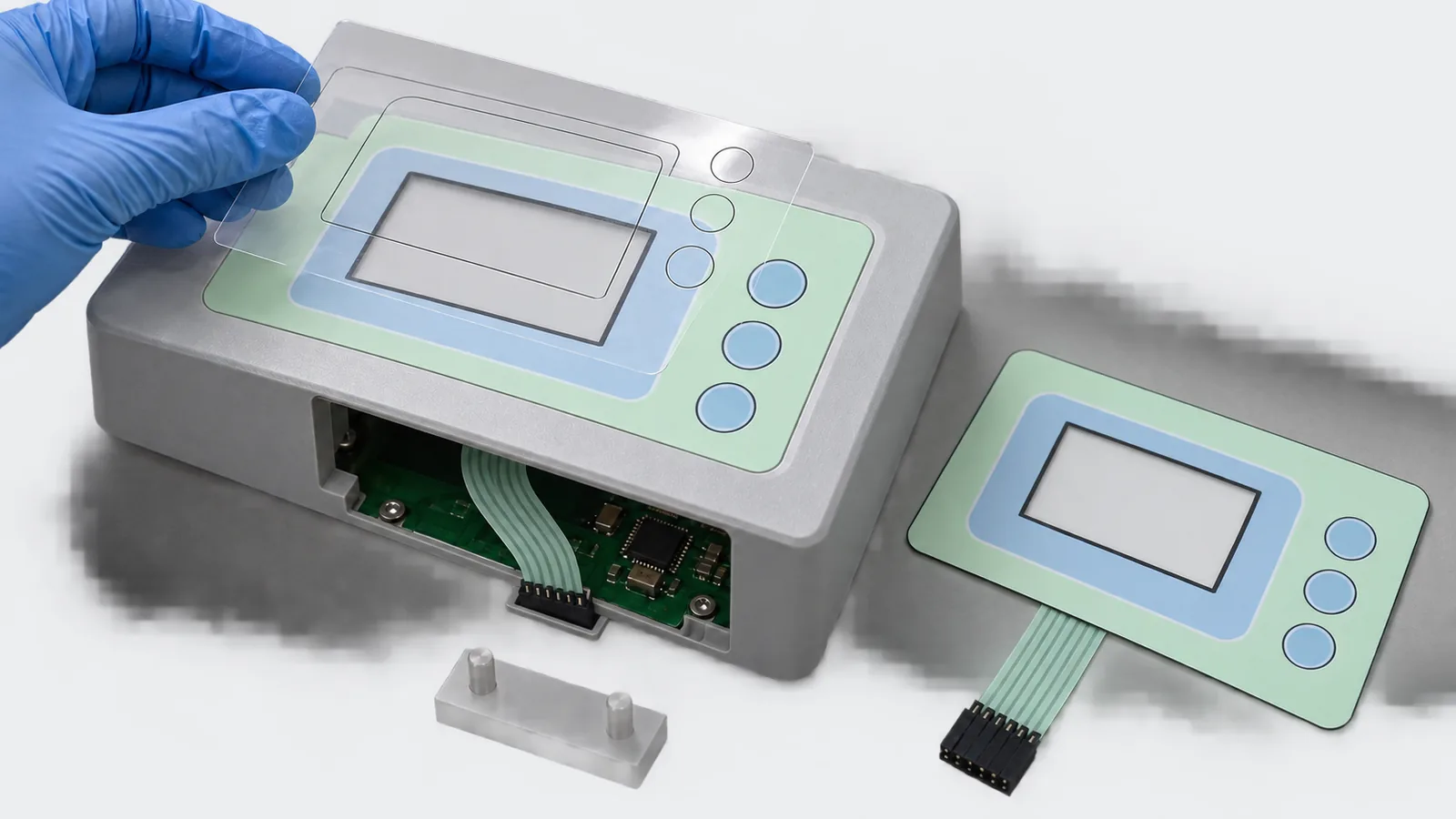
When medical-equipment use instructions change, do not automatically revise the control panel. Build an instruction-to-interface map first. Classify each changed instruction as documentation-only, a visible legend or window change, a physical-key function change, or a system-logic change outside the passive panel. Baoshengda can quote only the affected overlay, membrane circuit, tail and connector once that boundary is clear. Start the enquiry with the changed instruction, the controlled current panel and available interface evidence. Keep uncertain items as quotation assumptions, compare the revised loose sample with the approved baseline, and complete installed checks before releasing matched artwork, circuit and inspection files for production.
A current instruction update does not automatically create a panel revision
The FDA's September 18 correction communication says affected users should follow updated use instructions and complete specified pre-use system checks. The communication concerns the NOxBOXi nitric-oxide delivery system and NOxMixer module. It does not identify Baoshengda, disclose a membrane keypad, require a new control-panel legend, or assign any safety function to a passive overlay.
The durable component question is narrower. When instructions change, the equipment maker must decide whether the physical interface remains correct or whether a visible label, key assignment, display window, contact map or service-access cue is now inconsistent with the controlled device documentation.
The decision rule is to map each changed instruction to one physical interface owner before changing artwork. The current FDA communication supports the need to reconcile revised instructions and pre-use actions. Baoshengda's public medical-device HMI guide supports component review of overlays, tactile keys, membrane circuits, flexible tails, connectors and samples. That first-party evidence does not prove the correct medical instruction, software response, alarm behavior, risk control, clinical performance or regulatory release.
Use four change classes instead of sending a marked-up PDF
A marked manual can show what wording changed, but it does not tell a panel supplier which controlled files are affected. Classify the change before asking for price or tooling.
| Change class | Example buyer question | Passive-panel evidence | Owner outside the component |
|---|---|---|---|
| Documentation only | Does the instruction describe an existing action more clearly without changing what the operator sees or presses? | Confirm current artwork, key map and window relationship remain correct | Equipment documentation and regulatory owners approve the instruction |
| Visible interface | Does a legend, color zone, symbol location or display-window cue need to change? | Current and proposed artwork, panel geometry, color reference and revision note | Human-factors and device owners approve meaning and placement |
| Physical input | Does the permitted key function, active center or contact assignment change? | Key-to-contact map, circuit revision, tail pinout and connector evidence | Controller and software owners approve the accepted input and response |
| System behavior | Does the change concern sequence, alarm logic, pre-use checks or a safety response beyond the passive contact? | Record that the passive panel is unchanged unless an approved interface impact is issued | Equipment maker owns logic, risk control, verification and final release |
This map prevents a documentation update from becoming an unsupported component redesign. It also prevents a genuine key or circuit change from being treated as artwork only.
Start the enquiry with the changed instruction and one controlled baseline
An initial enquiry can begin before every release file is complete. Send the changed instruction or approved change summary, the current panel revision, straight-on front and rear evidence, the equipment revision, approximate quantities and the deadline for a first sample review. Mark confidential content before sharing and remove patient or customer information that is not needed for the component decision.
Name the controlling baseline. It may be a released drawing package, an approved golden sample or a reconciled service record authorized by the equipment owner. A field-marked panel or an unverified photograph can be supporting evidence, but it should not silently replace the controlled baseline.
Ask the supplier to identify missing mechanical, artwork and electrical inputs. That creates a useful conversation without presenting an unfinished change as approved.
Keep quotation assumptions separate from sample evidence
For an indicative quotation, state which class of change is being priced. A visible-interface revision may affect film, printing, color matching, embossing, window geometry or tooling. A physical-input revision may also affect the membrane circuit, spacer, dome locations, tail, stiffener, pinout or connector. If the controller-side input or released dimensions are unavailable, label the quoted contact map and geometry as assumptions.
Do not assume that unchanged outer dimensions mean an interchangeable part. A new legend can move over the wrong active center. A circuit change can reverse the expected pin map. A tail can keep the same length but change contact side or connector orientation. These differences need controlled evidence, not a note that the new panel “looks the same.”
Baoshengda can review manufacturability and the passive component interfaces. The equipment maker and qualified partners still own use instructions, human factors, medical risk analysis, software, alarms, system checks, cleaning validation, EMC, electrical safety and regulatory decisions.
Compare the loose sample, then check the installed interface
First compare the revised loose sample with the authorized baseline. Check complete outline, display-window position, legend registration, key centers, tactile structure, circuit continuity, contact map, tail length and direction, contact side, stiffener and connector. Record the drawing, artwork, circuit and sample revisions used for the comparison.
Then mount the same sample in a representative enclosure with the intended support, adhesive or gasket and mating connector. Confirm window alignment, edge seating, installed key feel, tail bend, connector reach and service access. If the instruction change affects an operator action, the equipment owner should verify that action in the complete device under its own approved protocol.
The mounted check does not prove the instruction is medically correct or that the system responds safely. It confirms only that the passive component and its declared interfaces match the approved component revision.
Release matched files, not a collection of separate approvals
Production release should connect the instruction-impact decision to one matched component package: mechanical drawing and datums, artwork and color references, material and finish, key geometry, circuit and pinout, tail and connector, adhesive or gasket, inspection points, accepted sample and change-notification rule. The package should also identify what did not change.
Purchasing should not release a new order from artwork alone when the contact map changed. Inspection should not accept a visually correct panel against an obsolete circuit. Service teams should be able to identify the equipment revision, panel revision and approved instruction set without guessing which file came last.
Send the change map before requesting a revised quote
Prepare a one-page map with four columns: changed instruction, change class, affected component evidence and responsible approval owner. Attach the controlled current panel, proposed artwork or key map if available, enclosure/interface evidence, quantities and open assumptions.
Use the Request a Quote page to ask for a component-level review of a medical-device HMI panel. Baoshengda can help turn an approved physical-interface change into overlay, tactile, circuit, tail, connector and sample inputs. The quotation and component sample do not replace the equipment maker's documentation control, software verification, medical risk work or final device release.
Need help reviewing a structure?
Send your drawing, photos, application, and quantity. Baoshengda can help check the structure before sampling.
Send Drawing for Quote