
A supplier transfer for an industrial robot service keypad should preserve more than the front artwork or a simple continuity result. Freeze the complete component interface: outer profile and display-window datums, key-to-contact map, tail exit, connector pinout, stack-up, adhesive boundary and installed support. An enquiry can begin with an old part, photographs, the equipment revision and the reason for replacement. A quotation should list every provisional material or dimension. Samples should be checked loose and mounted for fit, key function, release state, connector orientation and service routing. Production release needs approved artwork, mechanical and circuit records, an inspection plan and a retained reference. Robot safety validation remains with the equipment owner.
Define the replaceable component before comparing suppliers
An industrial robot may have several interfaces: a teach pendant, an enclosure-mounted operator panel, a small service keypad or local buttons near the work area. Those items do not have the same construction or responsibility. A service keypad may be a complete membrane-switch assembly with printed overlay, spacer, circuit layers, flexible tail and connector. Another panel may be only a passive graphic overlay over a separate switch board.
Start by naming the exact replaceable component. Photograph the front, rear, edges, tail exit and connector. Record the equipment model and revision, but keep customer or licensed artwork private. Note whether the old part can be removed intact and whether a mating housing, bezel or controller sample is available. If construction is uncertain, ask the replacement supplier to quote an explicit assumption rather than silently treating every flat control face as the same product.
A supplier transfer is not permission to redesign a robot control function. It is a controlled component-sourcing project. The equipment manufacturer or integrator owns the control allocation, safety function, machine validation and final release.
Use current robot-interface changes as context, not component proof
A September 14 Universal Robots announcement about its Gen 7 platform describes a redesign spanning the controller, teach pendant and tool-flange interface. It also identifies a local Smart Panel with physical input buttons. The release is current evidence that robot platforms continue to change where and how operators interact with equipment.
The announcement does not identify Baoshengda, disclose a membrane-switch construction or establish a component supply relationship. It therefore cannot be used to copy a product or claim compatibility. Its useful procurement lesson is narrower: when an interface platform changes, a replacement component must be tied to the correct hardware and software revision. A keypad that looks familiar may still have different mounting support, contact logic, connector orientation or allowed function.
Preserve mechanical, electrical and integration baselines together
Front artwork is only one layer of the transfer package. Mechanical evidence should define the panel perimeter, window and hole datums, total thickness, tail exit, adhesive coverage and supported mounting area. If a housing can apply preload or bend the switch, capture the bezel opening, backing surface and assembly sequence as well.
Electrical evidence should identify each key position, circuit common, contact path, connector pin and released-state expectation. A resistance or continuity check on one path does not prove the complete key map. If the existing design uses a matrix, diode, shielding layer or shared common, document that architecture before a new test fixture is approved.
Integration evidence connects the two. Tail bend radius, connector mating direction, strain relief, service access and clearance inside the enclosure can decide whether a dimensionally correct switch installs without damage. Do not approve the tail as a detached drawing while the panel and housing are reviewed separately.
| Transfer evidence | What the replacement supplier can evaluate | What remains with the equipment owner |
|---|---|---|
| Old keypad and front/rear photographs | Product family, visible layout, wear and missing inputs | Whether the old part represents the released revision |
| Mechanical drawing or measured sample | Perimeter, window, holes, thickness and tail exit | Housing tolerance, support and assembly process |
| Circuit map and connector view | Key paths, pinout, common structure and fixture concept | Control logic, assigned function and safety classification |
| Housing or bezel sample | Mounted fit, support, clearance and tail routing | Whole-device validation and installation approval |
| Approved sample and inspection plan | Repeatable component checks and revision reference | Final robot release, compliance and field authorization |
Separate enquiry inputs from quotation assumptions
A useful first enquiry does not need to pretend the file set is complete. Send the available old part, clear photographs, approximate dimensions, equipment revision, failure reason, sample quantity, expected production quantity and any known tail or connector information. State which drawings or housing samples can follow.
The supplier should return an assumption list with the quotation. That list may identify provisional film family, surface finish, adhesive, stack-up, tail length, connector and tolerance class. It should also state whether the scope is overlay-only or a complete membrane-switch assembly. Unresolved items should stay visible until a controlled sample or drawing closes them.
Price and lead time cannot be treated as fixed before the construction, quantity and evidence are reviewed. A supplier can help identify missing inputs and propose a sample sequence, but should not infer customer artwork ownership, robot compatibility or regulatory status from a part number or internet photo.
Approve samples in a sequence that exposes transfer risk
First compare the new loose sample with the released old reference. Check the complete perimeter, window registration, key-zone positions, tail exit and connector orientation. Verify the key-to-contact map and the released state, including unrelated paths that should remain open. Record the fixture revision and acceptance method instead of relying on a green pass light with no defined coverage.
Next install the sample in a representative housing or controlled mockup. Confirm that the bezel does not distort the active area, that backing support is appropriate and that the tail reaches the connector without twisting or sharp folding. Exercise the intended service action with the agreed glove or tool condition when relevant. Compare the approved reference and candidate under the same mounting and sequence.
A sample can approve only the items actually checked. Temporary tooling, provisional colors or hand-cut features must be listed so that a convenient prototype does not become an accidental production standard.
Release production with revision and retained-reference control
Before production, replace provisional assumptions with an approved package. It should include:
- controlled artwork and mechanical dimensions with datums;
- released circuit map, pinout and connector specification;
- agreed film, print, spacer, circuit, adhesive and support stack-up;
- tail exit, length, bend and strain-relief requirements;
- component inspection coverage and acceptance criteria;
- approved sample, revision identity, packaging and handling notes;
- change-notification responsibility for materials, tooling and artwork.
Keep one retained approved reference under known storage conditions and link it to the drawing and inspection revision. For service spares, also define how the part number distinguishes robot hardware revisions and how returned stock is prevented from mixing with a new release.
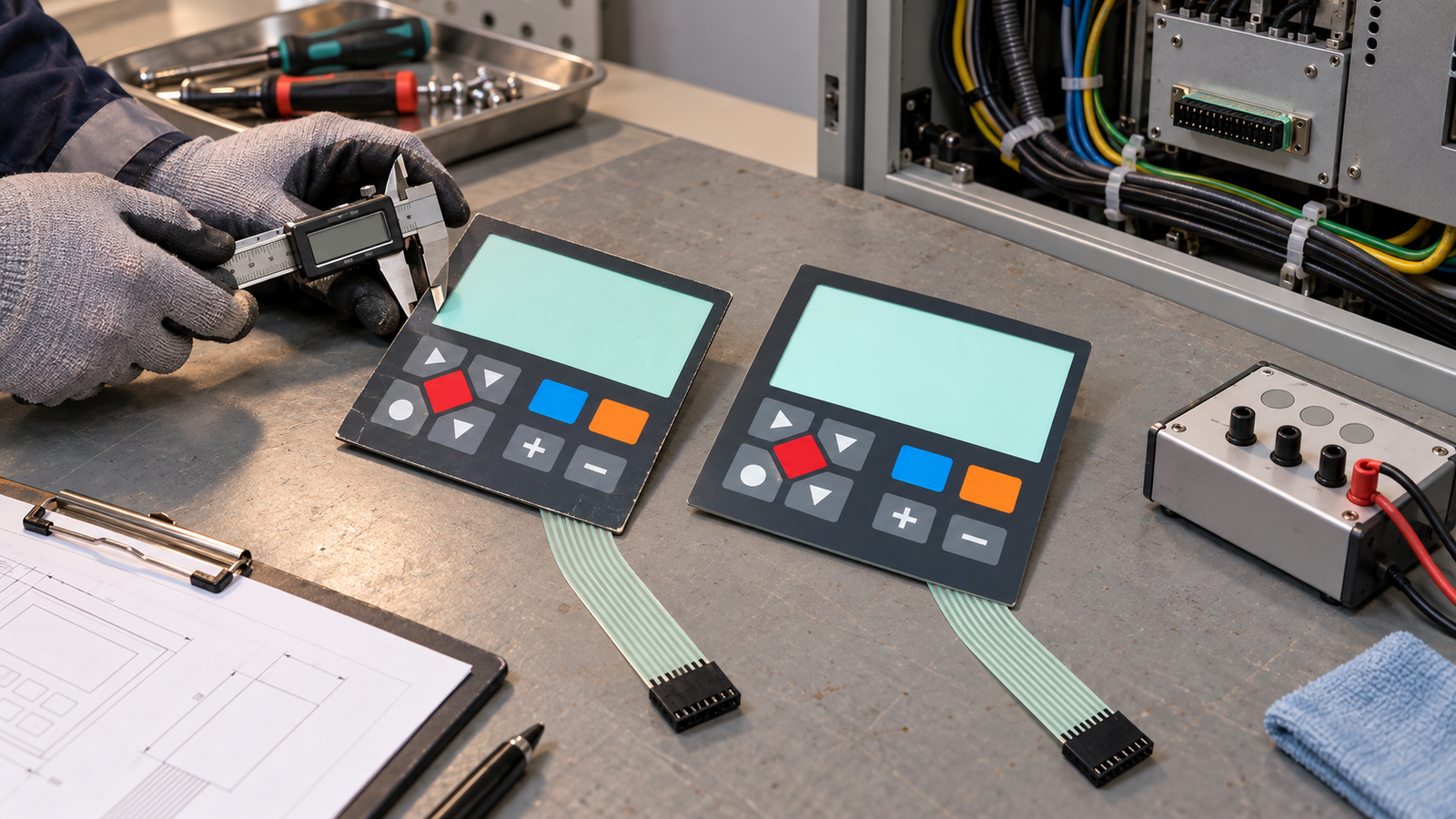
The generated cover for this article illustrates a generic old-versus-new service-keypad review beside an unbranded controller enclosure. It is not a real customer robot, a compatibility result or proof of any safety function.
Review the custom membrane switch construction and integration options before freezing a replacement scope. Then send the authorized old-part evidence for a supplier-transfer review and ask the response to separate quotation assumptions, sample checks and production-release requirements.
Need help reviewing a structure?
Send your drawing, photos, application, and quantity. Baoshengda can help check the structure before sampling.
Send Drawing for Quote