
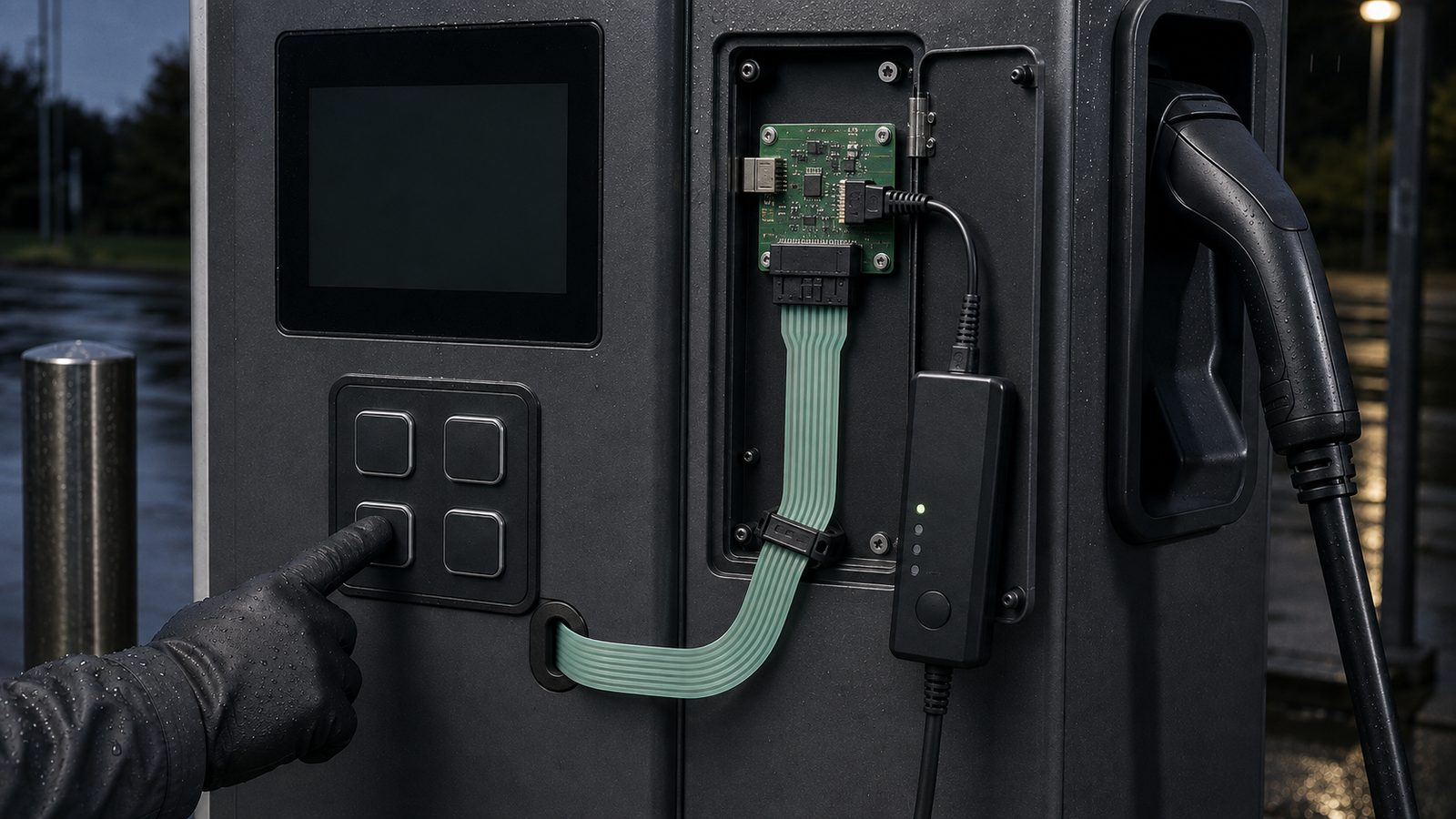
Before approving an EV charger keypad sample, trace every physical input through five linked checks: the key ID, contact closure, connector pin, controller event, and resulting visible or transaction state. A waterproof membrane switch for an outdoor charging interface can provide compact tactile input, but a loose-panel continuity test cannot prove that Start, Stop, Cancel, Help, or service navigation is interpreted correctly by the mounted charger. Approve the sample only after the final enclosure, seal, glove condition, tail route, connector orientation, controller mapping, and session-record test agree. Payment, charging authorization, network behavior, and electrical safety remain the charger-system team's responsibility.
Current charging data makes the action-to-record chain inspectable
The United Kingdom's National Data Library shows an Electric Vehicle Charging Transactions dataset updated on September 4, 2026. Its public description identifies location, time, total energy, and connection duration as transaction fields. The dataset does not specify a keypad, membrane switch, charger protocol, or user-interface design. It is also not evidence that the publisher uses Baoshengda components.
What it makes visible is the evidence boundary. A charger session is not just a key press. It becomes a sequence of controller decisions and records. If a physical stop key closes the correct contact but the controller assigns it to a navigation input, the keypad itself may pass continuity while the installed interface fails. If the controller accepts a stop request but the network record arrives late, the physical input should not be blamed without an event trace. If two replacement panels use different connector views or mirrored pin maps, visually identical key zones can produce different events.
For buyers, this is a sample-approval problem. The panel drawing, input matrix, controller event list, visible feedback, transaction fields, and test timestamps must use one controlled set of IDs. That turns a general outdoor HMI quotation into a package that purchasing, mechanical, firmware, network, and service teams can compare.
Freeze one input-to-event-to-record matrix before quotation
Start with the actions that genuinely need a physical key. A public charger may use a touchscreen, phone, payment terminal, vehicle communication, or remote operator for many steps. Do not add a physical key merely because there is space on the overlay. Use it where tactile discovery, wet-glove operation, accessibility, emergency recovery, service navigation, or a stable fallback path has been deliberately assigned by the finished-equipment team.
Give each key a stable identifier that appears on the artwork drawing, circuit drawing, connector pin map, firmware input table, test log, and service document. Define whether the contact is momentary or maintained, normally open or normally closed, and whether simultaneous or repeated presses are valid. Then specify the controller event expected from that contact and the visible response that confirms acceptance.
The transaction field is the last link, not the first. Some physical actions may create a session record immediately. Others may only request a state change that the charger later accepts or rejects. Record both the local event time and the backend receipt time. A delayed network message must not make a correct key look intermittent, and a bright status indicator must not be treated as proof that a backend record exists.
| Physical-input case | Component evidence | Mounted charger evidence | Transaction or system evidence | Approval decision |
|---|---|---|---|---|
| Start or confirm request | Intended contact closes; adjacent circuits remain open; pin matches drawing | Controller receives the named input and shows the defined accepted or rejected state | Session record uses the expected charger, connector and timestamp | Pass only when all identifiers reconcile |
| Stop or cancel request | Key returns normally and contact is repeatable under the agreed fixture | Charger enters the buyer-defined safe sequence and gives local feedback | End reason, energy and duration are recorded by the owning system | Panel supplier proves the input, not safe power-state completion |
| Help or service navigation | Correct matrix address or discrete line is present | Only the intended menu or service event appears | No charging transaction should be created unless specified | Reject unexpected side effects |
| Network delay during an input | Contact and controller event remain observable locally | Local feedback follows the offline rule | Backend arrival is delayed, queued or absent according to system design | Diagnose the communication layer separately |
| Replacement sample | Outline, key centers, tail datum, connector and pin map match the released revision | Installed response matches the golden sample | Event names and records remain unchanged | Approve only with revision-controlled parity evidence |
This table prevents the word functional from hiding four different tests. A supplier can prove a contact closes. The charger team can prove the mounted controller receives the correct event. The backend owner can prove the record is stored and reconciled. Sample approval should name which proof belongs to whom.
Test the keypad in the real mounting and weather boundary
A loose sample cannot demonstrate the interface that the operator touches. Install the keypad on a representative front plate or production-equivalent enclosure coupon. Use the specified coating, cutout, surface finish, adhesive or gasket, assembly pressure, and dwell time. Keep the complete perimeter landing visible during inspection. A product-family name such as waterproof does not establish a finished charger rating.
Define the wet and glove condition without creating an unsafe test. Record glove material or thickness, the amount and location of surface moisture, actuation direction, posture, and support behind the key zone. Press each key repeatedly without bracing the overlay edge. Check for missed inputs, adjacent-key activation, housing movement, edge lift, and slow key return. The buyer should set the numerical acceptance limits and the finished-equipment safety procedure.
Inspect the tail path with the charger open and closed. The drawing should show the tail exit, first allowed bend, bend keepout, service loop, stiffener, strain relief, connector insertion direction, contact side, and pin-numbering view. Keep the tail away from sharp sheet-metal edges, door seals, high-voltage conductors, heat sources, and moving cable hardware. A sample that works with an open service hatch can still be damaged when the door closes.
Use a continuous gasket or adhesive landing around the panel according to the released stack. Water should not be invited toward the tail exit by an unplanned groove or fastener. After the agreed conditioning, recheck appearance, adhesion, key actuation, circuit continuity, tail condition, connector retention, and input mapping. Whole-charger ingress verification belongs to the finished-equipment program.
Run four sample cases, not one successful session
A normal charging session is necessary but insufficient. Build a small test set that exposes where the evidence chain can separate.
First, run the normal case. Apply each physical input once, capture the local input identifier and controller event, observe the specified feedback, and reconcile the resulting session field. Use synchronized time sources or record the known offset. Keep screenshots or logs free of customer identities in supplier-facing packages.
Second, introduce a controlled communication delay or disconnected test network under the charger's approved laboratory procedure. Confirm which local actions remain available, which feedback is shown, and how queued or missing records are identified. The membrane switch should not be redesigned to compensate for undefined network behavior.
Third, interrupt the session at each buyer-defined boundary, such as before authorization, after connector detection, after energy flow begins, or while the controller is completing a stop sequence. Confirm that a repeated press does not create a duplicate event unless the specification calls for it.
Fourth, install a revision-controlled replacement sample. Repeat the exact matrix and record check. This exposes mirrored connectors, changed contact sides, shifted key centers, altered tail lengths, and undocumented firmware assumptions before a spare reaches a service site.
For every case, keep a failure classification field: component contact, harness or connector, controller mapping, visible feedback, network transport, transaction database, or unresolved. Do not replace a keypad because the first visible symptom appears on its front surface.
Keep the supplier boundary explicit
Baoshengda can review and manufacture the specified graphic overlay, embossed or flat key zones, spacer and membrane circuit, adhesive or gasket interface, flexible tail, stiffener, and specified connector. Agreed component checks can cover dimensions, appearance, key registration, circuit continuity, resistance where defined, connector orientation, and actuation under a named fixture. A mounted coupon can add evidence for panel fit, perimeter landing, glove operation, tail routing, and connector access.
Baoshengda does not define charger authorization, payment processing, transaction schemas, energy measurement, charging protocols, backend timing, network retries, firmware state machines, electrical protection, emergency isolation, cybersecurity, accessibility compliance, or finished-charger ingress rating. The equipment manufacturer and relevant system owners must define and validate those functions. The current public dataset supplies context for transaction evidence, not a charger-interface requirement.
The cover is a generated engineering application scene. It illustrates a de-energized mounted input-mapping check with a keypad, seal, tail, connector, event logger, and parked charging cable. It is not a customer installation, live field procedure, certification test, or proof of charger performance.
Send a drawing, sample, and RFQ package that can be compared
Before using the Request Quote page, prepare a controlled package with:
- front artwork and a stable ID for every physical key, indicator, display window, and tactile feature;
- the reason each action needs a physical input rather than touch, phone, vehicle, or remote control;
- contact type, circuit matrix or discrete line, electrical limits, debounce owner, and simultaneous-key rule;
- an input-to-event-to-feedback-to-record matrix with accepted, rejected, repeated, and offline behavior;
- charger front-plate drawing with datums, cutout, coating, surface finish, mounting orientation, and flat landing width;
- layer stack, overlay material and texture, adhesive or gasket request, perimeter detail, drainage concept, and tail exit;
- full tail geometry with first-bend keepout, service loop, stiffener, strain relief, closed-hatch clearance, and nearby hazards;
- connector manufacturer and part, mating part, contact side, insertion direction, keying, pin map, and pin-numbering view;
- glove and moisture conditions, mounting support, actuation method, repetitions, and buyer-set acceptance limits;
- a golden sample plus loose, enclosure-coupon, mounted charger, and replacement-sample quantities;
- test cases for normal, delayed-network, interrupted-session, repeated-input, adjacent-key, and replacement conditions;
- log fields and timestamps that let the buyer separate contact, mapping, feedback, network, and transaction failures;
- privacy rules that remove account, payment, vehicle, user, site, and customer identity from supplier-facing evidence;
- change-control rules for artwork, circuit, tail, connector, materials, controller mapping, and firmware interface;
- a responsibility matrix stating what the panel supplier, charger manufacturer, firmware team, network operator, payment provider, and test owner must prove.
Ask suppliers to return every assumption and open point with the quotation. A useful sample approval is not a photograph of a keypad that lights up. It is a controlled evidence chain showing that the intended key closes the intended circuit, reaches the intended controller input, produces the intended local state, and reconciles with the system record under the exact mounting and service conditions the buyer will release.
Need help reviewing a structure?
Send your drawing, photos, application, and quantity. Baoshengda can help check the structure before sampling.
Send Drawing for Quote