
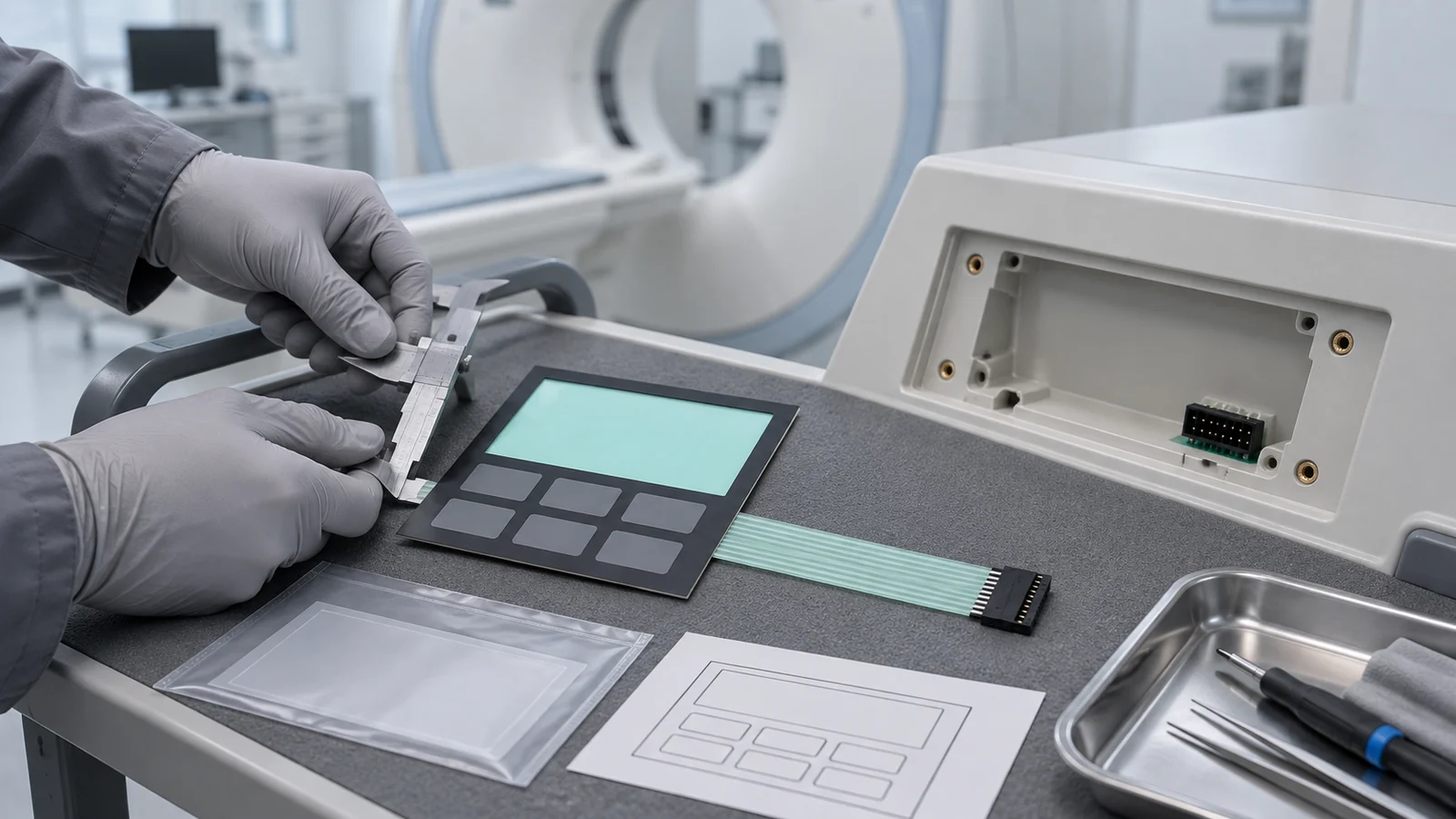
Freeze the passive panel revision before asking a replacement supplier to match it. Start with authorized front, rear and edge evidence, the panel opening and support datums, the key-to-contact map, tail exit, connector, known material stack and current revision. Keep every unverified dimension or material as a quotation assumption. Then compare a new sample with the approved reference first as a loose component and again in the representative console. Production release should control artwork, mechanical datums, circuit, tail, connector, stack, inspection method and change notification. The equipment maker still owns software behavior, scanner safety, EMC, cleaning validation and final system compatibility.
A new imaging installation makes service continuity visible
Philips reported on September 17 that Southwest Mississippi Regional Medical Center installed the first Rembra CT system in the United States for acute and high-demand imaging environments. The release describes emergency and general radiology use and cites faster initialization, image selection and patient positioning among the hospital's early workflow observations.
That is useful current context for equipment owners planning service continuity. It does not identify Baoshengda, disclose a membrane keypad, or prove any component supplier relationship. A CT operator panel is only one possible passive interface inside a much larger regulated system. The durable buyer question is how to transfer that passive panel without confusing visual similarity with an approved revision.
Establish one authorized revision baseline
A replacement project can begin with an old panel, photographs or measured dimensions, but those inputs do not automatically carry the same authority. Name one baseline and state why it is trusted. It may be a released drawing set, an approved golden sample, a controlled service-spare record, or a reconciled package signed by the equipment owner.
The baseline should connect the front appearance to the hidden interfaces. Capture the complete outline, display-window geometry, key locations, support and adhesive lands, rear stack, tail exit, bend-free zone, connector and contact map. Record the equipment and panel revision together. If an old sample was repaired, trimmed or relabeled in the field, do not present it as unchanged production evidence.
| Buyer decision | Evidence needed for the first enquiry | What may remain a quotation assumption | What must be verified before release |
|---|---|---|---|
| Panel identity | Authorized photos, sample history and revision label | Which legacy file is controlling | One reconciled baseline approved by the equipment owner |
| Mechanical fit | Opening, outer geometry, support datums and available depth | Measured dimensions without released tolerances | Loose outline plus representative mounted seating |
| Electrical handoff | Key-to-contact map, tail exit, contact side and connector evidence | Unreleased pinout, controller input or mating part | Circuit, pinout, connector and continuity criteria |
| Construction | Known surface, adhesive, backer, gasket and tactile evidence | Unconfirmed material brand or stack thickness | Controlled stack and agreed component inspection |
| Change control | Current supplier or service-spare revision history | Unknown historical substitutions | Named notification, traceability and segregation rule |
This table keeps evidence quality visible. It also prevents a measured replacement from being described as drawing-equivalent before the differences are resolved.
Keep passive-panel scope separate from scanner ownership
A component supplier can review the graphic face, tactile structure, membrane circuit, backer, adhesive or gasket, flexible tail, connector and component-level inspection points. The equipment maker or system integrator must still own the console enclosure, mating PCB or harness, controller behavior, display electronics, cleaning protocol, EMC, electrical and medical safety, service procedure and final system release.
That boundary matters during quotation. If the released connector or input circuit is unavailable, the supplier may price a provisional tail and connector based on supplied evidence. The quotation should label that assumption instead of implying verified scanner compatibility. Likewise, a supplier can manufacture to a specified cleaning-resistant surface or sealed component edge, but cannot infer complete-equipment cleanability or ingress performance from the keypad alone.
Approve the loose sample, then the mounted interface
The loose sample answers component questions efficiently. Compare overall shape, display-window position, artwork registration, key spacing, tactile consistency, stack thickness, tail length, contact side, stiffener and connector. Check the key-to-contact map against the controlled circuit record. Photograph the same sample from the front, rear and edge so later review does not depend on memory.
A mounted review answers different questions. Seat the sample in a representative console with the intended support, adhesive or gasket, mating connector and service access. Confirm that the panel lies flat, the window aligns, keys retain the expected feel, the tail stays inside its allowed bend zone and the connector reaches without strain. Record any fixture, console, interface-board and sample revisions used for the check.
The mounted sample does not approve imaging performance, software, alarms, EMC or patient safety. It confirms only that the passive component and declared interfaces are ready for the equipment owner's downstream validation.
Separate enquiry inputs from release records
A useful first enquiry can be incomplete as long as the gaps are named. Send authorized front, rear and edge evidence; approximate dimensions; the panel opening and support datums; the known tail and connector condition; the replacement reason; prototype, service-spare and expected production quantities; and the current equipment and panel revision.
For an indicative quotation, ask the supplier to list assumptions for measured versus released dimensions, surface and artwork, tactile method, circuit, adhesive, backer, gasket, tail direction, connector, tooling, sample quantity and inspection coverage. Exclude scanner electronics, software, EMC and final equipment validation unless a separate qualified owner is explicitly assigned.
Before sampling, add the controlled interface files or a documented reconciliation plan. Before production release, approve the artwork, mechanical drawing, circuit and pinout, stack construction, tail and connector specification, inspection method, representative mounted sample, change-notification rule and service-spare traceability. Do not collapse these four stages into one generic RFQ attachment list.
Ask for evidence support, not a whole-scanner promise
Baoshengda can review a medical-device HMI component package that includes the passive operator-panel face, tactile and circuit construction, flexible tail, connector, controlled component drawings and agreed inspection inputs. The practical supplier task is to expose missing interface evidence early, build a sample against declared assumptions and manufacture the approved passive component consistently.
The equipment maker remains responsible for the scanner enclosure, mating electronics, software, imaging performance, alarms, cleaning validation, EMC, electrical and medical safety, service installation and final system compatibility. To start a controlled transfer, send the authorized panel evidence, revision history and required quantities. Mark which files are released, which values are measured and what the loose and mounted samples must answer.
Need help reviewing a structure?
Send your drawing, photos, application, and quantity. Baoshengda can help check the structure before sampling.
Send Drawing for Quote