
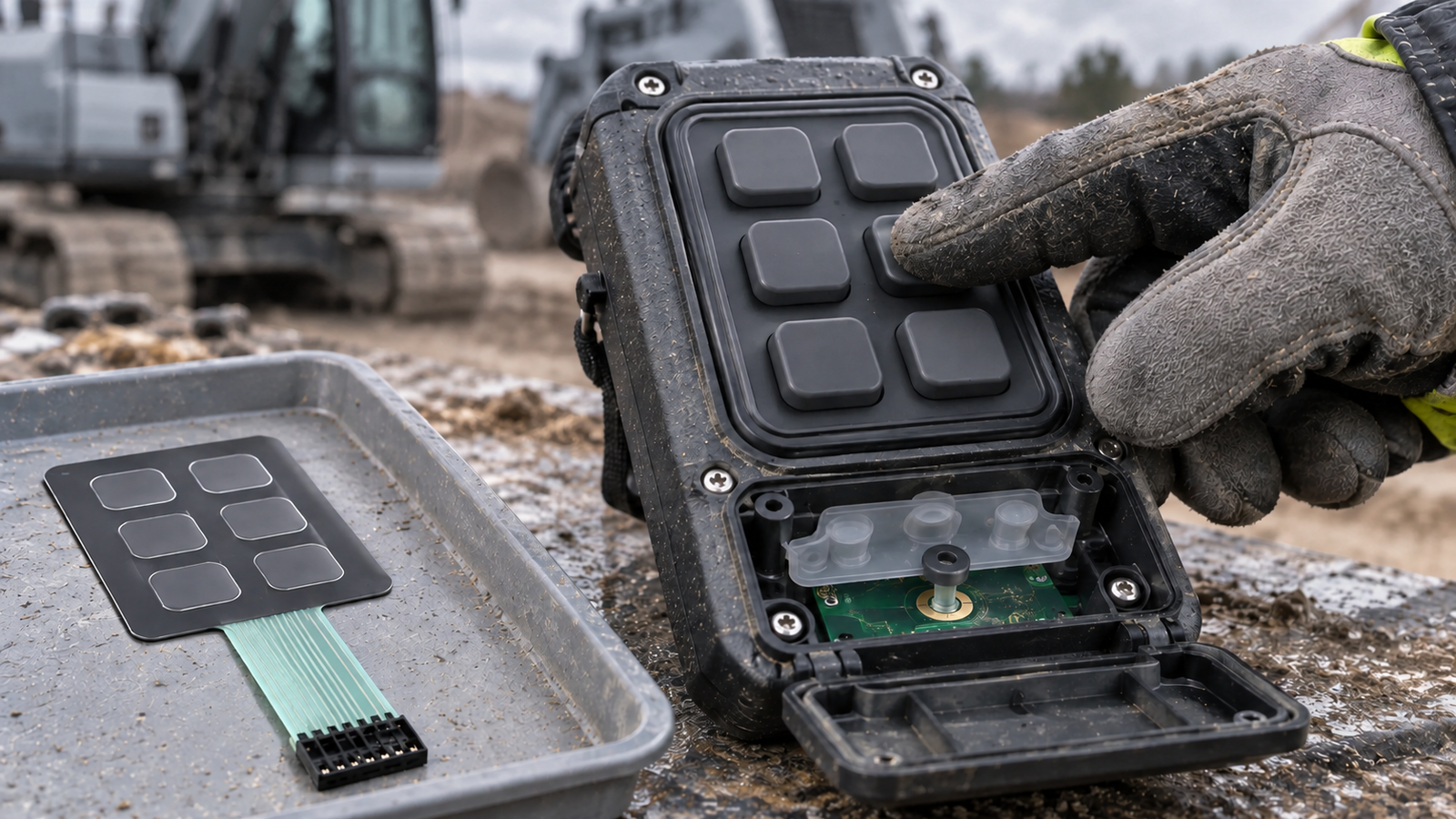
Choose molded silicone rubber keys when a gloved operator needs raised separation, defined travel and tactile differentiation between nearby commands. Choose a membrane overlay when a low-profile, wipe-clean graphic surface and a thin stack matter more than key travel. Do not choose either construction from an IP target alone. Freeze glove size, key pitch, travel and force window, command spacing, legend and backlight needs, drainage, enclosure support, mechanical stops and the PCB contact or flexible-tail interface before comparing quotations or approving samples.
A current remote-control showcase makes the application concrete
A Tele Radio and Allgon release dated September 8, 2026 says the company will present customizable radio remote controls for construction machinery, mining, cranes, hoists, conveyors and material handling at bauma CONEXPO India. The release emphasizes local adaptation and operator safety across these uses.
The release does not disclose how its keypads are constructed. It does not say that any displayed controller uses a Baoshengda keypad, a molded silicone keymat or a membrane overlay. The useful sourcing signal is the range of field tasks. A transmitter may be used with gloves, dust, vibration, weather exposure and visually similar adjacent commands, so the physical input surface should be selected from the operator action and enclosure architecture rather than from a material label.
For an OEM buyer, the practical question is not which keypad sounds more rugged. It is which construction creates the required movement, separation, sealing path and electrical handoff in the actual remote housing.
Watch the glove before selecting the material
Start with the largest intended glove, the hand position and the operating stance. A key that feels distinct to a bare fingertip on a desk can become ambiguous when the operator supports the transmitter with one hand and reaches across it with a padded finger. Measure the usable key top, clear gap, edge radius and height difference between neighboring commands. Keep frequently repeated commands reachable without covering other keys.
Molded silicone rubber can create raised keycaps, different key heights, shaped borders and a defined web that bends during actuation. Those features can help a gloved operator locate and separate commands by touch. The design still needs enough lateral clearance, controlled web geometry and a mechanical stop. A tall key with a soft unsupported web can lean or feel inconsistent, while an overly stiff web can demand more force than the operator expects.
A membrane overlay can give a broad, continuous graphic surface with shallow or embossed zones. It can be easier to wipe and can fit a thin front stack. Metal domes or another tactile construction may provide snap feedback, but the final feel depends on the complete mounted stack, support and key area. A flat overlay is not automatically unsuitable for gloves, and a raised rubber key is not automatically easier to use. The required action must be tested in the intended geometry.
Compare the two constructions through buyer evidence
| Buyer decision | Molded silicone rubber keypad | Membrane overlay | Evidence to request before release |
|---|---|---|---|
| Glove separation | Raised keycaps, gaps and different heights can create physical landmarks | Printed, shallow or embossed zones keep a flatter surface | Glove size, reach path, key-top size, pitch and wrong-key checks |
| Travel and force | Web thickness, geometry, material hardness and mechanical stop shape the stroke | Dome, spacer, circuit and support shape the snap and return | Force-displacement window on loose and mounted samples |
| Surface and cleaning | One molded mat can cover several keys, but valleys and coatings need review | A continuous film can provide a low-profile wipe surface | Soil, cleaner, abrasion and legend acceptance defined by the buyer |
| Sealing interface | A perimeter lip can be compressed by the bezel or housing | Adhesive land and panel flatness can close the overlay edge | Section drawing, compression or adhesive land, drainage path and mounted leak boundary |
| Electrical handoff | Conductive contacts commonly close against PCB pads; other contact schemes must be defined | Printed circuit, tail and connector can carry switch signals to the board | Contact material or circuit stack, PCB finish, pin map and controller input limits |
| Marking and lighting | Molded color, printing, coating and light transmission need controlled samples | Printed graphics, windows and backlighting layers can be integrated in the overlay | Artwork revision, day/night appearance and acceptable variation |
| Service replacement | Keymat removal depends on bezel, fasteners and sealing design | Overlay removal depends on adhesive, tail access and surface preparation | Replacement direction, part boundary, cleaning method and post-service check |
Do not turn this table into a universal winner. It is a way to expose what each quotation includes. Two suppliers can both quote “six-key outdoor keypad” while one assumes a loose rubber keymat contacting the buyer's PCB and the other assumes a complete printed membrane switch with tail and connector. Those are different parts, tooling scopes and acceptance plans.
Fit the keypad to the enclosure, not to an IP checkbox
Ingress protection belongs to the finished enclosure and test configuration. A keypad component can contribute a continuous lip, adhesive land or controlled edge, but it cannot establish the complete transmitter rating by itself. Housing flatness, bezel stiffness, screw pattern, cable or antenna openings, joint compression, drainage and service reassembly all affect the boundary.
For a rubber keypad, dimension the perimeter lip, compression land, keymat thickness, underside clearance and anti-shift features. Show where the bezel loads the lip and where compression must stop. Do not let a housing rib press on the moving web or let a mechanical stop overload the PCB.
For a membrane overlay, control the bond area, edge distance, panel texture, cutouts and any vent path. Define the tail exit, bend corridor, contact side, stiffener and connector orientation. If the tail crosses a housing joint, show the assembly motion and strain relief rather than specifying only total tail length.
In either construction, plan where water, dust or cleaning liquid goes after reaching the front. “Waterproof keypad” is not a substitute for a section view and a complete-controller test.
Build samples around three physical questions
First, does the loose component match its own drawing? For molded rubber, inspect overall dimensions, key height, web and lip geometry, visible finish, markings and agreed contact features. For a membrane assembly, inspect outline, graphic registration, embossing or domes, adhesive geometry, tail, stiffener and connector. Record the drawing and artwork revision with every sample.
Second, does the mounted keypad move correctly in the production-intent housing? Assemble the correct bezel, fasteners, PCB, support and gasket or adhesive stack. Measure the agreed actuation window, check key return, verify that neighboring commands are not triggered and repeat the glove task from representative hand positions. Include a deliberate off-center press because glove contact rarely lands perfectly at the key center.
Third, does the controller interpret the intended command? Tie each physical key ID to a PCB pad or connector pin and then to one controller input. Verify normal press, long hold, repeated press and simultaneous press conditions defined by the system team. Keep this evidence separate from the radio transmission, machine response and safety-function validation.
A sample should fail with a specific description such as “mounted upper key exceeds the agreed force window near the right edge” or “tail stiffener interferes with the rear cover.” A broad statement that the remote failed does not tell the keypad supplier or controller team what to correct.
Keep emergency stop and radio safety outside the keypad claim
A radio remote may include emergency-stop hardware, authorization logic, communication supervision and machine-side safety functions. These are system responsibilities. Do not treat an ordinary molded key or membrane switch as proof of an emergency-stop function, and do not ask the keypad supplier to certify machine safety from a loose component sample.
The component supplier can review and manufacture the buyer-defined keymat or membrane assembly and provide the dimensional, appearance, actuation or continuity evidence listed in the quotation. It does not certify the radio link, emergency-stop circuit, control logic, machine authorization, complete enclosure ingress rating or finished remote-control compliance unless those tasks are separately contracted with the necessary system requirements and test setup.
This boundary also applies to the current public release. The event announcement is market context, not validation evidence for a proposed keypad architecture.
Prepare one drawing, sample and RFQ pack
Before asking suppliers to compare constructions, send one controlled package with:
- the transmitter front, bezel, housing section, PCB position and available stack height;
- a command map that identifies normal, repeated, guarded and system-safety functions without assigning system safety to the keypad;
- glove type or maximum finger envelope, operating stance, key reach and wrong-key risk;
- key-top dimensions, pitch, height differences, travel and actuation-force window;
- selected rubber material, hardness or coating requirements when known, plus web, lip, contact boss and mechanical-stop geometry;
- or, for a membrane option, film and surface requirement, emboss or dome definition, adhesive land, tail route, contact side, stiffener and connector;
- legend, color, lighting and day/night acceptance requirements;
- dust, liquid, cleaner, temperature and service exposure with the complete-enclosure test owner named;
- loose-component, mounted-glove and controller-input sample methods with revision-linked records;
- prototype and production quantities, tooling assumptions, change-control rules and the evidence required with each lot.
Baoshengda can review buyer-supplied geometry for a custom molded silicone rubber keypad with controlled key, web, lip and PCB-contact features, or help define a separate membrane-switch option when the use case calls for a thin graphic surface. To compare the two fairly, use the Request Quote page and attach the same housing, command, environment and sample assumptions to both options. The resulting quotation should show the component boundary, open decisions and test evidence instead of hiding them behind a general “rugged keypad” description.
Need help reviewing a structure?
Send your drawing, photos, application, and quantity. Baoshengda can help check the structure before sampling.
Send Drawing for Quote