
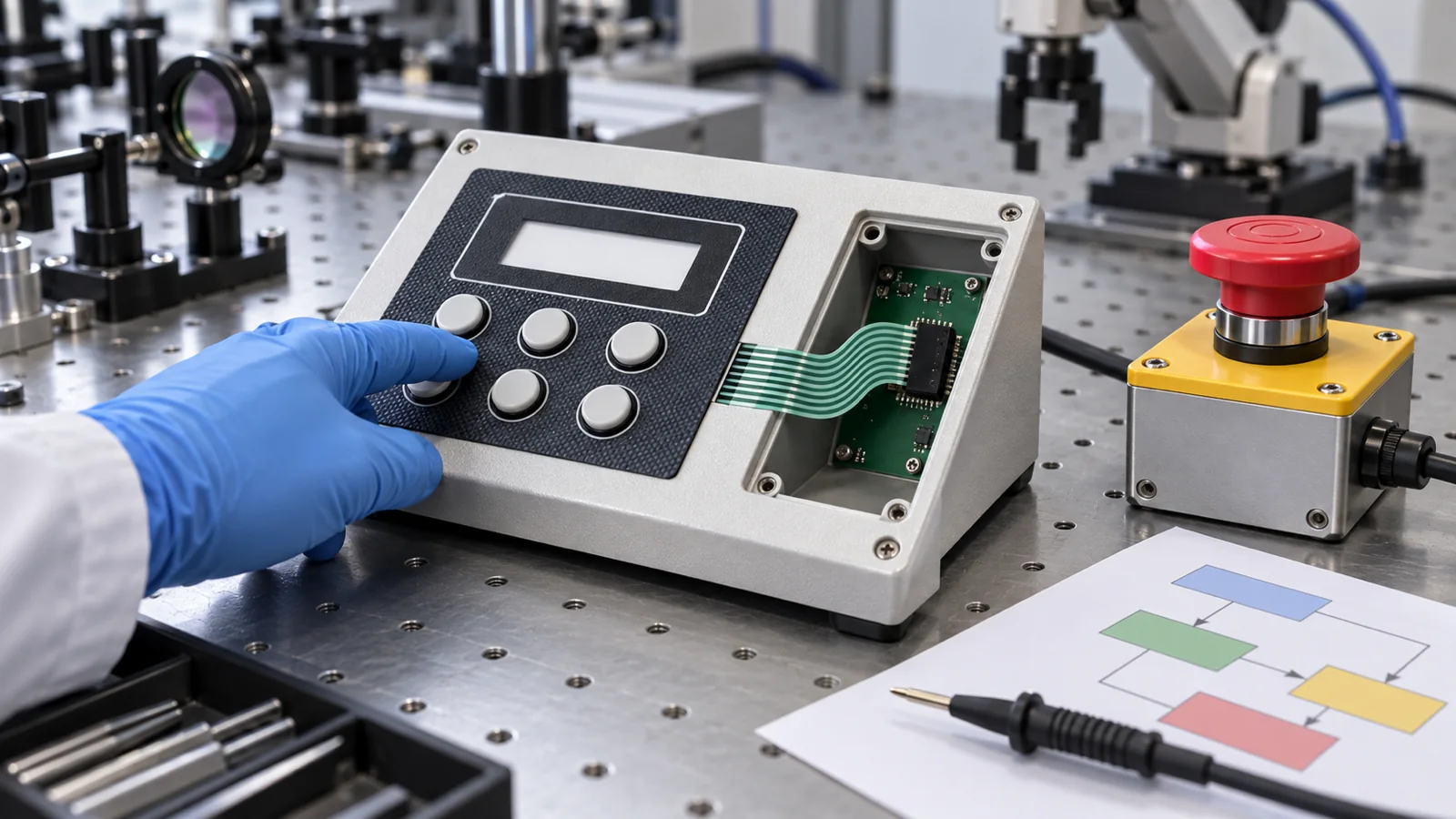
Do not begin an automated-lab membrane-keypad quote with a finished icon sheet. First map each operator action to one of four owners: routine local input, software-only command, maintenance or service action, or safety-rated hardware outside the membrane keypad. Only then freeze the keys Baoshengda may supply: active centers, spacing, tactile intent, legends, lighting, circuit, tail exit, and connector. An initial enquiry can start with an action list, enclosure view, approximate size, and quantities. Keep unknowns as quotation assumptions. Approve the local keypad in the mounted console, then release controlled artwork, circuit, pinout, stack, and inspection criteria for production.
A robotic lab is current context, not a keypad specification
MIT's September 17 report on a robotic optics laboratory describes a system that assembles optical components, tunes mirrors and lenses, responds to physical disturbances, and can be directed through a simple virtual interface. The team also discusses remote access and continued monitoring. The report does not identify Baoshengda, specify a membrane keypad, define a local recovery station, or establish any safety architecture.
The useful sourcing signal is narrower: increasing autonomy creates more operating states, but it does not decide which actions should be available on a local physical panel. That decision belongs to the equipment owner before artwork, circuitry or pricing is frozen.
The actionable rule is to assign every proposed action to one control owner before quotation. MIT's current example supports the need to distinguish remote commands, autonomous recovery and physical intervention. Baoshengda's public custom membrane switch guide shows that a component review can cover key layout and functions, tactile structure, indicators, tail and connector, overlay and adhesive, enclosure fit, prototype quantity and sample checks. That first-party evidence supports component-level review only. It does not prove a safe recovery sequence, emergency-stop circuit, software permission, laser interlock, whole-machine behavior or regulatory approval.
Give each action one owner before drawing keys
Start with verbs, not icons. List what an operator may need to do during setup, normal use, a recoverable interruption and maintenance. Then identify the state that permits each action, the person allowed to use it, the feedback expected after the press and the system that owns the result.
| Control class | Typical decision question | Evidence for the quotation | Boundary to preserve |
|---|---|---|---|
| Routine local input | Must an operator perform this action while standing at the equipment? | Action name, permitted state, expected feedback and key priority | A keypad contact can request an action; it does not prove the software will execute it correctly |
| Software-only command | Does the action require context, permissions or a guided sequence? | Screen flow, role owner and reason it should not become a permanent key | Do not add a physical key merely because panel area is available |
| Maintenance or service action | Is the action restricted to a service mode or qualified person? | Service-state definition, access method and confirmation path | Keep maintenance authority separate from ordinary operator access |
| Safety-rated hardware | Must the function remain independent of the membrane keypad and application software? | Equipment safety architecture and physical location, supplied by the responsible system owner | Do not represent a membrane key or ordinary contact as safety-rated hardware |
This is not a universal action list. The equipment OEM, laboratory owner and safety engineer must decide the architecture. The keypad supplier needs the approved component boundary, not authority to invent it.
Start the enquiry with an action map and enclosure evidence
A first enquiry does not require released artwork. Send the proposed local-action list, a straight-on console or enclosure view, approximate outer dimensions, intended operator position, glove condition if relevant, target sample quantity and expected annual volume. Mark which actions are fixed, disputed or still software-only.
Add the expected display or indicator relationship. If the keypad sits beside a separate safety device, show both locations and keep the devices distinct on the sketch. Provide the board or connector location, available internal clearance and preferred tail-exit edge. A photo can explain package context, but it cannot establish key-center dimensions, pin assignments, permissions or safety behavior.
Baoshengda can identify missing membrane-switch inputs and discuss a provisional construction from that package. The initial enquiry is an accessibility step, not production authorization.
Put every provisional choice in the quotation assumptions
The quotation should name what is being priced: key count, tactile or non-tactile concept, embossing, overlay material and finish, printed colors, windows, indicators or backlighting, circuit type, tail length and direction, connector family, adhesive concept, tooling, samples and production volume.
If the recovery-action list is not final, freeze a quoted version and label it provisional. Do the same for enclosure dimensions, connector orientation, pin map and lighting behavior. A unit price based on six keys and one tail cannot silently become authority for eight keys, a reversed contact side or a new service function.
Keep safety devices, robot controls, optical hardware, application software, interlocks and certification outside the supplier scope unless a separate, qualified party has explicitly assigned responsibility. A component supplier can manufacture to controlled inputs; it cannot validate the entire automated cell through a keypad quotation.
Use a mounted sample to check physical access and connection
A loose panel can confirm print, outline and basic switching, but it cannot answer whether the operator can find and press the intended local key at the actual console. Mount the sample on a representative enclosure with the planned display, surrounding hardware and separate safety device in place.
Run a controlled review for each permitted local action. Confirm key location and separation, tactile response, legend visibility, accidental-neighbor risk, indicator behavior where applicable, and the electrical contact observed at the agreed test point. Check that the tail exits in the correct direction, clears the enclosure edge, follows the allowed bend path and reaches the connector without twist or strain.
The mounted review should record the sample revision, enclosure revision, action-map version, glove or bare-hand condition, connector orientation and observed results. It does not replace equipment risk assessment, software verification, laser safety, interlock validation or emergency-stop testing.
Release one matched component package for production
Production release requires more than an approved front appearance. Control the mechanical drawing, artwork, film and finish, adhesive pattern, key geometry, circuit and pinout, tail and connector, dimensional and visual inspection points, electrical test criteria, packing protection and accepted sample reference.
Link the released keypad drawing to the approved action-map revision. If the equipment team later moves an action between software, maintenance and local control, treat that as a controlled revision rather than a label-only change. Purchasing, engineering and inspection should all be able to identify which functions the part contains and which remain outside it.
The supplier can review manufacturability and component evidence. The buyer and its system partners retain responsibility for automation logic, permissions, remote access, robotics, optical safety, interlocks, emergency-stop architecture and final equipment approval.
Send the control-owner map before polished artwork
Prepare one page with four columns: action, allowed equipment state, control owner and required feedback. Add the enclosure view, key-area envelope, display relationship, tail route, connector location, quantities and unresolved assumptions. Keep the separate safety-device location visible but outside the membrane-keypad function list.
Send that package through the Request a Quote page for a component-level review of a custom membrane switch. Baoshengda can help turn the approved local-action subset into keypad geometry, artwork, circuitry, tail, connector and sample checks. The quotation and sample should not be used as evidence that the automated laboratory, robot or safety system has been validated.
Need help reviewing a structure?
Send your drawing, photos, application, and quantity. Baoshengda can help check the structure before sampling.
Send Drawing for Quote